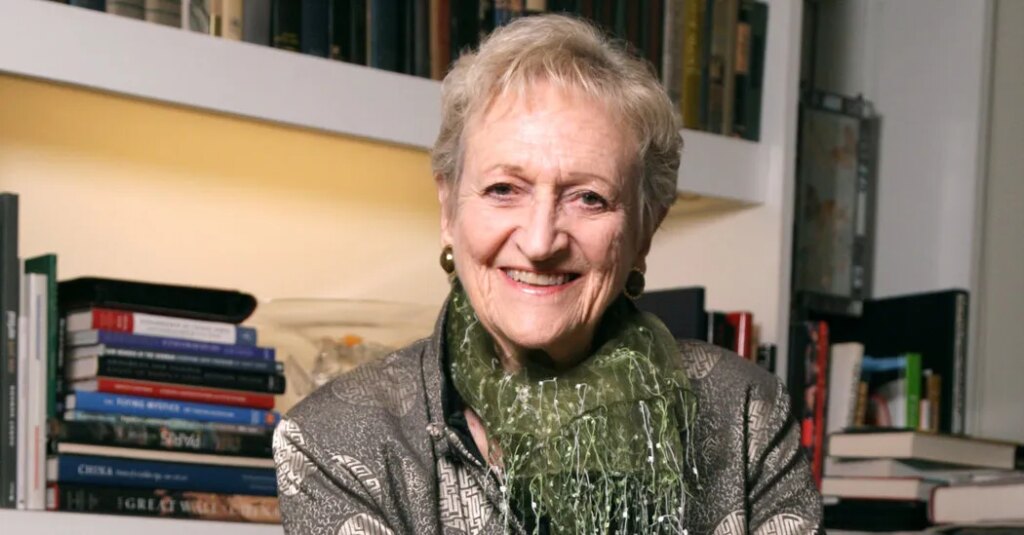
Annette Green once lobbied the City of New York to pipe perfume through the subway system. She also proposed a weekly cleaning of the city’s garbage trucks and a campaign to encourage New Yorkers to plant fragrant flowers in window boxes.
“Bad smells,” she told William E. Geist of The New York Times in 1984, “have a powerful psychological influence. They depress people and can even make them aggressive. Margaret Mead said that whole tribes went to war because they didn’t like each other’s smells.”
She added: “Maybe we need a new government agency to deal with quality of life things like this.”
Those lobbying efforts came to naught, an unusual outcome for Ms. Green, the longtime president of the Fragrance Foundation, a nonprofit that promotes the industry. During her four-decade career, she rarely had a miss. She successfully wrangled Hollywood and Broadway stars, perfume designers, beauty executives, magazine editors, department store heads and New York City mayors in service to her mission. She created Fragrance Week — otherwise known as the first week of June, and recognized every year since 1987 by mayoral proclamation — which saw Manhattan’s retailers and civic institutions taken over by events devoted to fragrance.
One year, the marble lions in front of the main branch of the New York Public Library wore elaborate floral wreaths, and stilt walkers and mimes handed out perfume samples as modern dancers romped about. Another year, she arranged for the fountain in front of the Plaza Hotel to be scented with a bespoke fragrance, while models riding Central Park’s horse-drawn carriages sprayed the stuff along Fifth Avenue. Yet another year, palm readers in department stores discerned shoppers’ fragrance personalities and handed out roses along with those ever-present samples.
The capstone of the week: the FiFi Fragrance Awards, the Oscars of the fragrance industry, presented at a gala held at Avery Fisher Hall (now David Geffen Hall) or another equally impressive venue, by celebrities like Elizabeth Taylor, Hugh Grant and Tommy Tune. In 1985, the stars of “Dynasty,” the prime-time 1980s soap, presented the awards. (Forever Krystle, a perfume named for Linda Evans’s character, Krystle Carrington, was a Fifi winner that year.)
It was all good business, for what had become a multibillion-dollar business.
“It’s a global fashion empire,” Harry Slatkin, the home-fragrance mogul, said. (Among many other innovations, Mr. Slatkin created scented rocks named for Elton John — Elton John rocks, get it? — for which he won a FiFi in 2004.) “And Annette had the vision to realize that home fragrance could be part of that. She was the Anna Wintour of the fragrance industry.”
After one of her events in 1985, Jean Pierre Lippmann, the president of Christian Dior Perfumes, told Ms. Green that he was bestowing upon her a special award, “that of High Priestess of the Fragrance World with power of divination.”
Ms. Green died on Oct. 8 at her home in Manhattan. She was 102. Her death was announced by her cousin Elizabeth Sobieski.
Annette Green was nearly born at the perfume counter at Wanamaker’s department store in Philadelphia on April 26, 1924.
Her mother, Mollie Green, a single woman who worked as a milliner, had traveled there by bus from her home in Atlantic City, N.J., for a last-minute shopping spree when her water broke. Annette arrived a few hours later, at a hospital nearby, and grew up in Belleville, N.J., outside Newark, where she and her mother lived with her mother’s parents.
During World War II, she worked as a secretary at the New Jersey office of the Army Signal Corps. After the war, she hoped to work at Harper’s Bazaar magazine. Instead, she was offered a job at American Druggist, another Hearst publication. She attended night school at New York University, studying journalism, which her mother paid for by cashing in war bonds.
Ms. Green went on to work in public relations for various beauty companies before starting her own firm in the early 1960s.
In 1962, she was persuaded by a former colleague who had become an executive in the perfume division at Revlon to take over the nearly moribund Fragrance Foundation, founded by Chanel, Coty, Elizabeth Arden and other perfume companies in 1949.
Before then, American women had not been enormous consumers of fragrance — and, in any case, they were habituated to wear just one scent, typically a French perfume like Shalimar or Chanel No. 5, and mostly on special occasions, like a Saturday night out. But by the 1950s, that had begun to change.
The Fragrance Foundation had no money and few boosters when Ms. Green took it on, as executive director and later president, strong-arming others in the industry to support it. She turned it into an educational resource as well as a public relations powerhouse, holding seminars on trends, bringing in not just financial analysts and retailers but futurists, psychologists, demographers and anthropologists, including Ms. Mead, whom she invited to an event at the Plaza Hotel.
Ms. Mead, who spoke about the importance of smell in primitive cultures, informed the group, “You can never have a personal relationship with someone whose smell you do not like,” as Ms. Green recounted in “Spritzing to Success With the Woman Who Brought an Industry to Its Senses,” a memoir with career tips that she published in 2018, when she was 95.
“The trouble with your industry,” she recalled Ms. Mead telling her, “is that it thinks it is selling product, when in reality it is selling people.”
Ms. Green presided over the musk years of the 1960s and early ’70s, when perfume companies began to take their inspiration from the counterculture, instead of Paris. She was a booster for the benefits of having a perfume wardrobe — a variety of scents that women could wear depending on their moods and activities.
She also oversaw the rise of designer perfumes, when seemingly every star had his or her own scent. She was enthusiastic about Michael Jordan’s entry in 1996, telling The Times, “He may sweat, but he’s a good-looking, well-dressed fashion maven.”
By 1997, she reported, there were 1,000 or so perfumes and colognes for consumers to choose from, and nearly 90 more would soon hit the market: 53 for women, 31 for men and five gender-neutral (or unisex, in those days). In 1996, she noted, U.S. customers had spent more than $5 billion on fragrance, up from $2.7 billion a decade earlier.
Ms. Green predicted the home-fragrance boom of the 1980s, when potpourri, deployed mostly by decorators in their English country-style interiors, went mainstream. She foresaw scent pods and aroma discs. She cheered the innovation of including scent strips in magazines, and offered solace when readers objected, as they did in 1992, prompting The New Yorker to discontinue the practice.
“The people who love them love them,” she told The Times. “I love them. But I will admit, when you have leakage, when you have too many in a magazine, they can be annoying.”
For those who were irked, she suggested: “Pull them out and throw them into a lingerie drawer.”
Ms. Green retired in 2002.
Like many eager transplants to the island of Manhattan, she was a true New Yorker. She rarely ate at home, and if she did, she didn’t cook. Her fridge held only Champagne and Haagen-Dazs chocolate and double-chocolate ice cream. The stove in her Gramercy Park apartment, where she lived for nearly half a century, had never been turned on.
When Rachel Syme, a writer for The New Yorker, visited just before Ms. Green’s 95th birthday, she counted some 100 bottles of perfume, including Joy, the Jean Patou classic.
Ms. Green never copped to a favorite perfume, but she once told a Times reporter, after explaining that sense memories were the most powerful, that her favorite smell was that of Crayola crayons.
The post Annette Green, ‘High Priestess’ of the Perfume World, Has Died at 102 appeared first on New York Times.