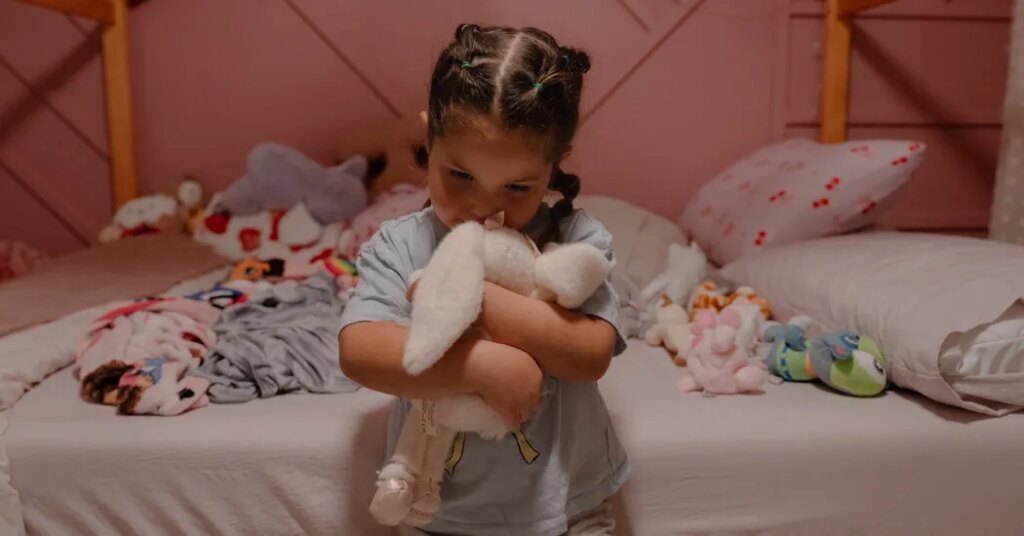
When Ryleigh Schecter answered the front door to her home, she was wearing an oversized lavender bow in her hair that matched the stripes on her shirt. “Rainbow” is her favorite color, she told me as I sat with her and her parents, Amanda and Aaron, in their cozy living room in Twinsburg, Ohio. To prove it, she recited the colors of the spectrum in order, adding “pink, silver, gold” at the end. She is 5.
Eventually, the Schecters and I began to talk about the medicine she takes, and on cue Ryleigh sped to the kitchen and raced back with a sandwich bag full of Skittles. It contained only the red, orange and yellow ones. “I don’t like the purple or the green,” she explained.
Ryleigh takes two drugs every night, one designed to treat breast cancer. Her mother mixes them as if from a chemistry set and administers them orally with a syringe. Ryleigh hates them.
“The first one tastes disgusting, and the second one tastes medium,” Ryleigh told me.
What does the first one taste like? I asked her.
“Dirty water mixed together,” she replied. After each dose, Ryleigh eats a Skittle to wash away the taste. She likes orange best.
Seven months ago, Ryleigh was diagnosed with an incurable brain tumor called D.I.P.G. Her drug regimen is part of a clinical trial, the only slim chance of extending or saving her life. Through trials, scientists start to understand not only what helps a particular child, but how generations may be cured in the future.
A child with diagnosed D.I.P.G. will usually get six weeks of radiation five days a week. After that there is no proven treatment, no standard of care. The average time between diagnosis and death is nine to 12 months. Knowing this, parents will consent to anything. They will move. They will quit their jobs. They will sign forms acknowledging that under experimental treatment, their child may suffer painful or debilitating side effects. Yet even under the care of the most brilliant oncologists, the disease is likely to progress.
Diffuse intrinsic pontine glioma usually strikes between 4 and 10 years old, with about 300 children a year diagnosed in the United States. It grows in the brainstem, which controls the primary functions of human life: breathing, balance, the heartbeat. There, it meshes with the tissue, “like sand in grass,” clinicians say. For these reasons, it is inoperable.
No one wants their child to become “a human guinea pig,” as Amanda Schecter put it to me, but when the choice is between that and nothing, there is no choice. Of course, the Schecters want to help science. But first they want to save their child.
When the Schecter family went looking for clinical trials, one avenue of hope had recently been closed. In August 2025 the National Cancer Institute, part of the National Institutes of Health, terminated the Pediatric Brain Tumor Consortium, long a cornerstone of the government’s pediatric brain cancer effort. When the government did not renew the consortium’s $4 million annual grant, eight ongoing trials were closed or paused. Described publicly as a consolidation to improve efficiencies, the closure was part of the Trump administration’s sweeping moves to upend the government’s approach to federal research funding.
The Pediatric Brain Tumor Consortium — 16 elite pediatric hospitals in the country working together to test novel treatments for D.I.P.G. and other brain cancers — usually ran six to eight active clinical trials a year. Most were Phase 1 trials, a drug or therapy’s first step toward government approval. When the government defunded the consortium, researchers at its member hospitals were testing a promising immunotherapy and were about to test a laser therapy. For D.I.P.G., they were experimenting with a skull cap that sends electricity directly into the brains of patients; they were also testing a vaccine.
The D.I.P.G. trials were once available through the consortium at multiple sites within half a day’s drive of Ryleigh’s home, according to Kara Buente, who helps families like the Schecters find trials through her nonprofit, The Bella Project. Both were paused. Ryleigh does not have access to either of them.
The Schecters settled on a Phase 2 trial called TarGeT-A, led by researchers at Nationwide Children’s Hospital in Columbus, Ohio. Ryleigh is doing well. During my visit, she served us pretend breakfast and pretend ice cream cones with toppings, then gave us the pretend check. In September, she started kindergarten and Amanda went back to work as a school principal. More recently, when Ryleigh asked her mother if she would get braces like her brother, Hudson, “it was a gut punch,” Amanda said.
The Schecters can’t understand why the government would dismantle a productive collaboration when their crisis is urgent. “Like, up a creek without a paddle and not knowing what the next step is,” Amanda said to me.
The National Cancer Institute pulled the plug on the Pediatric Brain Tumor Consortium in a video call on Aug. 14, 2025. The news was “catastrophic,” Ira Dunkel recalled in an interview at a cafe on Manhattan’s Upper East Side, near Memorial Sloan Kettering Cancer Center, where he works as a pediatric oncologist. At the time of the phone call he was also chair of the consortium.
Like everyone in academic medicine, Dunkel had been following the news of the Trump administration’s cuts to the N.I.H. budget, but he did not believe they would affect his work.
“I thought no political appointee or political person would want to be, like, shutting down research for children with brain cancer,” Dunkel explained, expressing himself carefully and in a soft voice.
A National Cancer Institute oncologist, Malcolm Smith, delivered the news. Smith and Dunkel had a long relationship, and Smith seemed to understand he was dealing a fatal blow, Dunkel told me. He knew “we were going to have to fire people and stop our studies,” Dunkel said. Smith would not tell him who made the decision or how it was made, attributing it only to “government leadership.”
When reached for comment, Smith said the conversation was “difficult, personally, for me.”
The $4 million grant was tiny in the scope of the $732 million that the N.I.H. spends annually on childhood cancer, but it was “hugely important,” Dunkel told me. In a Phase 1 trial, researchers test experimental treatments for safety in humans. Physicians and scientists within the consortium designed the medical aspects of their studies, but a team behind the scenes managed and administered the regulatory, operational and technological sides so they could be smoothly integrated among 16 research sites and available to patients nationwide.
Furious parent groups responded right away. About a month after the consortium was defunded, a bipartisan group from New York, including Representative Mike Lawler, Republican of New York, called on Health and Human Services Secretary Robert F. Kennedy Jr. to reverse the decision. “We cannot afford to take this step backward,” the group said in a letter.
The next week, the Trump administration announced a doubling of funding, to $100 million, for its data initiative to speed childhood cancer research.
“For too long, families have fought childhood cancer while our systems lagged behind,” Kennedy said in remarks at the White House. “President Trump is changing that. We will harness American innovation in artificial intelligence to find cures for pediatric cancer.”
By the time I met with Dunkel nearly a year later, the National Cancer Institute had updated its web page to include an FAQ explaining the closure of the consortium. It was “not a cost-cutting measure,” the FAQ said. Enrollment in the consortium’s studies had slowed. To improve efficiencies, its work would be absorbed by a larger government-funded research network also committed to early-phase trials, but with a broader focus on all childhood cancers.
At the cafe, Dunkel made his rebuttal. Yes, enrollment had slowed. Experimental cancer therapies have become so targeted that the number of eligible patients within an already small population has shrunk. Yet from his point of view, the consortium was doing good studies and publishing them in “high-impact journals.” Besides, he said, who cares if multiple networks are devoted to finding cures for childhood cancers? Other networks had similar aims, but they did not have the consortium’s singular focus. “Even while all these groups were coexisting, there were more good ideas than the capacity to study them,” he told me.
Dunkel came across as a man still in grief as he tried to tally the losses.
Children in clinical trials often give samples during research: tumor tissue, spinal fluid, blood. Sometimes, to help speed science along, parents donate the samples after a child’s death. With the closure of the consortium, something had to be done with hundreds of human samples stored at Children’s Hospital Los Angeles. If the originating hospital wanted them, they were returned. If not, they were destroyed.
At St. Jude Children’s Research Hospital in Memphis, 27 years of research data on more than 2,000 children with rare brain tumors had to be archived. Under the consortium, any researcher with a hypothesis could have applied to look at its data. Without a vetting process or dedicated staff, that’s going to be “much, much, much more difficult to do in the future,” Dunkel said.
Finally, there was the loss of the trials themselves. On Nov. 3, after queries from The New York Times, the National Cancer Institute updated its web page again.
The paused trials are “planned to reopen to enrollment in late 2026 or early 2027,” it said. For parents who have been told their child has a year or less to live, the 15-month administrative delay is agonizing.
One of the paused trials was called PBTC-059. A Phase 1 trial led by researchers at Texas Children’s Hospital in Houston, it was exploring the safety of CAR-T therapy in patients with a rare brain cancer called ependymoma. The therapy, in which a patient’s blood is engineered to boost its immune response, has generated huge excitement in the pediatric brain cancer community. CAR-T therapy has dramatically improved cure rates for the most common childhood leukemia.
Another trial, called PBTC-N14, was closed entirely. The first step after a brain-tumor diagnosis is often a brain biopsy, but these are invasive. Consortium researchers at Memorial Sloan Kettering were exploring whether cerebral spinal fluid, collected without surgery, might provide the same genetic information and help guide treatment while sparing children harm. “Everyone thought it was a good study, and tried to answer a good question,” its lead investigator, Matthias Karajannis, told me. “But it did not finish answering that question.”
The consortium ended in September 2026, with the weekly video meeting. It had a funereal tone, Dunkel said.
The shuttering was “one of the very worst professional moments of my career,” Dunkel told me. “I felt the loss of hope and opportunity for the parents and the patients. The loss of progress in the field for everyone involved, the doctors and scientists as well as the patients.”
“I guess I never really thought that this was my fault,” he said, then paused. “But I did feel like as the captain of the ship, I let down a lot of people.”
In late August 2025, Keith Desserich received a call from Dunkel, who relayed the news. “I think he was on the verge of tears,” Desserich told me.
Together with his wife, Brooke, Desserich founded The Cure Starts Now in 2007 after the death of their 6-year-old daughter, Elena, to D.I.P.G. The families who volunteer with The Cure Starts Now, most who have had a child die from a brain tumor, collect donations by hosting 5K runs and bowling nights and direct the funds toward promising, early-stage research.
Since 2017, Desserich had been on the steering committee of the Pediatric Brain Tumor Consortium. A Cincinnati-based entrepreneur in his professional life, he believes in funding numerous small projects in the hope that one will develop into what he calls “the home run cure.” He estimates that since 2017, The Cure Starts Now has given between $2 million and $3 million in seed money to projects initiated by consortium researchers.
Desserich is a boyish man with a bullish demeanor. After losing a child in this horrific and random way, a parent feels constantly besieged, he told me. In the lingo of his nonprofit, a child struggling with D.I.P.G. is a “warrior” and their illness is a “fight.” I met the Desseriches in July when I traveled to Tampa to attend the annual meeting of their nonprofit. Standing at the head of a chilly hotel conference room, Desserich exhorted the 50 member families to redouble their efforts. The closure of the Pediatric Brain Tumor Consortium was an “earthquake,” he said.
“How are we able to continue this research even if the government is not going to do it?” he asked.
The families in Tampa wanted me to know this: The primary experience of having a child with D.I.P.G. is helplessness. Parents want to fix things for their children. When the consortium lost its funding, the parents in Tampa were angry and bereft all over again. It felt “like picking off a scab,” said Lisa Hill, whose daughter Lauren, a basketball star, was 19 when she died in 2015. After the golf outings and ATV races and silent auctions, after endlessly reciting the idiosyncrasies of their beloved children to elicit dollars from friends and strangers, “We close down research for things that don’t have a cure?” said Josh Hines. He and his wife, Jill, were in Tampa after losing their daughter, Harleigh, to D.I.P.G in 2023.
In Desserich’s view, Dunkel and the other leaders of the consortium were old fashioned: too trusting of government, too modest. He had been pushing them to expand internationally to boost the numbers of patients in trials and to better showcase their groundbreaking ideas with promotion and PR. “There was this resistance of, ‘Oh, we can’t do that. Government won’t like it,’” Desserich said.
In the summer of 2025, he started hectoring them. “Do we think we’re fine for renewal?” he asked Dunkel. “What happens if government gets fickle?” He found Dunkel’s optimism naïve.
Soon after the Aug. 14 call, N.I.H. officials invited Desserich and a number of other parents to a video meeting. They tried to clarify their rationale, but Desserich thought they appeared as surprised by the termination as he was. An N.I.H. spokesman said they had been considering the move for years.
The lost funding does not bother Desserich as much as the loss of the intimate collaboration. The consortium held a competition every five years to identify the hospitals doing the most relevant and rigorous work. These members were “the dream team,” as Desserich saw it. And patients’ families were reassured by the government’s imprimatur.
As part of its most recent website update, the National Cancer Institute announced it was committing “approximately $4 million,” the same amount previously allocated to the consortium, to the larger network, to build brain-tumor expertise and expedite more early-phase clinical trials. Desserich was underwhelmed. “I don’t care if we had $60 million, $100 million. You’re not going to be able to duplicate” the consortium, he said.
Baylie Barclay heard about the closure from Desserich. It was “devastating,” she told me.
When a clinical trial stops enrolling new patients, she said, scientific discovery slows down. And in the case of a child with D.I.P.G., “you don’t have any time.”
Since their son Paxton died from D.I.P.G. in July 2025, Baylie and her husband, Lane, have committed themselves to raising money for pediatric brain-cancer research from their home in Turkey, Texas, a village of 300 people in the state’s Panhandle. On the one-year anniversary of Paxton’s death, the Barclays hosted a 5K run to raise funds for The Cure Starts Now. Every one of the residents of Turkey attended that day, Barclay told me, and together they contributed $20,000.
Barclay, who is 30, now works out of Paxton’s former bedroom as a family support coordinator for The Cure Starts Now. Paxton was the middle child, and his family remembers him as wild, the life of the party, a Western boy who loved his cowboy boots and kept souvenirs from the day in his pockets: wire nuts, dead minnows, sticks and feathers. His family has a saying, which they’ve printed on T-shirts: Live Like Pax. When they wonder what Paxton would do, they go camping or wake surfing.
As Barclay works, she is surrounded by Paxton’s Legos and his Pokemon cards. She finds families with new diagnoses on social media and writes quick, personal notes. She connects families with services: information about trials, financial support to pay for travel and hotels near treating hospitals, and provides a listening ear.
Focusing on funding science research keeps Barclay connected to her son. Near the end of Paxton’s life, he was angry, exhausted and tired of being isolated in the hospital. At 8 years old, he had been through three clinical trials. One day, she was on the phone when he heard her say that his cancer was incurable.
“And he said, ‘There’s no cure?’” Baylie remembered, “and I was like, ‘Not yet.’” She said this calmly. “And that was the day I was like, I’m going to do more. He would not have wanted me to ever stop.”
So when Paxton died, the Barclays gave every part of him gathered during trials to scientific research. “Take his information,” the Barclays told the doctors. “Take anything left over. Take his blood tests. Use them. Please, take it and find the cure. Whatever you need to do.”
The D.I.P.G. community online is close-knit. The Barclays and the Schecters didn’t know each other, but Baylie and Amanda are now in touch through social media. When Ryleigh Schecter was diagnosed, Baylie Barclay sent the family “Warrior” T-shirts emblazoned with Ryleigh’s name. The Schecters wore them on vacation.
In its web pages updated this month, the N.C.I. describes its revamped pediatric brain cancer research effort in a futuristic light: the larger network will take on a revitalized and accelerated effort to discover novel treatments through clinical trials. With “administrative modernization” and “the application of Super Intelligence (SI),” the new organization will “generate meaningful research results.”
They make it sound so slick and simple, Amanda Schecter said. In her experience, a clinical trial is a matter of countless blood draws and a squirming child in an MRI machine. Recently Ryleigh’s oncology team asked Amanda and Aaron to give blood and saliva samples, and to sign consent forms to use the tissue from Ryleigh’s biopsies in the event that they don’t need it. This is for kids in the future, they told her, and the Schecters automatically said yes. But part of Amanda wasn’t really listening. Her mind was on Ryleigh, down the hall in another room. Amanda finds her own mental chatter exhausting: She desperately wants to hope but not too much. On her Instagram recently she shared a poet’s incantation.
“So scared of time,” the poem went. “So aware of time. So desperate for time. So grateful for time. All at the same time.”
Produced by Jeffrey Furticella and Umi Syam.
The post Research Stalls for a Year Into a Cancer That Kills Children in a Year