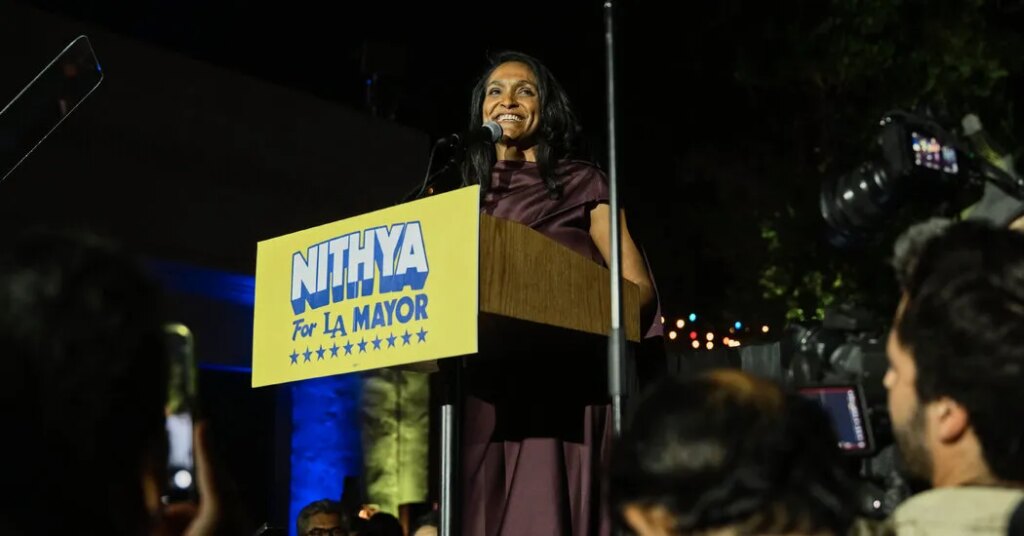
A month before Nithya Raman swept to victory as Los Angeles’s next mayor, she announced what she would do in her first 100 days if she won.
The audience was scant — the speech had somehow been scheduled outside during the dinner hour on a Sunday in searing heat with the Dodgers at home in the playoffs. Still, her most ardent fans gathered, sweltering, around her. If they expected a fire-breathing leftist manifesto from their candidate, a member of the Democratic Socialists of America, they were wrong.
Ms. Raman, a 45-year-old member of the Los Angeles City Council with a master’s degree in urban planning, didn’t talk about defunding police, removing the private sector from housing construction or other items from a D.S.A. wish list. Rather, she outlined a near future of mapping out trouble spots and restructuring org charts. She would launch dashboards and audits, she said, and base performance evaluations on results and metrics. In her pursuit of a more livable city, she would drill down to a “nitty-gritty” so granular that it would “make your eyes glaze over.”
“In just one century, Los Angeles built itself into a global metropolis, the gateway to the Pacific, a center of ingenuity and invention, and the cultural capital of the entire planet,” Ms. Raman exhorted. “Don’t tell me the city of Los Angeles can’t fix a streetlight!”
The speech was a striking shift in a deep-blue city that has spent the past decade consumed with big-picture crises: Covid-19. Natural disasters. Clashes with the Trump administration, particularly over federal immigration enforcement. In many ways, political experts say, the election Ms. Raman won two weeks ago was a plea for a way back to normal.
“The issue in this election was not left versus right, but change versus the same,” said Zev Yaroslavsky, the director of the Los Angeles Initiative at the University of California, Los Angeles, and a longtime civic leader. “It was broken versus fixed.”
What Ms. Raman will be able to “fix” in Los Angeles is an open question. Power to enact policy in the city is diffuse. The mayor represents only about 4 million of the 10 million residents of Los Angeles County. Local authority is shared not only with the 15-member City Council but also with the county Board of Supervisors, which controls most social service spending.
In two years, a shift in governance that voters approved in 2024 will turn the top county government job into an elective office, effectively installing a new, more powerful countywide leader to rival Ms. Raman.
The city’s budget — roughly $13 billion not counting the city’s water and power department and airport — has been stretched thin, in part by commitments made under Karen Bass, the current mayor. The police union, which heavily backed Ms. Bass for re-election, received significant raises during her tenure, constraining the amount of money that Ms. Raman will have for projects.
Downtown business interests, which backed Ms. Bass as well, won an overhaul of the city convention center that is projected to siphon more than $100 million annually from the city’s general fund in debt service for the next three decades. The Olympics, typically a huge financial risk for the host city, are coming to town in 2028.
In interviews, Ms. Raman’s supporters and local political experts predicted that she will draw from a new generation of Democratic big-city mayors to push her agenda. They include the democratic socialist Zohran Mamdani in New York, political centrists like Daniel Lurie in San Francisco and progressive technocrats like Michelle Wu in Boston.
Like Mr. Lurie, her advisers say, she intends to rebrand her embattled city as a comeback story. Like Mr. Mamdani, she plans to improve the housing supply and tenant protections. Like Ms. Wu, she is likely to rely heavily on data and community input. Like all three, they add, her approach is less likely to be ideological than pragmatic.
“There has been a wave in our way of thinking about mayors,” said Megan Mullin, a professor of public affairs at the University of California, Los Angeles. “A mayor can be a visionary, or a power broker, or a political boss, or a coalition builder. This is an idea of the mayor as the manager of a big operation that delivers services that make our lives possible in a city — the mayor as C.E.O.”
Historically, politics in sprawling Los Angeles have been driven by single-family homeowners who commute by freeway. But precinct-level data that has emerged in the vote for mayor shows that Ms. Raman was carried into office amid surging turnout by young voters and Latinos, who are more likely to rent and rely on public transit.
“A city that works” was her slogan, but rent control laws for tenants and dedicated lanes on the streets for bicycle enthusiasts and bus riders are not necessarily appealing to older property owners and freeway commuters, said Mike Bonin, executive director of the Pat Brown Institute for Public Affairs at Cal State Los Angeles.
“It’s a big shift, and it’s largely generationally driven,” Mr. Bonin said. “Where the two groups do coincide is just on this sense that the city is broken and let’s clean it up.”
Ms. Raman, 45, who joined the City Council six years ago in the aftermath of the George Floyd protests, has favored left-leaning policy goals like strong rent regulations, denser housing near public transit and a less militarized approach to policing. At the time, she was endorsed by the D.S.A., the movement that later would help elect Mr. Mamdani.
She has since had a fraught relationship with the organization. During her campaign, she vowed to regard it as just one part of her governing coalition, though the movement clearly influenced her pledge to replace the police chief.
Ms. Raman has said she will reorganize lines of authority in the mayor’s office, designating a “chief operating officer” and a “chief financial officer” to help her manage the dozens of department heads in the city who answer to the mayor but, in practice, have often operated with scant oversight.
She also has promised to appoint a “recovery czar” for Pacific Palisades, where rebuilding from the 2025 wildfires has been sluggish; a “nightlife czar” to revive the city’s restaurant scene and cultural districts; a Hollywood liaison to speed permitting and market local production; an advocate for renters to run an “office of tenant protections”; and an “experienced financial executive” to oversee city spending on the 2028 Olympics, which could cost Los Angeles hundreds of millions of dollars if there are overruns.
In concert with the city controller, Kenneth Mejia, a D.S.A.-aligned progressive, she has pledged to “launch tools in which you can see our progress, our successes, and our failures in real time.”
In that vein, she has said she will introduce public monitoring of the police department to ensure that it follows the city’s edicts against using local officers to conduct federal immigration enforcement.
She will also publicly audit spending on homelessness, a priority for Ms. Bass, who used city funds for motel rooms to address rampant street encampments after the pandemic. Ms. Raman’s plan is to use time-limited housing vouchers, which are less expensive but depend on a steady supply of vacant apartments and willing landlords.
She has also indicated that she will lean into her training as an urban planner, just as Ms. Bass leaned into hers as a physician assistant and lawmaker. To create urgency around the city’s chronic maintenance issues, Ms. Raman has pledged to publicly map broken streetlights and publish deadlines to repair them. To hasten building, she said, she will put housing permits on a “shot clock” to cut red tape.
Mike Murphy, a Republican political consultant who has advised past mayoral candidates in Los Angeles, said that Ms. Raman will have her work cut out for her. Aside from financial constraints, she will be working with a City Council whose members all declined to endorse her, though they congratulated her at a council meeting last week.
“She’s going to need a big coalition to make any changes, because politically in L.A., they’re so hard,” said Mr. Murphy. “Will she start firing police chiefs and be a justice warrior? Or will she widen her appeal so she can actually do things? D.S.A., not D.S.A.? It’s an open question. But it’s time for action now.”
The post Raman Has Lots of Plans. Los Angeles Has Lots of Obstacles. appeared first on New York Times.