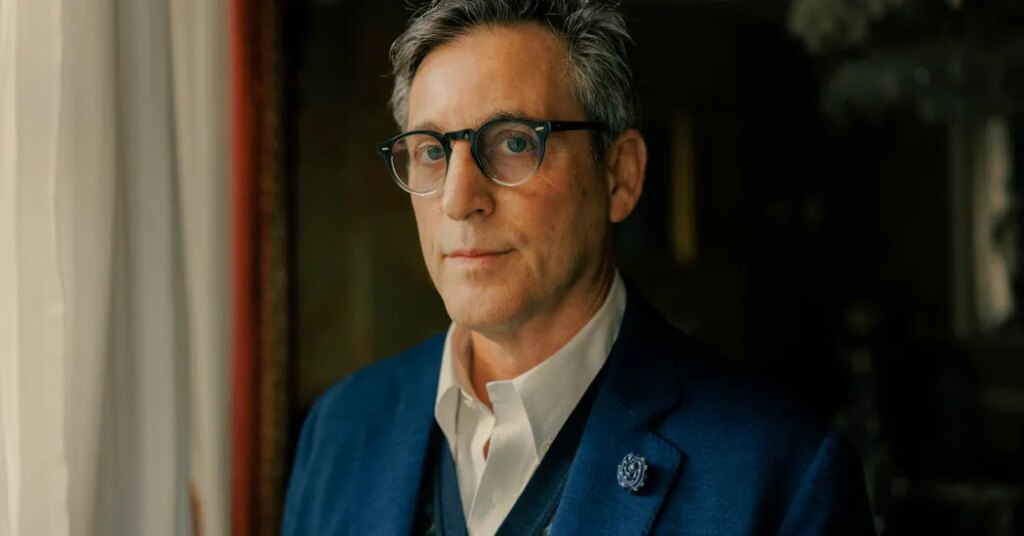
Michael Freeman says he had one thought when he first saw a photo from Jeffrey Epstein’s autopsy: “Wait a minute, that doesn’t look like a hanging mark.”
The noose had not left a smooth, consistent line on Mr. Epstein’s neck that slanted to a peak, as in a textbook hanging. Instead, the mark was deep, ragged and branched into a Y-shape on one side.
Dr. Freeman, a forensic scientist who studies bias and error in death investigations, spent a year examining Mr. Epstein’s autopsy file, which was given to him by the dead man’s brother.
He is seeking to publish his findings in a peer-reviewed journal, but has been rejected so far. On Monday he was presenting them at the Middle Temple, a London legal society, arguing that Mr. Epstein’s injuries are most plausibly explained by homicidal strangulation. He is also asserting that injuries on the body suggest there was a struggle, contrary to the medical examiner’s findings.
The totality of the circumstances surrounding Jeffrey Epstein’s death in a federal detention center in 2019 points overwhelmingly to suicide, and several investigations have failed to produce evidence that anyone other than Mr. Epstein had a hand in it. Dr. Freeman’s analysis, parts of which he floated in a New York Times investigation earlier this year, may rekindle long-smoldering debates about his death.
Forensic pathologists who have seen some of the autopsy photos, though not the entire set, have agreed that the mark on Mr. Epstein’s neck was atypical for a hanging. Some of those experts said the images could still be consistent with suicide, but they cautioned that the injuries alone could not tell the full story, and that a cascade of institutional failures would make it difficult to ever conclusively determine what happened.
The New York City medical examiner’s office, which performed the autopsy, said this week that it “stands by its determination” of suicide.
Much information that medical examiners would normally use to determine a cause of death was unavailable; the examiner was not permitted to inspect the cell, for example. That has left the autopsy photographs as some of the only concrete evidence.
After being asked by a journalist to look at the hanging mark, Dr. Freeman asked Jeffrey Epstein’s brother, Mark, whether he could see the complete file. As next of kin, Mark Epstein was one of the few people who had access to the autopsy. He shared the file with Dr. Freeman last November.
Mark Epstein said in an interview last week that he had also shown the materials to other experts who had asked to see them — but whom he declined to name — and that the results had been inconclusive. “They were all hemming and hawing,” he said.
Shortly before Monday’s talk, Mr. Epstein posted the autopsy photos online for all to see.
Dr. Freeman said in an interview that he had no idea who might have killed Mr. Epstein, nor did he care. He was focused only on what he called oversights in the death investigation and autopsy report. “All I’m interested in is, how did this get so sideways?” he said.
Jeffrey Epstein, a wealthy financier and convicted sex offender, is far from a typical subject for Dr. Freeman. As a consultant and scholar, he has argued that medical examiners too often ignore the most plausible cause of death in favor of one that excuses deadly force by the police or reinforces racial stereotypes.
He is not a board-certified forensic pathologist, the highest credential for medical examiners in the United States, but he has doctorates in epidemiology and forensic medicine and teaches forensic medicine at two universities. Dr. Freeman, an American, is also a fellow of the Faculty of Forensic & Legal Medicine at the Royal College of Physicians in the United Kingdom and the editor of its journal.
In one case, Dr. Freeman argued on behalf of a Black teenager charged with murder in Mississippi after a stillbirth, after tests found trace amounts of a cocaine byproduct in the baby’s blood. The umbilical cord had been wrapped around the infant’s neck, and the state had the country’s highest infant mortality rate. The charges were dropped.
In 2020, Dr. Freeman co-wrote a landmark metastudy on excited delirium, a term often used to explain deaths in police custody. His methodology and conclusions were hotly disputed, but they propelled a widespread rejection of excited delirium as a valid diagnosis or cause of death.
More recently, he consulted in the prosecution of a police officer who killed George Floyd in Minneapolis, using statistical probability to counter defense claims that drug abuse or heart disease had caused Mr. Floyd’s death. Dr. Freeman was also part of a panel of experts that identified dozens of deaths in police custody in Maryland that had been misclassified as natural or accidental.
Forensic pathology is sometimes said to be more art than science, and disagreements among experts are common. Medical examiners point out that they must defend their opinions in court, but Dr. Freeman is among critics who have complained that there are too few safeguards against bias and error.
For his Epstein investigation, he teamed up with two other skeptics, Itiel Dror, a cognitive neuroscientist whose real-world experiments have repeatedly embarrassed forensic practitioners, and Anders Eriksson, a forensic pathologist who led a Swedish government review concluding that “shaken baby” prosecutions had been based on flawed reasoning.
They are continuing to seek a publisher for their analysis. In the meantime, Dr. Freeman prepared his talk on Monday, which received a flurry of advance news coverage.
The talk was to be held at the University College of London, where reservations quickly reached capacity. But on Sunday, the school suddenly announced that it would not take place, citing “wellbeing implications for our students.” The talk was moved to the Middle Temple and those planning to attend were told they would have to watch it online.
In 2019, the medical examiner who performed the autopsy, Dr. Kristin Roman, faced limitations. There were no photos of Mr. Epstein hanging or with the strip of cloth around his neck. The piece of cloth sent to the medical examiner was not the one that had been used as a noose. The prison employee who found the body initially declined to speak to authorities.
Still, Dr. Roman told federal investigators that she had no doubt it was a suicide. There were no signs of a struggle and the body was “pristine,” she told them, with no bruises and no debris under the fingernails.
“This doesn’t look anything like a strangulation,” she said in a statement she gave to federal authorities.
Dr. Roman has since retired from the medical examiner’s office.
When the jail employee who found the body finally spoke with investigators two years after the fact, he recalled that Mr. Epstein’s rear end had been suspended about an inch off the floor.
Dr. Freeman used the employee’s description to reconstruct the hanging, creating 3-D computer models based on Mr. Epstein’s physique and the autopsy photos. He then used illustrations to argue that strangulation from behind was a better explanation for Mr. Epstein’s injuries, including fingernail marks above the ligature line, an abrasion at the base of the neck, and a deep, fresh hemorrhage in the left shoulder muscle.
He faulted the medical examiner for not testing Mr. Epstein’s fingernails for DNA.
Colleagues are welcome to dispute his findings, Dr. Freeman said in an interview.
“It should be, ‘Here’s my work. You do the calculations, you do the math, you take a look at it,’” Dr. Freeman said. “If you agree, great. If you don’t — tell me where I went wrong.’”
If you are having thoughts of suicide, call or text 988 to reach the 988 Suicide and Crisis Lifeline or go to SpeakingOfSuicide.com/resources for a list of additional resources.
The post Challenging Consensus, Scientist Says Photos Show Epstein Was Killed appeared first on New York Times.