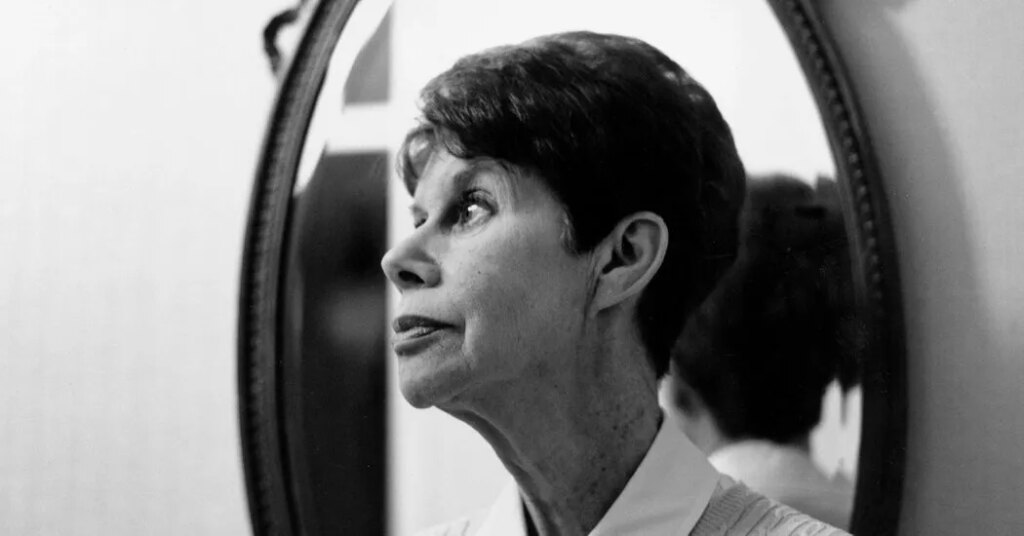
ANITA BROOKNER: Art and Life, by Hermione Lee
“Don’t make your books any shorter, please,” Graham Greene implored his friend Muriel Spark in a 1974 letter, “or you’ll disappear like Beckett.” Greene might have aimed the same (joking) admonition at other English women writers of Spark’s generation. Penelope Fitzgerald wrote ideally slim novels. So did Beryl Bainbridge, Barbara Pym, Caroline Blackwood, Alice Thomas Ellis and Anita Brookner.
This sorority of writers and their slender novels — the cream of which comprises a flawless bullet-train reading list — appeared so regularity on Booker Prize shortlists during the 1970s, ’80s and ’90s that the British press, which was sexist but also omnidirectionally caustic, suggested that a slot was held open each year for “the Thin Woman’s Novel.”
Brookner’s cool, gray and reservedly witty novels, the best known of which is “Hotel du Lac,” which won the Booker in 1984, are frequently about people leading solitary lives. Some come in at under 200 pages; a few are much longer.
Brookner (1928-2016) is the subject of a new, 500-page book from the tenacious and indefatigable English biographer Hermione Lee. At half the length, “Anita Brookner: Art and Life” would probably have been twice as good. It is padded out in ways that add drag to its stately propulsion.
Brookner didn’t want this book (or any other biography) written. She destroyed her letters and private papers. She obliterated personal photographs. She told an interviewer, “I shall leave no trace.” One imagines her in a slim skirt and a Virginia Woolf cardigan — she was always sleek and well-groomed — skipping cheerfully across a bridge she has timed to explode just behind her. She planned to get away clean.
“How she would have hated having a biography!” Lee writes. She composed one anyway, as a tribute, and to combat the perceived notion of Brookner and her work as dour and gloomy. She wants to replace that perception with what she says is a truer image: “life-changing writer, nonpareil stylist, courageous thinker, extraordinary human being.”
Lee mostly succeeds at her task: Her book is very, very good in places. But because relatively little is known about Brookner’s private life, Lee is forced to search for workarounds to fill the pages. She takes every detour that presents itself. And the plot of what seems like every Brookner novel (she wrote 25) is parsed at length, with extended quotations collaged in.
Consuming this book can be like reading the introduction to a reissue, an introduction that goes on for hundreds of pages. It’s a commonplace compliment to say that a literary biography sends you racing back to read the subject’s work, but this one does the opposite. It makes you feel you’ve just ingested a chef’s tableau of Brookner novels and need a few months to come back with a fresh appetite.
Brookner grew up in suburban south London, the only daughter of a middle-class family. Her father was a one-time tobacco salesman, and her depressed and neurotic mother was a failed singer who was disappointed in Brookner for not being the charming, ebullient girl she’d imagined raising. Brookner was not a recluse, but she was reticent and content to be alone with a book.
Her father and many of her wealthy relatives were first-generation Jewish immigrants (the family name was changed from Bruckner), and her extended family took in Jewish refuges during World War II. Brookner graduated from King’s College in London in 1949, and then attended the prestigious Courtauld Institute of Art, where she got a degree in art history.
She became a serious scholar, the author of many well-regarded books of art history. The Institute would be her home for the next 40 years. She spent 10 of those years in Paris, a period she called her happiest, drifting daily from museum to museum and soaking in French fiction. She read Le Monde for the rest of her life.
At the Courtauld, she studied and then worked under Sir Anthony Blunt, the intimidatingly erudite and persuasive British art historian. Brookner was shocked when, two decades later, he was revealed as a Soviet spy. She was more shocked to learn that she’d unwittingly been a stooge in his deceptions, relaying what she thought was innocent information.
The press made a big deal out of this, as well as her one other “scandal.” After she won the Booker Prize and was thrust onto the cultural map in England, it was discovered that she’d shaved 10 years off her age, from 56 to 46.
Lee handles the Courtauld years with terrific vividness. Brookner’s lectures, delivered with iron control, were said to be riveting performances — delivered, one student recalls, “with a ferocious undercurrent of tension.” A cigarette, often an unfiltered Woodbine positioned at a theatrical angle, was part of the way she held a room.
She didn’t publish her first novel, “A Start in Life” (1981), until she was 53. Its first sentence was, “Dr. Weiss, at 40, knew that her life had been ruined by literature.” Brookner said she needed to start late because hers was a process of discovering things “I didn’t know were there.” She also wrote to vanquish her depression.
She drafted her novels quickly, generally in three months, and wrote nearly a book a year for many years — by the end, some felt that she’d written too many and that they were too similar. She was deemed a pioneer of the “aloof-spinster genre.” These critics miss the steel, and the reserves of emotions below it, in Brookner’s work.
The epiphanies in her books are often negative ones. One of her central themes, present too in writers from George Eliot to Sheila Heti, is that good behavior is likely to get you nowhere.
Brookner had her critics, including a new generation of young feminist writers. She ran counter to the counterculture. Her characters sometimes said things like, “It will be a pity if women in the more conventional mold are to be phased out, for there will never be anyone to go home to.”
Brookner herself never married or had children. Her mother had been cruel about her romantic prospects. She was more handsome than beautiful, Lee observes, and sometimes felt outside the pheromonal scrum. She didn’t want to marry a “weak” man.
She had many friends (Julian Barnes was one) but leaned into her solitude as a semi-ironic shield — she disliked book tours, readings and other forms of self-promotion — often repeating lines like, “I am one of the loneliest women in London.” When she attended parties, she would come early and leave just as others were arriving.
Lee rakes up stray but memorable details. Brookner was a connoisseur of clothing and jewelry. She cared about food, once writing that she “cooks gravely and with some anxiety, mindful of tradition and taboo.” But she ate little and limited her time at a restaurant, with a friend, to one hour. She sometimes, as did Clarice Lispector, fled dinner parties midmeal.
She left us this observation: “Food, however mediocre, must be served with authority.”
Brookner’s sense of humor was always ready to surface. She once delivered a speech attacking the bad writing in art criticism. At the end, she revealed that all the terrible sentences she’d cited were from her own work. When she began one of her novels, she wrote to a friend: “You realize what this means? Insomnia, dyspepsia, flatulence, migraine etc. until it is finished.”
Late in life, Brookner had dementia. When at last she became unable to read, she still liked having a book in her hands.
ANITA BROOKNER: Art and Life | By Hermione Lee | Knopf | 528 pp. | $45
The post A New Biography of Anita Brookner Challenges Her Aloof Image appeared first on New York Times.