Most people know that eating raw or undercooked chicken is a bad idea because you can get sick from salmonella or other types of microorganisms that can contaminate food. But there are some other food safety mistakes that can expose you to a different — and serious — food-related illness: botulism.
Botulism is a rare condition caused by a paralyzing neurotoxin that is produced by the bacterium Clostridium botulinum. The spores can be found naturally in certain environments — and even ingested without any problem. They’re only dangerous when they start to grow and produce the toxin that can cause botulism. Symptoms of foodborne botulism are mostly neurological, including drooping eyelids, slurred speech and muscle weakness. These symptoms are a medical emergency.
There are a couple hundred cases of botulism each year in the United States, but only about 8 percent of them come from contaminated food, and many cases are preventable, according to federal health data. Sixty-six percent of cases reported in 2021 were infant botulism (more on that below), 24 percent were due to wound contamination and 4 percent were from other causes.
Here’s how experts say the toxin can form in certain foods and what you can do to avoid getting sick.
Vacuum-sealed fish
Some botulism-causing bacterial strains found in seafood can grow at temperatures as low as 38 degrees Fahrenheit — well within refrigerator range.
That means vacuum-sealed frozen fish left to thaw in the refrigerator can give the strain the low-acid, low-oxygen conditions it needs to thrive. (Vacuum-sealed fresh garlic, mushrooms and onions can pose a risk, too.)
The bacteria don’t thrive under acidic conditions — meaning a pH lower than 4.6 — so if the pH is higher, so is the risk, especially if there’s a lack of oxygen-rich air exposure.
“A vacuum-packaged fish is a perfect recipe for botulism,” said Don Schaffner, chair of the department of food science at Rutgers University.
The simplest way to avoid risk is to open the vacuum-sealed packaging to let in oxygen before you thaw it, Schaffner said.
You can remove the fish from the original vacuum-sealed packaging, place it in a plastic bag or food storage container and thaw it in the refrigerator as you would other foods. Once you have removed it from the original package, you can also use the defrost function on your microwave, Schaffner said.
Home-canned foods
Improperly home-canned, preserved or fermented foods are one of the most common sources of foodborne botulism in the U.S., said Wade Syers, food safety specialist at Michigan State University Extension.
Most strains of the bacteria tend to thrive in low-acid, low-oxygen and often room-temperature conditions. If low-acid foods such as carrots, green beans or potatoes aren’t properly pressure-canned — a food preservation method — the spores can survive, and the sealed, moist, warm jar gives them the right environment to germinate and produce the toxin.
In one of the largest botulism outbreaks in recent U.S. history, 29 people were sickened and one person died in 2015 in Ohio after eating potato salad made with improperly home-canned potatoes. The potatoes had been processed in a boiling-water canner rather than a pressure canner, and boiling-water canners don’t get hot enough to kill the spores, according to the Centers for Disease Control and Prevention.
When home-canning, use only approved recipes, such as those from the canning guide from the U.S. Department of Agriculture or resources from the National Center for Home Food Preservation. Pressure canning, which uses steam in a pressurized pot to reach temperatures of 240 degrees Fahrenheit or more, destroys the bacteria’s spores, said Ellen Shumaker, food safety extension specialist at North Carolina State University.
Baked potatoes
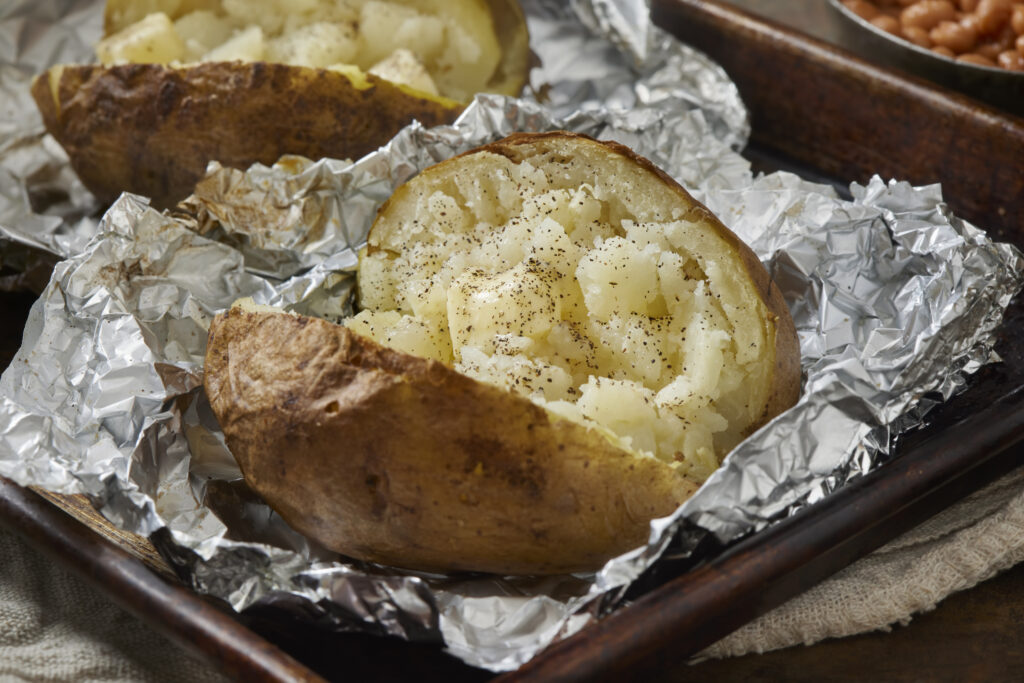
Potatoes can carry the bacteria’s spores (and other microorganisms) from the soil, and while baking will kill many microorganisms, it doesn’t kill spores, Schaffner said. If a baked potato — particularly one wrapped in aluminum foil — is left at room temperature still wrapped, it can create the right low-oxygen environment for the spores to grow and produce the toxin.
In a 1994 outbreak, 30 people were diagnosed with botulism after a Texas restaurant served a dip made with baked potatoes that had been wrapped in aluminum foil and left at room temperature for days.
Mitigating risk isn’t too hard. You can wrap your potato in foil to bake it — simply unwrap it once you remove it from the oven. And don’t leave it sitting at room temperature for more than a couple of hours.
If you would rather save the potato than eat it while it’s hot, take off the foil, put it in a food storage container and refrigerate it within two hours. Refrigerator temperatures keep the strains typically found in potatoes from growing, Schaffner said.
Dented cans
Damaged low-acid canned foods can pose a botulism risk.
Small dents are usually fine, but deep or sharp dents, especially on the seams along the side or rims, can break the airtight seal. This can let bacteria in or alter the environment inside the can, Shumaker said.
Also, she said, avoid cans that are bulging, swollen or leaking. Bulging can be a sign that bacteria inside the can are growing and producing gas.
Honey
Honey can carry Clostridium botulinum spores. A mature gut microbiome will keep them from growing, but in babies, the spores can germinate and produce the toxin. This can cause infant botulism, which is rare but is the most common form of botulism in the U.S.
That’s why the American Academy of Pediatrics (AAP) advises against giving honey to babies and infants younger than 12 months, including putting it in their food, water or formula. Symptoms of infant botulism can include constipation, followed by decreased movement, a weakened gag reflex, loss of head control and “progressive descending generalized weakness and hypotonia,” among other signs, according to the AAP.
“But that’s only a risk for these young infants that don’t have a firmly established gut microbiome yet,” Schaffner said.
While honey is one of the most well-known dietary causes of infant botulism, the spores also can be acquired by swallowing contaminated dust or soil.
Shumaker said that, while small, the risks of botulism come mostly from improperly home-canning foods, vacuum-sealed fish and some other improperly stored foods — but you can take simple steps to protect yourself and your family, such as following safety protocols when preparing, thawing and storing foods.
The post 5 food safety mistakes that can raise your botulism risk appeared first on Washington Post.