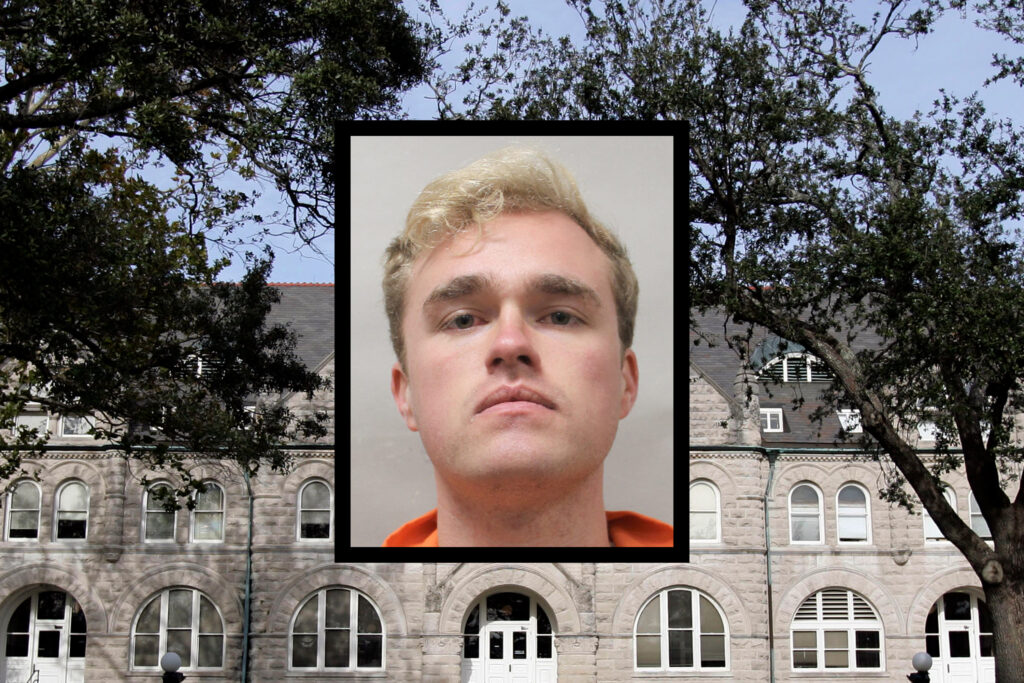
Tulane University assured junior Cameron Lewis that the fellow student she accused of rape would not be allowed to graduate while the school investigated.
It was May 2022, eight months after the alleged attack, and Tulane had paused its inquiry in deference to a parallel investigation by New Orleans police.
The accused student, senior Tate Weston, spent that summer earning credits from a state university in Texas.
By the time Tulane found him responsible for the sexual assault and recommended expulsion, Weston had transferred those credits — and Tulane had granted him a diploma, records show.
Weston went on to enroll in Washington and Lee University’s law school in Virginia in 2024. After The Washington Post inquired about his status, the school said early this month it was placing him on leave and hiring a law firm to conduct an investigation and review the law school’s policies.
Weston, 25, of Austin, was indicted earlier this year on a charge of second-degree rape. On Thursday he pleaded guilty to second-degree battery, a felony, and misdemeanor sexual battery, as part of a deal with prosecutors in New Orleans. He was sentenced to three years’ probation and will not be required to register as a sex offender.
“I hope he can find peace with himself,” Lewis told The Post after the hearing. “And I hope the Tulane administrators can find accountability, or that accountability will find them.”
Lewis agreed to be named in this story.
Weston’s path through three universities in three states highlights what experts say are gaps in college disciplinary systems that can allow students accused of sexual misconduct to graduate, transfer or enroll before investigations are resolved or sanctions imposed.
A Post review of hundreds of pages of court filings, confidential university records and communications involving college officials shows how administrative delays and decisions allowed Weston to move from campus to campus as the criminal case dragged on for five years.
Citing confidentiality laws, Michael Strecker, associate vice president of Tulane, declined to answer questions for this story about why the university awarded Weston a diploma but said the school now prohibits students from graduating while under an investigation that could result in expulsion.
“We recognize the seriousness of these issues and continually evaluate our policies and processes to identify and address gaps,” Strecker said in a statement.
Jayme Blaschke, a spokesman for Texas State University, where Weston earned additional credits, declined to say whether the university knew he was under investigation, citing privacy laws.
At Washington and Lee in Lexington, Virginia, spokesman Peter Jetton acknowledged that law school admissions staff were aware when Weston applied that he had a misconduct finding at Tulane, but said they did not conduct any “additional inquiry.”
“This has raised broader concerns around our law school admissions practices and how the law school monitors ‘character and fitness’ requirements for its students,” Jetton, the law school’s associate dean of communications, said.
In response to detailed questions for this story, Weston’s attorneys said in a statement that Weston “has always adamantly maintained that he is innocent of rape” and that his plea deal shows he “is not, and was never, the violent rapist portrayed in reports.”
They also said he had been fully candid with Washington and Lee officials.
“He disclosed in detail in his application that he’d been accused of sexual assault at Tulane, found responsible, and expelled,” the attorneys, Sarah Chervinsky and Amelia Schmidt, said. “As the criminal investigation and later charges developed, he promptly and repeatedly updated law school leadership.”
Experts told The Post that many universities have been reluctant to adopt standards for how to respond when students come under criminal investigation for sexual assault.
“Schools are trying to make everyone happy and not actually just do the right thing,” said Laura Dunn, a New York-based attorney who specializes in cases involving sexual violence. “Unfortunately, what I’ve seen a lot, and this is to avoid litigation, is schools leave themselves a lot of discretion. And that discretion is almost always where the vast majority of horrible errors are made.”
The issue has drawn renewed attention since a former Cornell University student filed a lawsuit alleging sexual misconduct against multiple fraternity brothers. One of the men was banned from campus for three years after he graduated, according to the New York Times. Another student transferred to a university in South Florida, where officials said they were unaware of the allegations that led Cornell to expel him, The Post previously reported.
Lewis, who accused Weston of pinning her to her bed as he choked and raped her, is now 26 and in a graduate program at Tulane. Her allegations and the universities’ handling of the matter have received no previous media attention.
The New Orleans Police Department and the Orleans Parish District Attorney’s Office, which prosecuted the case, did not respond to requests for comment.
Aubrey Harris, an attorney who represented Lewis for two years during the criminal investigation, said in a statement that delays and inaction in sexual violence cases can cause survivors to feel ignored.
“It is heartbreaking when the institutions people turn to for help fail to show up for them,” Harris said.
A report of rape
The two Tulane students first met in the summer of 2021, when Lewis sent Weston a message through the dating app Bumble. They saw each other in person twice and had no physical contact before the night of the assault, Lewis told a civil court judge years before Weston was charged, as she sought a restraining order against him.
On a night in mid-September 2021, Lewis and Weston exchanged messages on Snapchat, according to screenshots obtained by The Post.
“Do u want to hang,” Weston asked.
“Well like not tonight bc i have to wake up early in the morning! Try me another time,” Lewis messaged.
“Are u sure? I’d smoke u out,” Weston responded. He was referring to marijuana, Lewis later told police.
Lewis at first declined, saying she had already taken sleep medication. She assented when Weston said he was only four minutes away, the screenshots show.
At about 2 a.m. on Sept. 19, Weston arrived at the off-campus residence where Lewis lived alone, she testified in civil court. She said his breath smelled of liquor. For about five minutes, they made small talk.
Weston asked if he could take off her clothes, and she said no. Then, she testified, he grabbed her shoulders and pulled off her top. She felt uncomfortable and began to try to move away from him, she said.
He blocked the doorway, she said.
Lewis said Weston — who is nearly a foot taller than her, records show — pinned her on the bed, holding down her torso with his arm and elbow.
He used his knees to spread her legs apart and slapped her face, she said. He forced his fingers inside her mouth, vagina and anus, she said.
“Whenever I tried to move, he put his arm across my throat,” she testified. “And whenever I started to become more vocal, he put his hand on my throat and squeezed so I couldn’t make any noise.”
Lewis estimated that Weston had his arm around her throat for about five minutes. After he let go, she said there was a “moment of stillness.” She thought he might leave. But then, she said, he penetrated her with his penis.
Five minutes after he left, she called 911, she testified.
A detective accompanied Lewis to the University Medical Center New Orleans. A sexual assault nurse examiner took photographs of her body and DNA swabs for evidence, records show. In a report obtained by The Post, the nurse documented small red marks known as petechiae, typically observed after tiny blood vessels burst, on Lewis’s neck.
That night, Lewis declined to disclose Weston’s name to police, saying she feared retaliation.
By the next day, Tulane campus police had learned about the sexual assault allegation and notified the dean of students, records show.
Nearly three months later, in mid-December 2021, Lewis gave Alison Cofrancesco, from Tulane’s victim support services office, her assailant’s first name, Tate, and his major, philosophy, internal university records show. She also shared a photo from his Bumble profile.
School officials searched a database of students by first name, then narrowed the list by age and major, records show.
“The only match was Tate Weston,” Cofrancesco wrote in an internal university document.
‘He won’t be able to graduate’
On March 15, 2022, Weston received a written notice from Tulane that he was the subject of a “major matters investigation” for the alleged sexual assault of Lewis, records show.
The allegation did not trigger an investigation under Title IX, the federal civil rights law that governs how universities respond to sexual violence. A Tulane spokesman said that off-campus conduct does not fall under the law.
Unlike a Title IX investigation, there would be no live hearing or cross-examination. A single investigator would gather the facts and determine the outcome. The possible sanctions ranged from a written warning to expulsion.
In April 2022, Weston and his attorney asked the university to defer its investigation, citing the New Orleans police investigation, records show.
He was “9 credits shy of graduating,” according to a note in Tulane’s administrative case file.
Christopher Zacharda, the director of student conduct, told Lewis that the university had granted Weston’s request for a deferral, records show. The school’s policy allowed for administrative investigations to be paused during the early fact-finding stages of a police investigation, Zacharda told The Post.
The deferral would last until the end of 2022 unless the criminal investigation finished before then, according to records.
Weston was banned from the campus but was permitted to finish his spring semester classes remotely. The school issued an interim suspension for the summer and fall that would prevent him from registering for new classes.
Lewis wrote to Zacharda in an email that she believed it was important to finish the administrative investigation before Weston could graduate, given the “exceedingly grave” allegations.
Administrators tried to calm her fears, according to communications reviewed by The Post.
“He can’t register while being on interim suspension — so he won’t be able to graduate or be on campus as long as the deferral is in place,” Cofrancesco, the university case manager, told Lewis in a May 2022 text message. Cofrancesco did not respond to The Post’s request for comment.
Meanwhile, Weston enrolled for the summer 2022 semester 500 miles away at Texas State University near Austin, according to its spokesman.
In October 2022, Lewis received a phone call from Zacharda, who told her that Weston had graduated from Tulane, internal university records show. Weston had requested that his credits from Texas State University be applied toward his Tulane degree.
Zacharda, who is now at Northwestern University, told The Post he could not speak to specifics of the case because of privacy laws but noted that his office at Tulane had not been involved in issuing diplomas.
The investigation’s findings
When the deferral expired at the end of 2022, Weston gave Tulane officials a statement denying Lewis’s allegations.
“I would like to provide this statement in the hopes of clearing my name and putting this matter behind me before I begin my next chapter — which includes applying to law school myself,” he wrote in a letter to Tulane’s investigator, Jacqueline Barber, in December 2022.
He had not been drinking, had not taken illicit drugs and “never raped or otherwise sexually or physically assaulted” Lewis, he wrote. Any interactions he had with his accuser were “consensual,” he wrote.
Because criminal prosecution remained a possibility, “the extent to which I can cooperate fully and speak freely is still extremely limited,” he wrote. “It is my hope that the assertion of my constitutional rights is not used against me.”
In an additional letter to Barber, Weston went on the offensive.
Although he had previously described Lewis as “alert and sober,” he questioned whether her medication affected her “ability to accurately recall and relay the events on the night in question.” He noted that Lewis lacked “injuries commonly seen in cases of strangulation,” such as bloodshot eyes or swollen lips. He wondered why, if someone were under assault, they would not try to yell, scream or leave their home.
Lewis had an opportunity to give an impact statement. She told Barber that after having nightmares, she threw away her old bed and bought a new one, hoping it would help her sleep. She regularly missed classes and rarely left home.
She accused Weston of finding a way to “cheat the system” by graduating before the investigation concluded, saying that he had shown “no accountability, no personal growth, nothing.”
“I have the ultimate ask,” she told the investigator. “My position is that the degree be revoked.”
In April 2023, roughly a year and a half after the alleged assault, Barber ruled that Lewis’s allegations were “credible enough by far” to meet Tulane’s burden of proof, a preponderance of the evidence. Weston was responsible for the assault, Barber found.
She issued the most severe sanction available: expulsion.
Barber noted that she did not have the power to revoke a degree that had been granted following “procedural gamesmanship,” referring to Weston’s graduation during a pending investigation. (Tulane’s spokesman told The Post that the school revokes degrees only in cases of academic misconduct but said that policy is now under review.)
Weston appealed the findings in May 2023 to Zacharda, the director of student conduct.
Weston argued that he had not engaged in gamesmanship. He wrote that expulsion would carry lifelong consequences, including the possibility that he might not be admitted to law school or the bar.
“Should that occur, I would be unable to become a lawyer, which has been my dream, and for which I’ve already invested enormous time, energy and money,” he wrote in May 2023.
He added that his attorney had put Tulane “on notice” over concerns about lack of neutrality and fairness, records show.
His appeal was denied.
“Effective immediately, you are permanently separated from the University,” a Tulane official wrote to him in a letter dated May 30, 2023, adding that the expulsion would be noted on his transcript.
Lewis later sued Tulane in Louisiana state court under the pseudonym “Jane Doe,” alleging that the university had mishandled parts of the investigation. In court filings, Tulane responded that she had a history of filing “meritless” claims against the university.
Warnings to Washington and Lee
The fears that Weston expressed in his appeal did not immediately materialize during his application to Washington and Lee law school in early 2024.
Current applicants to the law school are required to answer questions related to their “character and fitness,” including whether they are the subject of a criminal investigation, have ever been expelled or faced any university disciplinary action.
Weston’s attorney said he submitted a two-page document as part of his application acknowledging that Tulane had found him responsible for sexual assault and expelled him after he graduated. Weston also disclosed in that document that his accuser intended to pursue criminal charges but noted that New Orleans police had never questioned him, according to his attorney, Schmidt. She described the disclosures in a letter she sent to Washington and Lee this month that was obtained by The Post. The attorney did not provide The Post with a copy of Weston’s disclosure.
Jetton, the Washington and Lee spokesman, did not answer questions about Weston’s disclosure.
Weston was admitted on April 16, 2024, according to his attorney.
In November 2024, Lewis emailed Melanie Wilson, the dean of Washington and Lee’s law school, and Lauren Kozak, the university’s Title IX coordinator, among other university officials. The subject of her email was: “Victim Notice of Sexual Assault by WLU Student.”
She attached documents showing Tulane’s investigative findings.
“He may pose a potential threat to the safety of other students,” she wrote, adding that there was an active New Orleans police investigation of Weston.
That same month, Maria Saez Tatman, Washington and Lee’s associate dean of law student affairs, community and belonging, met with Weston to let him know that Lewis had contacted faculty and administrators, according to Schmidt’s letter to the university.
Wilson, Kozak and Saez Tatman did not respond to requests for comment for this story.
By early 2025, Lewis’s rape kit had finally been tested. Authorities obtained a warrant for Weston’s DNA, which came back as a match, according to court testimony.
Saez Tatman was aware of the search warrant and told Weston that “even if he were arrested he would be presumed innocent and permitted to continue as a student,” Schmidt wrote in the letter to Washington and Lee.
Weston was arrested in December 2025.
Jetton said the university’s president and board of trustees were not informed of Weston’s misconduct finding or arrest until late October, the same week The Post asked for comment.
He said the school’s upcoming review will “identify any shortcomings and implement appropriate changes to ensure our admissions and related policies reflect our commitment to fostering a safe and supportive learning environment.”
In a New Orleans courtroom Thursday after Weston pleaded guilty, a judge invited Lewis to speak about the impact of the crime.
“After you raped me, I wished at times to forgo my education, to forgo my career and to end my life,” she said to Weston.
Institutions such as the New Orleans Police Department and Tulane “possessed the power to help me escape what you did,” she said. “Instead, they left me trapped in it.”
Freelance reporter Ashley Cusick contributed to this report from New Orleans.
The post Tulane granted him a diploma while investigating him for rape appeared first on Washington Post.