Daniel Sanchez was driving his pickup truck through a college town in North Texas on a Sunday afternoon last summer when he noticed the glow of bright blue police lights behind him. As he pulled over, he realized it wasn’t one or two squad cars; it was half a dozen. Police officers rushed to his door, guns pointed at him. “I thought that I was going to die,” he told me. “Like, honestly, when I saw the amount of cops around me and the guns, I’m like, Oh, whoa, what is this?”
Sanchez was patted down, his arms cuffed behind him as an officer guided him into the back of a police vehicle. Born in Mexico, Sanchez came to the United States as a teenager and was undocumented for many years but later obtained a green card. As he sat in the backseat, “Always on Time” by Ja Rule played on the radio. An officer opened the door and repeatedly asked whether he had any explosives in his truck. No one would tell him why he was being arrested.
About 36 hours earlier, a police officer had been shot and injured outside the Prairieland Detention Center 60 miles away. What had started as a July 4 demonstration by a group of protesters shooting off fireworks had become the scene of a violent attack on the officer, who was airlifted from the scene but survived. Law enforcement flooded the area, arresting anyone involved, then widened their search. Ten people were already in custody—Sanchez’s wife was among them—but the shooter was still at large. Sanchez, though, hadn’t been at the ICE detention center that night. He told me he hadn’t even been aware of the plans or that his wife was going. The couple had gotten into a fight earlier that week, and he had been staying at his parents’ house. At the time of his arrest, he was still trying to piece together what had happened, what his wife had done, and how much trouble she was in.
FBI agents had been watching him that morning, and they had been listening in when his wife called him from jail, frantically telling him to hire a lawyer and to possibly adopt her daughter. “I’m scared of the proximity for you,” she had told him. Soon after that call ended, the agents photographed Sanchez as he carried a taped-up box out of his parents’ house and placed it into his truck bed. They followed him as he drove nearly 50 miles northwest to an apartment complex in Denton and left the box outside a door on the second floor. Law enforcement didn’t have a warrant for his arrest, so officers continued to follow him and looked for a reason to pull him over. Eventually he made what they considered a wide right turn.
Sanchez was taken to a holding facility. Even though he had provided his identification to police, he was listed for two days as John Doe while his family tried to locate him.
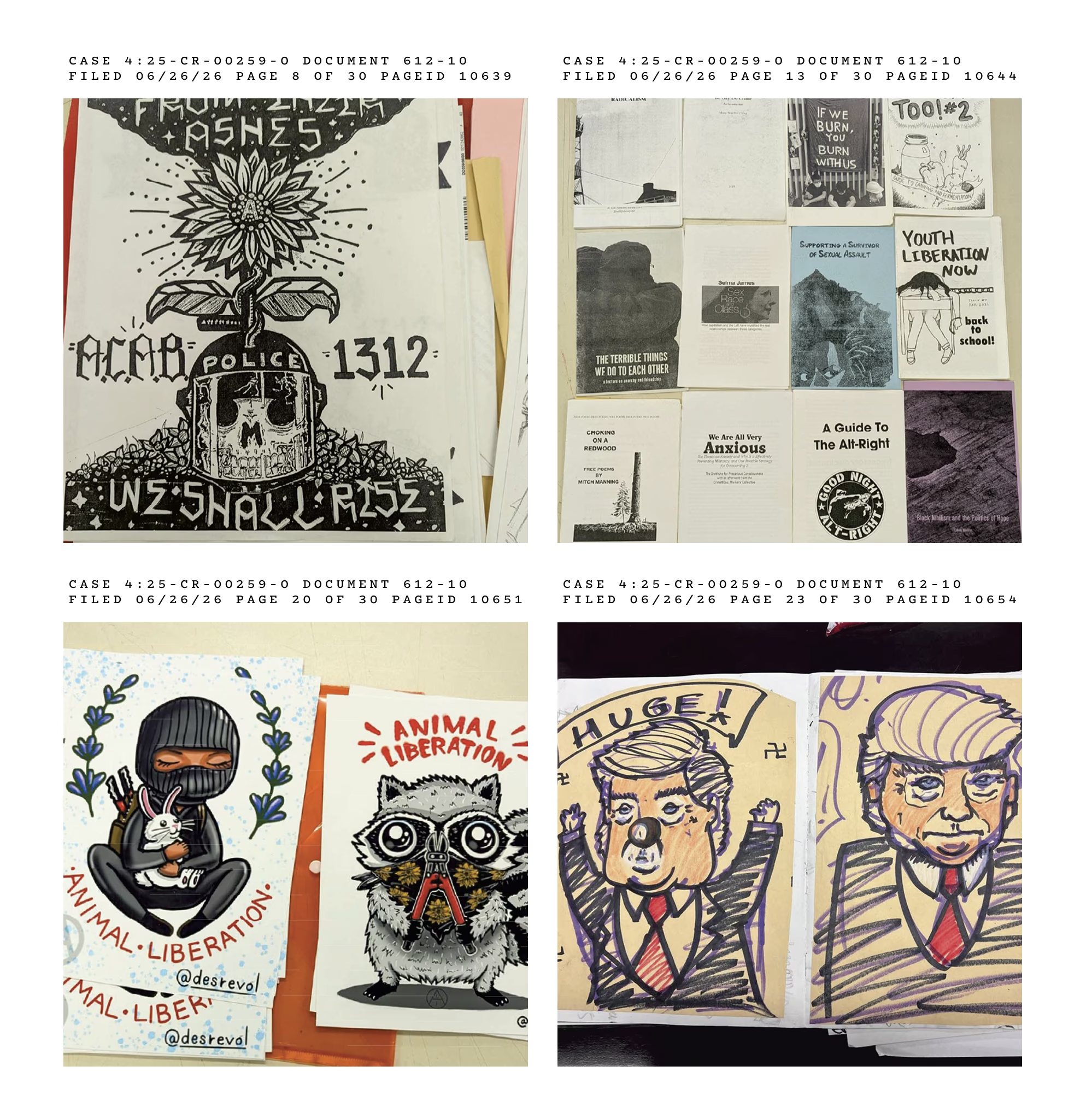
And what about that box? It had been taken inside the apartment, and nearly six hours later, investigators obtained a warrant to seize it. Armored vehicles pulled up to the apartment complex, and agents threw a flash-bang and broke through the front door, which one tenant later described as “something like you’d see in Fallujah.” The agents found Sanchez’s box in a closet. There were no explosives inside, no guns, nothing directly connected to the protest that had turned violent. The items later submitted as evidence include several dozen political booklets on a variety of topics that prosecutors claimed ideologically tied Sanchez to the shooting. One of the titles was War in the Streets: Tactical Lessons From the Global Civil War Vol. 1. One was a “primer for the criminally-minded anarchist.” One that the prosecution would point to during the trial was called Insurgency: An Anarchist Journal of Total Destruction.
The box also contained some of Sanchez’s artwork. One drawing shows a skull inside a police helmet with a flower growing out of it, and text that reads From their ashes we shall rise. It also has the letters ACAB, which stand for “All Cops Are Bastards.” Other pieces promote “animal liberation,” depicting a masked person cradling a bunny or a masked raccoon holding shears. Another sketch has Donald Trump in a red tie, his face colored like a clown’s, with three swastikas around him. The most shocking illustration in the box shows four versions of Trump hanged by a noose; in two of them, he holds a sign reading Hang in There, with cats clinging to a rope.
Although there was nothing illegal about making such artwork or possessing the booklets, prosecutors claimed that Sanchez moved the box as part of a conspiracy to protect his wife. They accused him and other defendants of being part of a North Texas cell of antifa, considered a terrorist group by the Trump administration. Although many of the cases that the administration has tried to bring against anti-ICE protesters elsewhere in the country have fallen apart before going to trial, the Prairieland case proceeded. Defense attorneys for Sanchez and others had been so convinced that their clients would not be convicted that they didn’t call any witnesses. But after a three-week trial that concluded in March, a jury found all nine defendants guilty. A judge then classified the convicted men and women as terrorists, and imposed sentences to match.
The gunman who injured the police officer was sentenced to 100 years in prison. Sanchez’s wife, who helped organize the protest, was given 70 years. Sanchez got 30 years.
As I tried to understand this sentence, I combed through Sanchez’s phone records, and the geolocation data on his phone. I went through hundreds of photos from the government exhibits, reviewing materials that were collected but never discussed at trial. I talked with Sanchez for more than six hours across more than two dozen prison phone calls, and he never came across as defensive, but I looked for evidence that he might have been hiding something. I figured something really bad must have been in that box, and I just hadn’t seen it yet. Or, alternatively, that Sanchez must have had some bigger role in the events than what had been reported. But I found no hidden explanation for what had happened to him. As best as I could establish, Sanchez is set to spend the next 30 years in prison simply for moving a box of radical zines.
For years, Sanchez was active at protests. He eagerly collected leftist political magazines—including more innocuous titles about canning and fermentation or race and gender inequality, and more radical ones about avoiding surveillance or engaging in confrontational protest—and he participated in a book club named after the anarchist Emma Goldman. Growing up in both Mexico and Texas, Sanchez, who is 40 and goes by Des and Dani, liked to make funny artwork that caused viewers to look twice. As a teenager, influenced by the writings of Che Guevara, he began leaving graffiti in gentrified neighborhoods as a critique of profit-driven developers. He had a punk-goth style, a distrust of police, and a distaste for cruelty toward animals, and he came to define his views as anarchist.
In his early 30s, he met Maricela Rueda, a poet who shared his politics. They were both artistic and creative, emotional and expressive. They married in 2020; she would become a doula, and he became a father figure for her young daughter.
Several years ago, Sanchez receded from the book club after he had a falling out with some of the members, and began spending more time on his art. He had taught himself to tattoo using materials he ordered online, and he and two close friends—brothers who go by the names Dro and Kilo—had just opened their own studio. He sought to make his art relatable and accessible. He studied children’s books for inspiration and infused his work with playful animals—while keeping a focus on politics. A 2024 campaign to raise awareness of banned books featured a vinyl sticker he made of a possum reading Art Spiegelman’s Maus, with text around it reading Trash Fascism, Not Books.
When Trump returned to the White House, so too did Sanchez’s dismay over immigration policies that brought enforcement officers into cities to arrest as many people as possible. Sanchez had once worked as a teacher’s assistant in an elementary school, and he had seen how attendance dwindled when families worried about raids. “There are kids that will not see their parents come back from work,” he wrote on Instagram, adding that he wasn’t afraid to lose clients or friends who supported Trump and his immigration policies.
[From the November issue: The babies left behind in America]
Sanchez’s wife was also angry. Just before July 4, 2025, Rueda told her friends that she wanted to organize a protest. She was frustrated at work. “Can we burn it all down?” she wrote in a small-group chat that did not include her husband. She proposed a demonstration at the detention facility to attract attention and support the detainees inside. Plans spread through Signal group chats. Some participants were part of the Socialist Rifle Association and had spent time training with firearms and learning tactical maneuvers from Benjamin Song, an activist and former Marine Corps reservist.
On Independence Day, protesters gathered outside the Prairieland facility. They wore black clothing and masks. Some turned off their cellphones or put them in metallic-lined bags that blocked tracking services. One protester had a red cooler with fireworks in it. Others had backpacks with water, snacks, and first-aid kits to treat life-threatening traumatic injuries. Many had guns but some left them in their cars.
As fireworks exploded in the air that night, Rueda shouted into a megaphone a phrase that translates to hope: “¡Esperanza!” A little after 10:30 p.m., two of the protesters peeled away to vandalize vehicles in the parking lot and spray-paint an unmanned guard shack: Fuck you pigs. A detention-center employee ordered them to leave, and some protesters began to comply. Another employee called the police, reporting that someone was trying to get into the facility. Alvarado police Lieutenant Thomas Gross sped over, jumped from his car with his Glock 9-mm drawn, and saw a figure dressed in all black and a neon-green face mask holding an AR-15-style rifle. As Gross ran toward the figure and yelled “Get on the ground,” there were bursts of gunfire. Gross collapsed and screamed, “I’m hit!” A bullet struck him near his neck. He was briefly hospitalized as law enforcement began to hunt for the shooter, later identified as Song.
Song had encouraged others to carry firearms, and he alarmed some of them when he suggested the night before the protest that they break into the facility to free some of the detainees, an idea that did not gather support, according to testimony from one of those who pleaded guilty. One of the defendants later told the FBI she suspected that Song had intentionally shot the officer “in cold blood” and used the group of activists as “cover while he gets the fuck away.” Song avoided arrest for 11 days. Police stopped other protesters as they tried to leave, and they found firearms and body armor in several cars. “This is like a targeted hit on Prairieland,” one officer remarked to another, an exchange captured in body-camera footage.
Sanchez told me he barely knew Song and was unaware of all of this. He had been staying with his parents in Garland since the argument with his wife earlier in the week, which he would not detail for me other than to say it was “personal stuff” and unrelated to what later happened at Prairieland. “Dani had nothing to do with it,” Rueda told me in a brief call she made from prison after I wrote her a letter. “Dani was not invited.” When I asked her why, she responded, “We have different friends.”
So that night, as she was shouting outside the detention center, he was an hour’s drive away with a group of his friends at an AMC movie theater, watching 28 Years Later while eating popcorn and drinking a Coca-Cola Cherry slushie. He told me he didn’t even know that the detention center existed.
By morning, when the shooting was starting to hit the news, Sanchez told me he was still unaware of it. He called his wife around noon, but she didn’t pick up. He drove to their house and didn’t see her car, so went inside to let the dog out and tend to their cats and rabbits. She tried calling him from jail, but the call didn’t go through. Rueda called her mother and, in Spanish, said “something terrible has happened” and that they needed to find an attorney. She said she couldn’t get into details on the phone but urged her to reach out to Sanchez so he could find out more information from “the community.” She said in the call that Sanchez was not involved. But to law enforcement, her insistence that her mother reach Sanchez made it sound like he could be.
Sanchez told me that he drove to Rueda’s mother’s house, where they discussed finding a lawyer, then returned for nearly two hours to the house he shared with Rueda. I asked him several times whether he moved anything from the home at that time, and he said no: “They’re trying to say that I took stuff out of there, like so-called evidence. And it’s just ridiculous.” Prosecutors later suggested, without providing any proof, that he could have taken material away from the home, because investigators’ subsequent searches there failed to turn up the incriminating materials they’d found in the homes of others.
That evening, on Sanchez’s way back to his parents’ house, he stopped by his tattoo shop and asked to speak with his co-owners in the back. He soon began sobbing inconsolably. “I have never seen him so serious in his life,” Kilo told me. “He seemed really scared and like he didn’t know what to do.” They talked through ways to help, but they also urged him to keep his distance. “We were like, Dude, you can’t do anything. Stay away. Once it’s that big, you don’t want to risk anything,” Kilo said.
[Read: What the Prairieland prosecutions reveal about Trump’s America]
That evening, Sanchez prayed and burned incense. After a sleepless night, the phone rang at 10:55 a.m., and the operator asked if he would take a call from the Johnson County Jail. Seconds later his wife was on the line. “I don’t know what the fuck happened. Like, I can’t believe that that would have happened,” she said, according to a recording later entered into evidence. “Everybody’s life is fucking ruined because they’re gonna fucking put us on parade.”
Police were listening in on the call, and four officers from an FBI surveillance team were outside Sanchez’s parents’ house. About 30 minutes after hanging up, FBI agents watched from a distance as Sanchez loaded the cardboard box into his 2012 white Chevrolet Silverado. Sanchez told me that the political zines in the box had been there for years, but that it didn’t seem wise to hold on to them now “because at any point, immigration can show up at your house.” He insists he wasn’t trying to cover up anything related to his wife, that everything in the box was his.
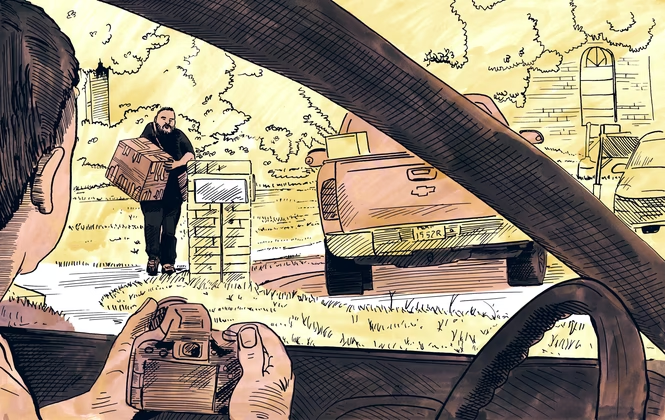
The prior day, he had been in touch with Kelsey Fryman, a longtime friend who was part of the book club. Sanchez was nervous that law enforcement could come after him. “I mean, his wife is being called a terrorist for attending a protest. He is an immigrant dealing with the Trump administration’s immigration policies,” she told me. She urged him not to throw away the materials in the box and to bring them to her instead. “I was like, A chance for some artwork and some zines? Sign me up,” she told me.
Looking through the items, it’s clear why Sanchez worried they were problematic. But it’s also hard to see how having radical pamphlets and artwork merited his prosecution. “It’s literature!” Fryman told me. “Political literature is supposed to be protected under the First Amendment. How is giving a friend political literature a crime?”
Two months after the shooting in Prairieland, the conservative activist Charlie Kirk was assassinated, and Trump and Stephen Miller—then a top aide who has since become the president’s chief of staff—declared war on liberals. Antifa generally refers to the decentralized movement of left-wing protesters who organize regionally and oppose some combination of facism, capitalism, and the mainstream political parties. But in Miller’s rendering, antifa was a fully formed militant organization with a hierarchy and leadership structure that experts say does not actually exist. “With God as my witness, we are going to use every resource we have at the Department of Justice, Homeland Security, and throughout this government to identify, disrupt, dismantle, and destroy these networks,” Miller said. Soon after that, Trump signed an executive order designating antifa as a domestic-terrorist organization. Then he signed a memorandum urging DOJ to prosecute crimes committed by antifa members “to the maximum extent permissible by law.” The Prairieland case was an opportunity to do so.
[Read: A chief of staff who ‘will crack skulls’]
The defendants were collectively branded the “North Texas Antifa Cell.” Prosecutors added new terrorism charges, accusing the group of being part of “a militant enterprise.” Seven defendants agreed to plea deals, which involved admitting guilt and signing declarations that those in the group adhered to anti-fascist ideologies. Sanchez told me that he was offered several plea deals but rejected them all. Prosecutors initially said he could plead guilty to tampering with evidence in exchange for a 10-year sentence and agreeing that he was part of a terrorist organization. Then they dropped the latter condition. Months later they said they’d add more charges if he didn’t agree. When he declined, he said, they added a conspiracy charge. Later, their offer dropped to five years. A guilty plea, however, would mean losing his green card and getting deported. “I’m like, No, this is my home,” he told me. Besides, he said, “I’m not going to sign that away because I didn’t do anything.”
Around Thanksgiving, a procedural error led to Sanchez being freed for eight days. He visited the wildlife center where he had volunteered, and held baby opossums and raccoons. He went to the mall, attended his nephew’s piano recital, and listened to KPop Demon Hunters music. His family and friends had a celebration combining Christmas, Thanksgiving, New Year’s, and his birthday all at once. His mom made vegan pozole, and a friend gave him a tattoo on his right wrist: No one is illegal. And then, when the mistake was confirmed, he returned to jail.
His brief bit of freedom occurred as the legal threats were growing. A superseding indictment combined his case with those of the protesters who were at Prairieland so they could be tried as a group. This approach allowed prosecutors to broaden the scope of who could be tied to the crime, the same way investigations into an international terrorist network implicate not just those who commit violence but those who fund the network and materially support its ideology.
Jeffrey Breinholt, the former deputy chief in the DOJ’s counterterrorism section, helped pioneer the use of such laws after 9/11. But in the Prairieland case, there was not the same type of well-established group with a defined, shared ideology. And prosecutors were using some of the most aggressive tools at their disposal to target those who showed up at an event to express dissent with government policies, even if they didn’t destroy property or hurt anyone. “I think this is way out of line,” Breinholt told me. The principles of jurisprudence that he helped establish, he said, “are being misused now for political purposes.”
During the trial in March, prosecutors tried to paint the entire group as violent. Even if some members had left their weapons in their cars, they still had spent years promoting the idea of anarchy. The prosecution pointed to some of Sanchez’s anti-police artwork to suggest that the group opposed law enforcement. Kasey Bennett, an FBI special agent who focuses on domestic and international terrorism and weapons of mass destruction, testified that although possessing such materials is legal, they show “a joint ideology.”
This was the closest explanation I have found for why Sanchez was deemed guilty: He knew some of the people who were there and shared similar beliefs. The materials in this box, prosecutors argued, helped show motive and intent for the attack. Bennett testified that, because similar political pamphlets were found in the possession of several of the defendants, it indicated a connection between them. “And when a number of people are involved in something, what do we typically call that?” a prosecutor asked Bennett in court. The agent responded: “a conspiracy.” The government’s reasoning prompted broad condemnation from civil-rights, free-speech, immigration, and legal organizations.
On cross-examination, Sanchez’s lawyer emphasized that none of the items were illegal to own, and none were related to the shooting. It was true that Sanchez knew some of the other protesters. He was married to one of them, after all. But others questioned during the trial said they had never seen him before. One said that the first time he met Sanchez was when they were in jail awaiting trial.
To enhance charges of a conspiracy, prosecutors pointed to some of the materials in the box that could have been Rueda’s, including a letter from a child addressed to “Mrs. Sanchez.” It was a thank-you note for teaching a hip-hop class, Sanchez told me, something that he did before he met his wife, who did not take his last name. “The kid does not know how to spell, unfortunately,” Sanchez said.
I pressed Sanchez on some of his artwork that appears to depict vandalism and violence. “All of it is satire,” he insisted. Some of it, he conceded, is “a little raw and pretty shocking.” He mentioned an ICE vehicle in flames, and pointed to the butterflies emerging from it as a commentary that something beautiful could emerge if hard-line immigration policies were abolished. “It doesn’t mean that I’m encouraging people to do anything.”
I also pressed him on his four-panel drawing of Trump in a noose. This wasn’t discussed at trial but was included in the government exhibits. He had been trying to riff on a 2009 Banksy work called Hanging Klansman. They were sketches on scrap paper, he said. “It never developed anything, you know? So it just stayed on that piece of paper.”
Sanchez considers himself an anti-fascist but told me that it’s “absurd” for him to be considered a member of antifa. “It’s a label for something that is not real. They’re trying to label something and create an organization of something that is not an organization.”
The prosecution rested after nearly three weeks of trial. Defense attorneys were so confident they did not see a need to call their own witnesses and moved to closing arguments, a common legal strategy. Christopher Weinbel, a public defender and one of Sanchez’s lawyers, argued that Sanchez had moved the box not as part of a cover-up, but “because he didn’t want to be involved.”
“We don’t lose our freedom when we move our own belongings. We don’t lose our freedom when our friends and family get arrested,” Weinbel said in closing. “Alexander Hamilton said the practice of arbitrary imprisonments is the favorite instrument of tyranny. That’s what’s happening.”
During the trial, Sanchez recalled, the defendants were treated like the terrorists they were accused of being. They were transported to the heavily secured courthouse each day in something that resembled a military convoy. They were moved in wheelchairs, with their hands cuffed behind them and their ankles locked to the chairs. In the courtroom, they were told by the marshals not to make eye contact or wave at their family members. “We just had to be catatonic the whole time,” Sanchez said, “just like, try not to express any emotions.”
The jury deliberated for two days and reached its verdicts on a Friday afternoon ahead of the local school system’s spring break. The judge read each of the verdicts aloud; Sanchez’s came last.
We, the jury, find the defendant, Daniel Rolando Sanchez Estrada, guilty.
Nearly everyone was found guilty on nearly all charges. For Sanchez that included charges of concealing documents and, along with his wife, conspiracy to conceal documents. The only sounds in the room were people crying. “Everybody immediately thought, you know, it’s like their lives are ended,” he told me.
Afterward, Sanchez called his sister and his mom, who were in the car together. His sister remembers him screaming: Why did this happen? How did this happen? I didn’t do anything. I didn’t do anything. I shouldn’t be here. I shouldn’t be here. In the background, his sister recalled, she could hear other defendants wailing in sounds that haunt her. “They were all in disbelief,” she said. When I brought up the moment with Sanchez, who is nearly always composed and even jovial, he became emotional.
Three months later, everyone was sentenced. Song, the shooter, received 100 years. Most others got 50 years. The numbers were outside of recent norms. The average prison sentence for a domestic-terrorism attack that resulted in at least one person being injured but no deaths—which is what occurred at Prairieland—was 8.6 years, according to an analysis of criminal convictions from 2014 to 2019 by the National Consortium for the Study of Terrorism and Responses to Terrorism. Judge Reed O’Connor, the chief judge of the Northern District of Texas, oversees one of the most conservative jurisdictions in the country. Nearly every judge was appointed by a Republican president, and decisions tend to be upheld by the Fifth Circuit, considered the most conservative appellate court.
During his sentencing hearing, Sanchez told the judge about his love of literature, art, and education. Some of his art can be raw and controversial, he said, but it’s how he performs his activism. He mentioned having read Benjamin Franklin’s autobiography while in jail, how the Founding Father’s writings and pamphlets were controversial, too, but they were protected. “I believe in a world where many worlds can fit together, and we take care of each other, and we help each other overcome whatever adversities and challenges we have,” he said. “I’m a father. I am a husband, I’m a teacher. I’m an artist. A poet. I am many things, Your Honor, but I am not a terrorist.”
The presentencing recommendation for a nonviolent offense and a first-time offender was 10 to 16 months. But Frank Gatto, an assistant U.S. attorney, said that Sanchez should receive a harsher sentence. “He’s part of this same community. He shares in their beliefs. He shares in their ideology. He shares in their disagreements with government policy,” he told the judge.
Sanchez’s lawyer argued that this was ridiculous. Such sentences should be reserved for ISIS recruiters. Hardened criminals. Murderers. Not for someone who moved a box of his own materials, none of which were illegal.
Those appeals did little to sway O’Connor, who treated Sanchez as if he were a career violent offender and put his crime into a category more significant than hijacking an airplane. O’Connor also used his judicial discretion to order that the sentences be served consecutively rather than concurrently. He said that although he understood Sanchez’s argument, his movement of the box “was part of a cleanup operation” after “a terrorist attack.” A 30-year sentence was appropriate. “It serves to deter others from this kind of conduct, ensures just punishment,” he said. With his decision final, the proceedings concluded and the judge remarked: “Good luck to you, sir.”
Over several months, I kept wondering if I was missing something. Had some of the materials that Sanchez moved actually belonged to his wife? Was he trying to conceal evidence? Had he kept in closer touch with those who were at the protest than he had admitted? I found nothing to support any of these possibilities, but neither could I definitively rule them out. Even so, it was hard to understand how he deserved a 30-year sentence.
[Read: In Trump immigration cases, it’s one thing in public, another in court ]
I reached out to Gatto, the U.S. attorney who tried the case, but he didn’t return my messages. I tried O’Connor and Judge Mark T. Pittman, who oversaw the trial. They declined to talk. The names of jurors are not public, and I couldn’t find any who had identified themselves. I asked the White House whether Miller, who pressed for the framework that was used to convict Sanchez, would talk, but instead received a statement: “President Trump has made it clear: Antifa terrorists and their networks will be investigated and prosecuted to the fullest extent of the law.” Attorney General Todd Blanche and FBI Director Kash Patel—who both issued statements praising the sentences—also declined requests to talk about the case. (A DOJ spokesperson said in a statement that Sanchez and others “were afforded every right of due process” and that “the court handed down sentences that were appropriate given the guidelines and reflected the seriousness of these crimes.”) I had hoped to hear from the police officer who was shot, but he also did not return my messages.
Sanchez’s family is now waiting on an appeal, but it could be two years before it gets taken up in the Fifth Circuit. His parents took in the shar-pei-bulldog mix he was set to adopt. He has been calling his teenage stepdaughter, who is living with her biological father, and gotten reports on the new Spider-Man movie. His friends have kept the tattoo shop running. His sister, a bookstore owner, added a section for banned books and is trying to figure out how to file his taxes.
In the aftermath of Prairieland, the Trump administration has tried to use a similar approach in a number of other cases, with mixed or incomplete results, in Washington, Illinois, and Minnesota. Xavier T. de Janon, the executive director of the National Lawyers Guild, told me that it is hard to undersell the significance of the Prairieland case. It should serve as a wake-up call, he said, for any American who believes that democratic rights are protected and prosecutions have their limits. “I don’t know if it’s rational to say that anymore,” he said.
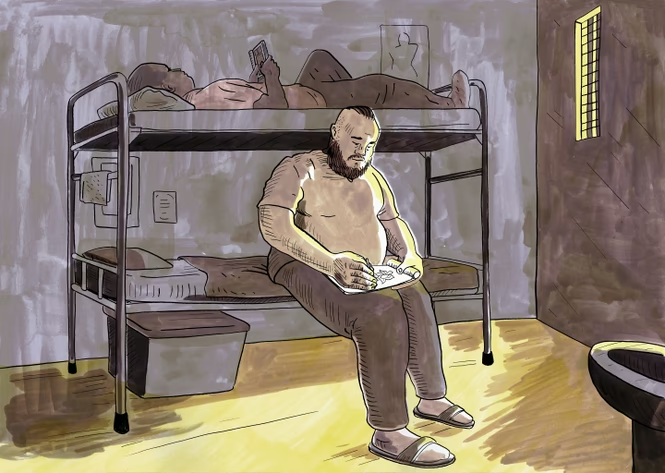
Sanchez is now prisoner No. 95099-511.
I spent weeks attempting to meet with him at a medium-security prison complex in Victorville, California. It is the same one that once housed John Walker Lindh, who was sentenced to 20 years after pleading guilty to aiding the Taliban. Despite Sanchez agreeing, the warden denied my request, under a broad provision in the regulations that “the interview would probably cause serious unrest or disturb the good order of the institution.” I asked whether I could come during normal visiting hours, or make other accommodations, but was denied without explanation.
Sanchez is allotted 15 minutes of phone time a day, so we began a series of truncated calls spanning three months. Some days the prison went on lockdown and I wouldn’t hear from him at our appointed time. Other days he could make several calls, but there had to be a gap of 30 minutes between each. In his section of the prison there were only six phones for more than 100 inmates, he told me, so he would get in line again and again. He was remarkably calm and measured, asking about my weekends at the start of a call and often ending with a cheery, “Blessings!”
He has been working in the library and offers book recommendations to other inmates, and noted that the prison collection includes George Orwell’s 1984. Interspersed among the romance novels, religious texts, and Westerns, he has checked out books that would not have been out of place in the box that he moved: Feminism, Film, and Fascism; The Handmaid’s Tale; and Animal Liberation. One day he noticed that The Week magazine featured an illustration of Trump with a voting box on fire—an image not too different from ones he used to create.
He has been drawing again, sticking mostly to animals and flowers—nothing political. He has been writing poetry that he reads over the phone with a delivery fitting of a slam session. Most of his fellow inmates, who have long sentences and a history of felonies, think he is strange, especially when he attempts to continue his vegan diet. “They see me coming in, and they’re like, What are you in for? And I’m like, Oh, books.” He chuckled a bit in disbelief. “It’s completely wild. Honestly, it seems surreal. If it wasn’t so cruel, it would be laughable and ridiculous,” he said. “But I’m in here.”
In our six hours of conversations, he seemed remarkably at peace. He professed no regrets about any of his actions over those few days last year, or not fleeing when he had a chance, or not taking the plea deals placed in front of him. He hasn’t lost hope that his appeal will succeed or a future president might issue a pardon. But he grew tearful at what it would be like to be released from prison—reunited with his family, vegan tacos, and his motorcycle—only to be deported to Mexico.
In prison, he tries to find small pleasures—waking up to the smell of rain, his morning cup of instant coffee. Sometimes the scene outside the brutalist-style facility reminds him of the movie Dune. He takes note of the pigeons and crows hoping for scraps near the cafeteria, and he relishes his brief moments outside and reading by the lamp in his cell. But each day, he tells me, when the steel door slams shut and there’s a loud click from a key turning the lock, time stops—and the heaviness of his situation hits anew.
The post 30 Years for Moving a Box appeared first on The Atlantic.