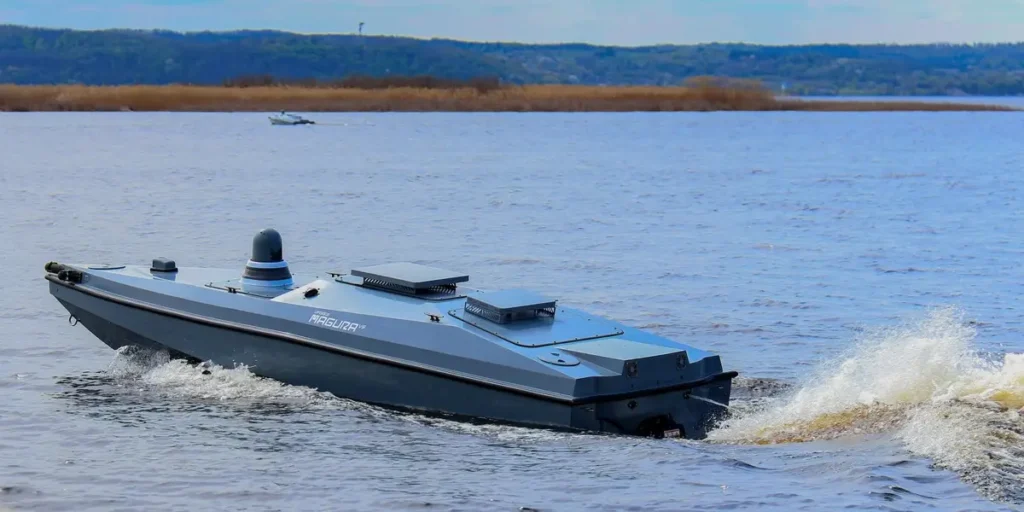
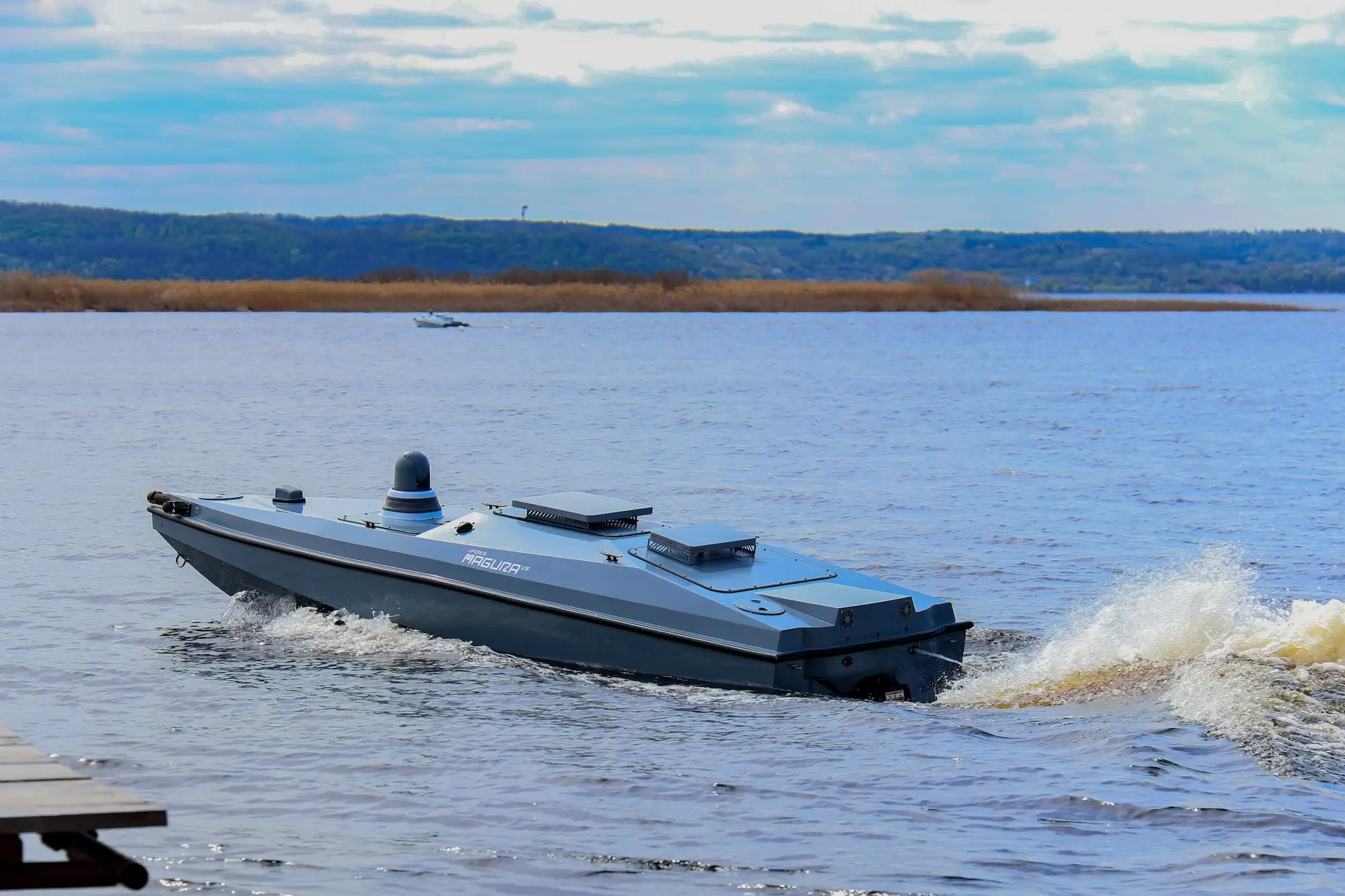
Ukrainian naval drones that have hammered Russia’s navy are now coming for Russian targets on land.
Magura drones made by Ukrainian-founded defense company UFORCE played an important role in Ukraine becoming a formidable force at sea even without a conventional fleet of warships.
Naval drones have damaged and destroyed numerous Russian vessels, pushing Moscow to move much of its Black Sea Fleet away from occupied Crimea.
Ukraine’s Main Intelligence Directorate, the GUR, revealed in August that it had used Maguras as FPV drone carriers to strike Russian targets on land, leveraging a control vehicle equipped with the “Podlyot” radar complex, which detects aircraft, missiles, and drones, and a Parol-4 IFF interrogator, used to distinguish between friendly and hostile aircraft.
The Maguras “pose a threat to the Russian occupiers on land as well,” the commander of the GUR’s “Group 13” said. “This marks a fundamental shift in the nature of the conflict,” said the commander, who uses the call sign “Thirteen.”
Oleg Rogynskyy, the founder and CEO of UFORCE, told Business Insider that he couldn’t comment on the operational specifics, but he said that “it’s not hard to imagine” a Magura launching something like the company’s heavy Nemesis drone, which could then fly inland to target Russian air defense systems.
The Russian air defense systems, he said, were built to take out missiles, not incoming heavy bomber drones flying low at night.
In other August wins, the GUR said that drones launched from Maguras destroyed a Russian Pantsir-S1 air defense system, and then later that month, they hit two S-400 launchers and a ground-based antenna used to control Orion drones. A month earlier, a naval drone used by the 123rd Territorial Defense Brigade dropped a ground robot off on the Kinburn Spit for an unusual combat mission.
And Ukraine is training for more operations like these. Rogynskyy said that Maguras were used in a September exercise to launch drones, drop off amphibious ground drones for a beach assault, and deliver supplies. He said he expects to see more creative uses as time goes on.
In March, Ukrainian President Volodymyr Zelenskyy spotlighted the growing capabilities of Ukraine’s naval drones in an address to the UK Parliament.
“We started with simple kamikaze sea drones. Then we built drones with turrets that can shoot down helicopters,” he said. “Now we have drones that can shoot down Russian fighter jets from the sea. We have developed boats that carry other drones. We also have boats that strike targets on land from the sea.”
The GUR said in October that after destroying ships in Russia’s Black Sea Fleet, “the Magura drone was significantly improved.” It explained that now “it is a multifunctional platform capable not only of sinking surface objects, but also of carrying missile weapons, as well as aerial drones for striking ground targets.”
Before they became drone carriers, Magura drones were armed with alternative weaponry for engaging non-naval targets. In 2024, for instance, one shot down a helicopter with a missile. Last year, the GUR said that Maguras had been used to shoot down Russian fighter jets.
Rogynskyy said some of these uses were a surprise to the company. “I didn’t expect it. It’s the ingenuity of Ukrainian engineers and Ukrainian soldiers that really drives this,” he said.
UFORCE, which also makes ground drones, AI software, and command-and-control systems, is one of Ukraine’s biggest defense companies. Founded in Ukraine and headquartered in London, with major hubs in Kyiv and Washington, DC, it has also attracted significant international interest.
The company’s Magura drones have been involved in multiple multinational military exercises. UFORCE has also developed a new MV7 model for UK waters and is partnering with RECONCRAFT, an American special-operations boat maker, though no new production runs, customers, or contracts have yet been announced.
UFORCE announced on Thursday that it raised $700 million in a Series A funding round from investors, including the UK government and Silicon Valley-based venture capital firms, bringing the company’s total valuation to $6 billion.
The company wants to scale its manufacturing both in Ukraine and in partner countries to strengthen their defense.
Talking about this round of investment, Rogynskyy told Business Insider that “it’s time to scale.” He said that the future of naval warfare “is all about fully unmanned navies and autonomous patrol presence, et cetera, as well as autonomous standoff.” In the near term, he said, many navies want a hybrid approach, coordinating operations between classic crewed assets and drones.
He predicted that “pretty much every navy on the planet is going to be scaling itself using cheap, attainable, unmanned assets that are AI-controlled.”
Read the original article on Business Insider
The post Ukraine’s naval drones made their name attacking Russian warships. Now they’re taking the fight onto land. appeared first on Business Insider.