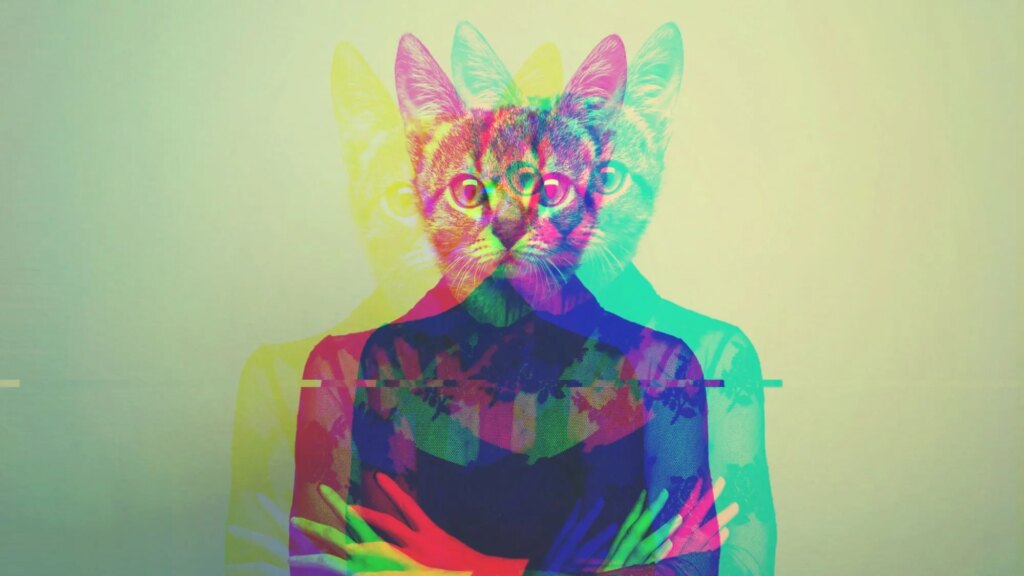
A 28-year-old guy named Karl had lifesaving brain surgery. The procedure left him with a surreal, unexpected trade-off: some humans he looked at post-surgery had catlike features, and some cats he looked at had humanlike features. According to a new case study published in the journal Cortex by researchers at Dartmouth College, Karl’s brain started applying Snapchat-style filters to real-life faces.
Doctors removed part of Karl’s right temporal lobe to fix a tangled mass of blood vessels that were threatening to cause a fatal brain bleed. Because that region handles facial recognition, the operation triggered a rare overlap of two neurological disorders: alinopsia and prosopometamorphopsia.
In plain English, his visual system gets specific features stuck in memory and pastes them onto whatever face he sees next. If his grey tabby cat, Luna, is the first creature Karl sees in the morning, the people he runs into later sport her enlarged pupils or cute tabby stripes. If he looks at a person first, Luna gets stuck with human eyes for hours at a time.
Man Undergoes Brain Surgery, Starts Seeing Human Faces on Cats and Cat Faces on People
It sounds like the kind of thing no one on earth has ever had to go through, and yet lead author Brad Duchaine notes that a similar case was published in the same scientific journal, Cortex, back in 1986.
That case report was about a stroke survivor who saw a poodle’s face transposed onto the head of fellow bus passengers. Rather than swapping out the entire face, Karl swapped only individual features, turning humans, for instance, into Cats cast members.
To see what Karl was seeing, Duchaine’s team used ChatGPT 5.5 to create pictures that Karl helped refine, as if he were describing a purse snatcher to a police sketch artist, and it’s hard to tell what’s more disturbing: whatever Karl was seeing, or AI’s version of it.
Duchaine says she’s heard from about 250 people who experience similar facial distortions, many of whom are being treated for psychiatric problems and are being put on antipsychotics even when the villain here is some scrambled neural wiring.
The post How a 28-Year-Old Developed a Rare Condition That Makes People Look Like Cats appeared first on VICE.