Simon Garfield is the author of “The Pen: A Human History,” from which this article is adapted.
“My fellow Americans,” President Lyndon B. Johnson began. “I am about to sign into law the Civil Rights Act of 1964.”
Johnson’s speech, broadcast on radio and television from the East Room in the White House, lasted about 10 minutes. “Let us close the springs of racial poison,” he said. “Let us pray for wise and understanding hearts.” Then the real business began — the signing and the pens.
A photograph of his desk shows his speech, the bill, two microphones, a glass inkwell, a round silver pot of pens and a large wooden tray with drilled slots for an additional 50 pens. The pens were part of a tradition: The president would use several pens to sign a new law, writing a section of his name — perhaps a letter, perhaps a dot or dash — with one and then switching to another. Everyone who had been vital to bringing the law to fruition would receive a pen as a souvenir.
The Civil Rights Act of 1964 was the product of multitudes, and many of them were among the packed audience in the East Room on July 2, 1964. Martin Luther King Jr. was there, and so were Attorney General Robert F. Kennedy, Sen. Hubert Humphrey (D-Minnesota) and other lawmakers and politicians involved in the act’s making. They all got pens.
As would be expected for an inscription that required more than 70 pens, it looks as if Johnson wrote it blindfolded. His handiwork, slightly smudged, reads: “Lyndon B. Johnson Approved July 2, 1964 Washington D.C.”
It took more than a quarter of an hour to write these three lines.
The story of presidential writing instruments must, of course, begin with the signing of the Declaration of Independence on July 4, 1776, by John Hancock, president of the Congress. Hancock’s large, looping signature was a defiant show of supremacy. His name became a stand-in for “autograph.”
After his election in 1860, President Abraham Lincoln was given a trimmed eagle feather by an admirer who had learned that his Democratic predecessor, James Buchanan, had used one to write his inaugural speech. Lincoln followed suit, addressing a divided nation with an appeal to “the better angels of our nature.”
In 1921, Lincoln’s quill was stolen from an exhibition hosted by the Chicago Historical Society, and it has never been recovered. A lesser pen made from goose feather was removed from his desk in the White House on the night he died and is preserved at his Presidential Library and Museum in Springfield, Illinois.
In August 1916, Stephen Mather, soon to be the first director of the National Park Service, was sent the dip pen that President Woodrow Wilson used to sign the legislation that enshrined official protection for national parks. The pen Wilson used to sign the United States’ entry into World War I about eight months later — a dip pen with a marble handle — is displayed with some pomp atop an Inuit walrus tusk at the Woodrow Wilson House in Washington. A cartoon published a month before that signing shows Wilson on a tightrope over a shark-infested Atlantic, using a large quill pen as his balancing tool.
Some quills were used multiple times for different pieces of legislation over the course of many years and several presidents. In 1891, an eagle feather signaled President Benjamin Harrison’s approval of the International Copyright Act, and the same quill was used by President William Howard Taft in 1911 to agree to the construction of the Lincoln Memorial. Wilson then used the historic implement to sign the 1916 congressional charter for the American Academy of Arts and Letters, where the pen was archived, only to be called out of retirement in December 1921, when President Warren G. Harding confirmed U.S. participation in the Four-Power Treaty, which determined the peace and ownership of dominions in the Pacific.
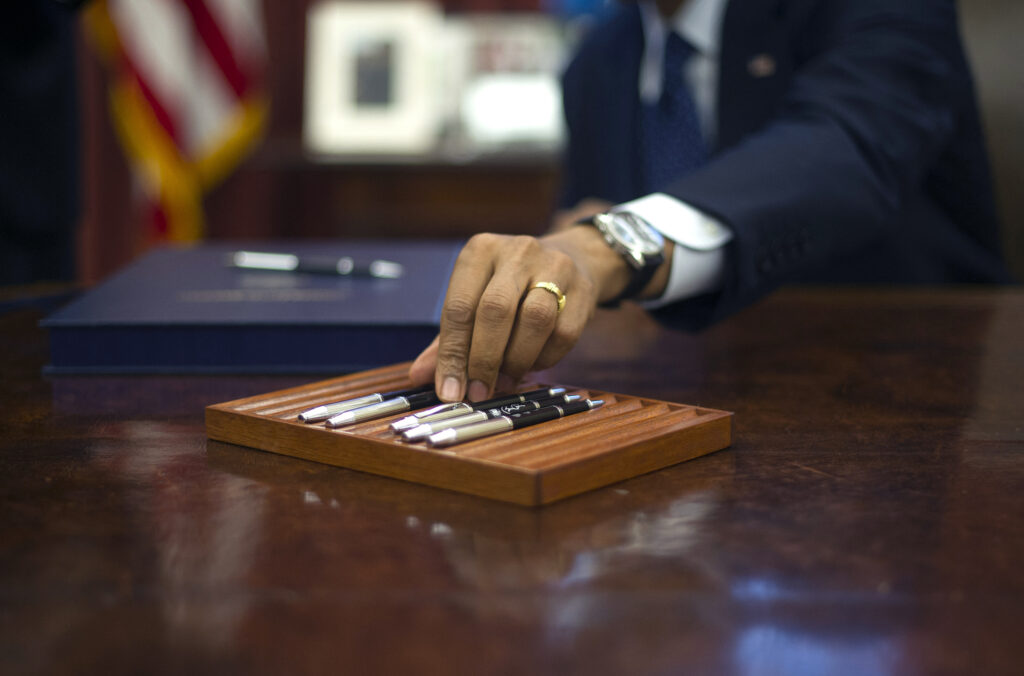
The multi-pen ceremony may have begun with Harry S. Truman or Franklin D. Roosevelt, and it became a regular tradition in the early 1960s. Perhaps, with John F. Kennedy in the White House, it signified a new level of presidential celebrity. By the time Barack Obama became president, the signing pens had long since changed to ballpoints. Obama used multiple pens in January 2009 to secure his first piece of legislation, the Lilly Ledbetter Fair Pay Act, which changed the time limit within which an equal pay lawsuit could be filed. He called it “a nice tradition, though it made my signature look like it had been written by a 10-year-old.”
To sign the Affordable Care Act in 2010, Obama used a shiny black-lacquer, wide-bodied Cross Townsend. A.T. Cross had been supplying presidential pens since the Reagan era. Cross pens looked the part: sober with subtle accents, expensive but not exorbitantly so. And they were made by a company established in Providence, Rhode Island, in 1846.
In January 2017, Donald Trump also used a Cross pen. But the following year the mood changed. “I was signing documents with a very expensive pen, and it didn’t write well,” Trump said in a November 2018 documentary. “It was a horrible pen, and it was extremely expensive.” His replacement was significant. “I started using just a Sharpie, and I said to myself, ‘Well, wait a minute, this writes much better, and this cost almost nothing.’”
Not that the regulation models would do. Trump disapproved of the color of the Sharpie, a watery grey. “So, I called up the folks at Sharpie and I said, ‘Do me a favor, can you make the pen in black? Can you make it look rich?’”
The folks at Sharpie made it rich by stamping Trump’s signature on the side of each pen in gold ink. Similar Sharpies appeared on the Trump merchandise site. Trump has used the pens not just to sign executive orders and photographs for fans, but also to make notes for speeches. This made his comments clearer to read, both to their author and to cameras.
Early in his second term, Donald Trump accused Joe Biden of frequently using an autopen to sign executive orders, something Trump later admitted to doing himself. Indeed, the tradition is a storied one. In 2004, Defense Secretary Donald Rumsfeld received criticism for using an autopen to sign condolence letters to some families who had lost relatives in the Iraq War. A primitive version of the autopen goes back as far as Thomas Jefferson.
In its defense, the autopen is not Docusign, the computer program that generates an electronic signature that usually bears no resemblance at all to that of the signee (the company claims more than one billion successfully fulfilled transactions). At least autopen still uses a real inked pen, even if it is operated by a robot.
On Jan. 21, 2025, at the start of Trump’s second term, Trump’s choice of pen wasn’t an issue. Eight Sharpies on a wooden tray awaited his first batch of executive orders, and his supporters cheered as he signed each one inside Washington’s Capital One Arena.
Trump’s signings did not follow tradition. He signed seven documents with the same pen. And once he finished, he didn’t offer them to colleagues who had shaped the legislation. Instead, he set one aside, stood up from the desk, gathered the seven remaining Sharpies and tossed them into the crowd one by one.
The post What a president’s pen — and Trump’s Sharpie — can tell you appeared first on Washington Post.