The 10 winners of The New York Times/New York Public Library Best Illustrated Children’s Books Award are chosen each year by a rotating panel of three expert judges. On the 2026 panel were the artist, illustrator and children’s author Edel Rodriguez, the children’s author Julie Fogliano and the children’s librarian Kelly-Ann Smith. Children’s book publishers were invited to submit up to 10 picture books published this year in the United States. We received nearly 800 books, and the judges made their selections purely on the basis of artistic merit.
While We’re Here
written by Anne Wynter; illustrated by Micha Archer
Anyone with small children in their life can relate to the frantic race to get out the door. There is always somewhere to be and some obstacle that hinders you from being there on time, or at all. In “While We’re Here,” a mother and daughter “hurry, hurry” to get to a birthday party in the park — only to find out it happened the day before. To defuse the disappointment, the mother treats the daughter to a leisurely wander, during which the little girl learns that simple, unplanned things, like stumbling upon a duck pond or rolling down a hill, are often the best things. Archer’s cut-paper collage illustrations match the tempo of the story in the way a musical score relates to the action of a film. The more fast-paced “hurry, hurry” pages are full of colors, patterns and textures whose energy mirrors the characters’ hustle and bustle. Once the pair realize they’ve missed the party, the illustrations zoom in on just the two of them, creating a quiet intimacy. Then, as the mother encourages the daughter to relax and enjoy the park “while we’re here,” the illustrations open up into expansive double-page spreads of vibrant blues and greens that are inviting, serene and meant to be savored. — Julie Fogliano
Duel
written and illustrated by Shawn Harris
An inventive take on Rorschach inkblots — or butterfly paintings, as they call them in kindergarten — “Duel,” rendered in tempera and acrylic, expands the possibilities of what a picture book can be. The colors on these pages — yellows, pinks, blues, greens and reds — flow, dance and sway. With a different perspective depicted on each double-page spread, the images never become predictable. The compositions, set across long horizontal spaces, are dynamic, clever and bold. All this beauty is at the service of a taut and fun story about two rival queens fighting over control of one hill. Harris is an artist who clearly enjoys working with his materials. I hope “Duel” will inspire young readers to give his latest technique a try. — Edel Rodriguez
Ahab and the White Whale
written and illustrated by Manuel Marsol; translated by Chloe Garcia Roberts
These illustrations revel in the joy of paint. Gooey and impastoed areas rub up against gentle, watery, more colorful areas. Random marks carved into the paint share space with collaged paper and inked lines. Shades of blue, white, red and brown coexist in harmony. The entire book is a lesson in how expressive mark-making can be used to tell a unique story — in this case “Moby-Dick” from the viewpoint of Ahab. The characters, too, stand out for their eccentricity and raw power. It’s exciting to see gallery-level painting in the pages of a children’s picture book. Marsol has created a memorable world; we all want to dive in. — E.R.
Mariposa’s Journey
written by Belen Medina; illustrated by Juana Martinez-Neal
Here the story of a young girl seeking sanctuary is elegantly intertwined with the migration of monarch butterflies. Done in acrylic paint, pastels and colored pencils, Martinez-Neal’s soft, detailed artwork movingly chronicles their trek across mountains and rivers, through wind and rain. Against a saffron background infused with brownish hues, a vibrant orange visually connects the traveling butterflies and the coat Mariposa wears. As the girl and her mother endure challenges, the butterflies offer comfort through their shared experience. Finally, as they all approach their destination and Mariposa reflects on her journey to a safer home, the color palette shifts to include shades of blue, signaling resilience and transformation. — Kelly-Ann Smith
Night Ride
written and illustrated by Christopher Myers
This striking and mesmerizing wordless picture book follows a group of young friends as they navigate New York on bicycles after sunset, encountering iconic landmarks brilliantly brought to life by Myers’s stained-glass artwork. Each double-page spread immerses us in the riders’ experience and the lively communities through which they pass (training a spotlight on everything from parks and bridges to neighborhood bodegas). The bright colors used for the people and the sights of the city stand out against the dark colors of the night. — K.S.
Bored
written and illustrated by Felicita Sala
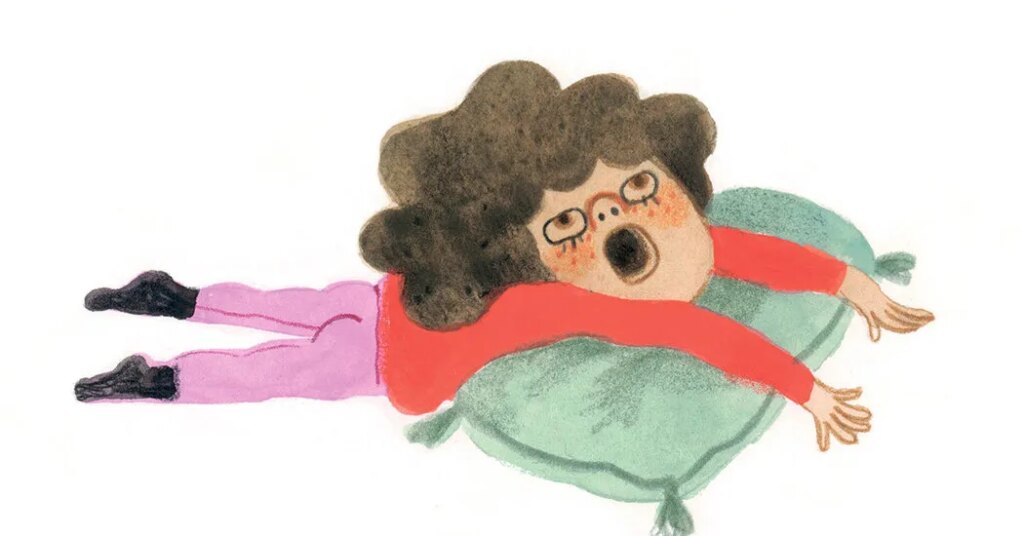
On this book’s second double-page spread, we find a comically despondent Rita flopped over the side of a chair, staring blankly into space. Never have I seen a more accurate depiction of the melodramatic misery of a bored child. (I wouldn’t be surprised if someone told me Sala’s paintbrush was infused with leftover “boredom gas,” as the narrator calls it, from her own childhood.) In an effort to relieve her boredom, Rita swings her arms around “like fans,” stomps, stretches and sings until she’s worn out and draped across a mountain of pillows. It is here that her “fuzzy rock” of a brain floats her out of her boring room and off to a special “non-boring place just for bored people,” where she becomes quite busy exploring the contents of her own imagination. Sala’s respect for Rita’s feelings really shines here. She leaves her plenty of space to work through her boredom without intervention or heavy-handedness. And her ability to capture the physicality of boredom, in all its droopy, slumping absurdity, is nothing short of extraordinary. “Bored” is a hysterically genuine (and genuinely hysterical) ode to one of childhood’s greatest adversaries. — J.F.
Goldfinches
written by Mary Oliver; illustrated by Melissa Sweet
In my school, poetry was presented as something that needed to be explained, examined, picked apart and inspected: for meaning, for rhythm, for rhyme, for literary devices. So much so that we were forced to leapfrog right over the experience of the poem in search of some other kind of understanding. Clearly, Sweet did not teach at my school. In “Goldfinches,” her art celebrates nature with the same joy and wonder that Oliver brought to her poem of the same name. Sweet’s dynamic mixed-media collage, watercolors and pencil drawings, combined with a breathtakingly vivid palette, create the thoughtful detail of a bird-watcher’s field journal, the solitude and contemplation of a country walk, and the wild magic of the natural world. By allowing the reader to step outside the confines of “poetry” and into the poem itself, Sweet lets the true depth and breadth of Oliver’s words radiate. At the end of “Goldfinches,” Oliver asks, “Have you ever been so happy in your life?” I’m fairly certain that had she been given the opportunity to hold this exquisite book in her hands, Oliver would have answered Yes. — J.F.
Kiki & Me
written and illustrated by Leo Timmers; translated by David Colmer
Told from the horse’s point of view, “Kiki & Me” is a heartwarming story about the deep connection between a young girl named Kiki and her equine companion as they navigate changes — forming new relationships that push their own to evolve in surprisingly powerful ways. Timmers alternates between colorfully painted, wordless double-page spreads, which show the pair traversing stunning landscapes together, and black-and-white pen-and-ink artwork in a fun comic-strip style, which highlights the expressiveness of our horse narrator and the smaller moments that have shaped their lasting bond. — K.S.
Between
written and illustrated by Anna Walker
This is a resplendent book. Created with spray paint and pencil, in only two colors, the illustrations exude a subtle, inviting glow. The compositions are immaculate and evocative. The setting is a garden at night, inhabited by a moth and a cricket. The characters hide, seek, hop and fly, eventually finding each other in the mist. Walker’s delicate touches of additional paint — dots, splatters and highlights — bring readers deep into a world so enchanting they may never want to leave. — E.R.
The Heart of Our Home
written and illustrated by Janelle Washington
Centered on a family’s wooden kitchen table, “The Heart of Our Home” honors shared traditions and everyday moments. Through layered collages and intricate cut-paper artwork, Washington captures intimate gatherings and routine rituals. Each page is filled with realistic details related to ordinary, heartfelt activities such as hair-braiding, fish preparation and the lighting of candles to celebrate Kwanzaa. When they pick up this book, readers will immediately feel the love and comfort that Washington’s illustrations so palpably evoke. — K.S.
The post The 2026 New York Times/New York Public Library Best Illustrated Children’s Books appeared first on New York Times.