An unassuming object serves as the tantalizing touchstone for a new exhibition at the National Gallery of Art featuring images by and of African Americans from early in the history of photography. Barely the size of a Post-it note, the circa-1860 studio portrait shows a young Black woman wearing an elegant dress and fingerless lace gloves. Hand-tinted — which would have cost the customer extra — the black-and-white tintype is framed with an ornate-looking brass mat in a foldout case lined with embossed red velvet.
The woman’s name and hometown are unknown, as is the identity of the photographer. The only clue is a slip of paper that lends the show its title, with “Remember me” written on one side and “Annie” on the other. Is Annie the woman pictured or the person to whom the memento may have been given? Whatever the circumstance, the portrait conveys an air of poise and self-assurance, captured with what was then a relatively new technology. Preserved in excellent condition, it must have been treasured by whomever possessed it.
The notion of representation percolates throughout “Remember Me: Picturing African Americans in Early Photography,” a show that explores how Black Americans embraced this novel art form to shape identity over nearly a century, going back to the dawn of the medium. But the picture is complicated: The history of those who were photographed is often missing or fragmentary, and Black photographers’ own images of African Americans were often lost.
The photographs are on view at the National Gallery for the first time since the museum acquired them in 2023 from Ross J. Kelbaugh, a now-retired Baltimore public schoolteacher who spent five decades collecting images documenting African Americans. A number of them have a connection to Baltimore or the D.C. area. (An interactive screen helpfully explains early photographic processes, including the daguerreotype, made on a silver-coated copper plate; the less-expensive ambrotype, made on a glass plate; and the even cheaper tintype, made on metal.)
“Remember Me” profiles three prominent Black photographers who set up daguerreotype studios in the 1840s in northern states: Augustus Washington in Hartford, Connecticut; James Presley Ball in Cincinnati; and Glenalvin Goodridge in York, Pennsylvania. All were successful entrepreneurs who, unlike many other daguerreotypists at the time, imprinted their names on their work.
All three had Black and White customers (Washington’s clients included abolitionist John Brown), but their surviving work is mainly of White subjects, including most of their photos on display. The exception are two portraits that Washington took after he emigrated to Liberia in 1853, seeking a better future, of fellow U.S.-born Liberians.
The exhibition’s largest section, focusing on Black people before, during and just after the Civil War and generally portrayed by White photographers, is perhaps its most surprising. It also raises the most unanswered questions.
A half-dozen daguerreotypes and ambrotypes are mostly of Black women (but also a Black man) pictured with White children who were under their care. A daguerreotype estimated to date to 1848 — the earliest on view — depicts Martha Ann “Patty” Atavis, who looks directly at the camera with a steely, resolute gaze as she holds on her lap Anna Whitridge, the child of her enslaver, a Baltimore doctor. Portraits such as these were sometimes commissioned by enslavers to project a favorable image of slavery in which Black caregivers were treated like members of the family, according to curator Diane Waggoner.
Most of the Black adults and the White children in these pictures are unidentified, and it’s not clear whether the African Americans were enslaved, like Atavis, or worked for White families as paid caregivers.
Another grouping includes five photographs of smartly dressed Black men whose identities and stories are likewise lost to history. According to Waggoner, fancy attire did not necessarily indicate a free status, because enslaved people sometimes saved up to have their portraits taken or their enslaver might have commissioned a piece.
Black people were also photographed during the Civil War, seen in a pair of poignant albumen prints, also known as cartes-de-visite, of a drummer boy thought to possibly be 14-year-old Hamilton Taylor, who served in an infantry regiment of the U.S. Colored Troops. A hand-colorized albumen print of a Black chaplain and soldiers recuperating from injuries at L’Ouverture Hospital in Alexandria, dating to roughly 1864, is rare in that all 12 men’s names were recorded.
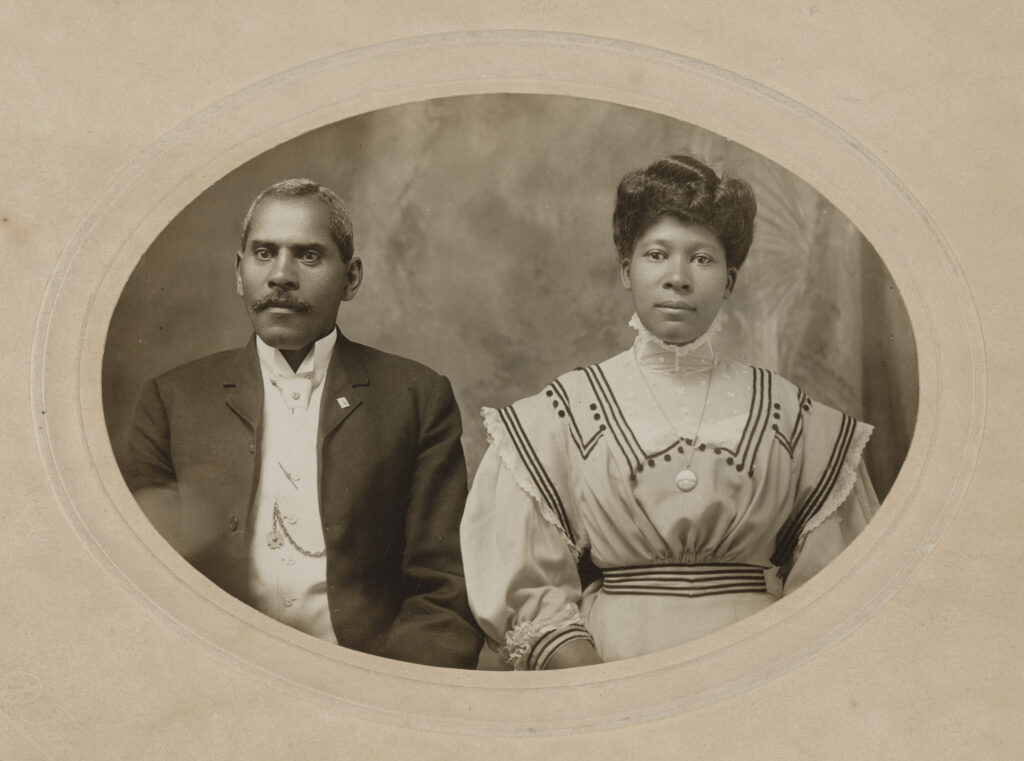
The last section of “Remember Me” highlights early-20th-century Black artists who primarily served their own communities, capturing likenesses and everyday scenes. Images from turn-of-the-century D.C. include one of a stylishly dressed unnamed couple taken in about 1899 by Daniel Freeman, one of the city’s first Black photographers, and of Navy employee Matthew Taylor, his family and dog on the steps of their well-appointed Anacostia home in 1907.
From later decades are works from the portfolio of prolific Harlem photographer James Van Der Zee — among them a full-length portrait of a fashionable Jazz Age couple in 1924 and a resplendent picture of a bride from 1930, all unidentified — and by Addison Scurlock, who founded a studio in 1911 that became a fixture in the Black community on U Street in D.C.
While these more recent gelatin silver prints, produced from negatives, aren’t as rare — or as rarely seen — as the older works, they are powerful expressions of identity and individuality. As elsewhere in “Remember Me,” even if many stories remain shrouded in mystery, the images’ mere survival attests to photography’s importance in representing African Americans.
Remember Me: Picturing African Americans in Early Photography Through March 14 at the National Gallery of Art, West Building. nga.gov.
The post Names are lost, but faces endure, in show of early photos of Black Americans appeared first on Washington Post.