Six months on, Ebola continues to hack a deadly trail across eastern Democratic Republic of Congo.
When the outbreak was first detected in May, it resembled a single, giant blaze, with infections concentrated in a handful of towns in one province.
It has since morphed into a far bigger, more elusive foe, creeping into eight provinces and splintering into numerous hot spots as its moves through one of the world’s great rainforests.
Instead of one big fire, there are many now, scattered across a vast area about the size of Britain.
Health workers have corralled the virus where it was first detected, but infections are soaring elsewhere. Biakato, a small town deep in the rainforest, suddenly accounted for as many as one-quarter of new cases nationally. Yet its beleaguered residents were left almost entirely on their own, with dangerously little to defend themselves against the fastest-growing Ebola outbreak in history.
“We see the same mistakes as before,” said Dr. Jean-Jacques Muyembe, who helped discover Ebola in 1976 and now heads Congo’s National Institute for Biomedical Research. “It’s as if we were starting from zero. It’s very disappointing.”
And if that were not enough, the campaign to contain the epidemic has run into a terrifying new threat: the Islamic State.
Ebola was already swamping Biakato when I got to the town in mid-October with the photographer Daniel Berehulak. Exhausted health workers reported 300 cases in the span of a month, up from 20 the month before.
But there were only two doctors, they hadn’t been paid in months, and they felt utterly abandoned. The aid workers who would normally pour in and set up an Ebola treatment center were being scared off by rebel fighters who have been terrorizing the region for years.
Their fears were tragically realized in recent days when the rebels, who are affiliated with the Islamic State, killed 106 people in a series of attacks across the region, U.N. officials said. One of the deadliest episodes occurred 25 miles south of Biakato, where militants torched homes, shops and health facilities, forcing Ebola patients to flee their beds. Thousands of residents also fled in an exodus likely to further spread the disease.
Even by the standards of eastern Congo, where conflict has raged for three decades, the fighters — from a group called the Allied Democratic Forces, or A.D.F. — are considered especially brutal. They roam the sprawling forests, periodically springing from their hiding places to mount attacks. Civilians are beheaded, mutilated and abducted. Children are forced to fight with the group. Mass killings have taken place at funerals and churches.
In 2019, the group pledged allegiance to the Islamic State, and by one recent estimate, it is the world’s second-deadliest group for civilians. Now, its terror tactics are hobbling the fight against Ebola.
A tentative effort to rescue Biakato is underway. Aid groups are using helicopters to fly over the perilous forests and have begun to build a treatment center. Even so, the local volunteers battling to hold back the tide of infections say they are in an impossible bind.
“We’ve got the A.D.F. on one side, and Ebola on the other,” said Jean-Lefranc Sakara, head of a Red Cross team that collects the Ebola dead from their houses. “We are well and truly caught in the middle.”
Daniel and I reached Biakato after a jolting two-hour ride through the rainforest. A wall of trees rose on either side, interrupted in places by ghost villages, their deserted buildings barely visible behind grass and weeds.
The fighters started preying on this forested corridor five years ago, ambushing passing traffic and raiding settlements. Most residents have since fled.
“It wasn’t safe for children any more,” said a man who suddenly emerged from the bushes, “so everyone moved to Biakato.” He hurried away, vanishing into the tall grass.
This muddy track, running 85 miles through the rainforest, has become the central artery of the outbreak. Cases are soaring in the towns of Beni and Mambasa, at either end of the road. Halfway along it lies Biakato.
Since May, more than 5,000 people have died in this outbreak, and experts fear it is growing so fast that it may surpass the devastating West Africa epidemic of 2014 to 2016, the largest on record, which killed more than 11,000. As recently as September, experts thought they were getting a handle on this one, but in recent weeks the transmission rate has risen again, according to official figures obtained by The New York Times, meaning it is still out of control.
Here in the district traversed by the Beni-Mambasa corridor, the transmission rate is double the average, suggesting that Ebola is spreading largely unchecked, experts say.
As we pressed on, Biakato came into view, its tin roofs sparkling amid the sea of green. On the edge of town, municipal workers guided us through a hand-washing station. In the center, motorbikes roared as people flowed into small shops and gold counters. Farmers dried cacao beans on giant mats, their lucrative crop used to make chocolate.
At the town hospital, chaos reigned. Families clustered by the gate, some wailing, as the bagged bodies of Ebola victims were carried out. An isolation area had been set up inside a pediatric ward. Patients sat listlessly on the steps outside, some visibly weak, separated from a bustling public section by a flimsy strip of orange fencing that did almost nothing to contain the disease.
Ebola patients and their relatives gathered by the fence, chatting at close quarters. One patient shared a bottle of juice with a visitor, passing it back and forth, risking transmission through infected saliva. Conditions were so bad that 75 percent of Ebola patients had died, the town’s records showed.
Espérance Kombi, a mother of seven, had been in the ward for two weeks. She looked stronger than most patients, but was traumatized by the deaths and suffering she had witnessed.
“I need a second heart to endure what I’ve seen in there,” she said, pointing to the ward door. “This one is not enough,” she added, tapping her chest.
Until recently, violence was the most pressing concern in Biakato. In May, fighters with the Islamic State affiliate stormed into the town, killing 21 people. Soldiers from nearby Uganda began patrolling the streets, under an agreement with the Congolese government, to ward off attacks.
But the upheaval continues just outside town. It got so dangerous recently that a group of hunter-gatherers from the forest, whose ancestors had lived there for centuries, took shelter beside the town’s Catholic church.
Alice Gloria, 18, sat on a stoop, still dazed by her ordeal. In September, fighters snatched her and her family from their farm. For four nights, she was marched through the forest, her 1-year-old baby in her arms.
At night, the fighters raped her repeatedly, she said in a whisper. “The older men did it.”
Ms. Gloria escaped on the fifth day, as the fighters attacked another farm. She walked for three days, carrying her daughter, until they reached Biakato. But her husband, Augustin, couldn’t escape with them. He was back in the forest, his fate unknown. “Still no news,” she said.
At first, it seemed that Ebola might bypass Biakato, said Job Bakwata, the town’s chief medical officer. The first recorded case was a gold miner who returned from the town of Mongbwalu in June, then died. But in the months that followed, as the virus ravaged other areas, Biakato had only a dribble of cases: one more in June, 14 in July, 20 in August.
Then in mid-September, infections surged, overwhelming the battered town.
Mr. Sakara, the Red Cross volunteer, threw himself into the response. A onetime seminarian, he had moved to Biakato four years earlier in search of safety. The rebels had attacked his home in the mountains of North Kivu, killing a sister and three brothers. “My grandfather told me to get out,” he said. “We came here to start over.”
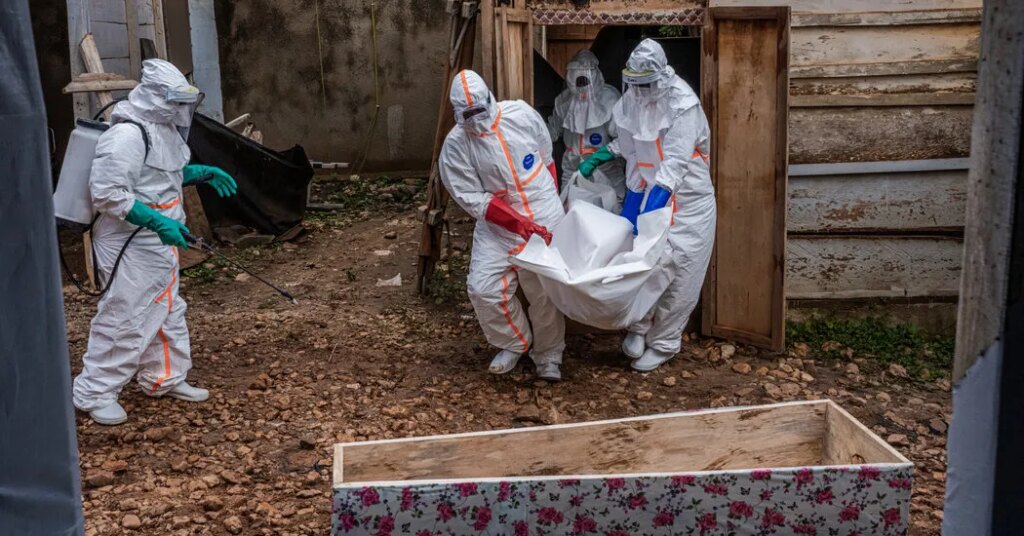
After Ebola hit, he dropped everything to lead a small team that collects and disinfects the bodies of Ebola victims. Working that close to the virus was daunting, he said. The volunteers had protective suits but little training, and he felt terrified in the homes of Ebola victims who had just died, mopping up their infected blood or dragging their contaminated mattresses outside.
His team also faced hostility from the very people they are trying to save. Mourners hurled stones as they tried to bury the dead, showering them with insults and accusing them of somehow profiting from the outbreak. “They call it ‘Ebola business,’” he said.
That hostility was a disaster for the effort to stop the virus from spreading further. Ebola victims are at their most contagious after they die, which can turn unmanaged funerals into superspreader events.
Over the previous week, four members of his 12-person team had quit, fearing for their lives, he said. Nobody had stepped forward to replace them. “You cannot imagine what we are going through,” he said.
Rebels and many residents have one thing in common: Both groups were drawn to Biakato by cacao and gold. In a forest clearing outside town, Ismail Mbafumoja plucked a colorful pod from a branch, split it open and scooped out a brown seed coated in white pulp. “Cacao,” he said.
Until recently, his biggest worry was guarding his crop against Islamic State fighters and Congolese soldiers, both of whom he considered a threat. But now he had little time to farm at all because of all the funerals for Ebola’s victims. “I can’t count how many I’ve been to,” he said.
The farmer paused outside a neighbor’s house. Nobody was home, he said, because a child who lived here had just died. “Ebola,” he said.
The care Biakato’s patients so urgently needed could be found just 40 miles away, in Beni.
A treatment center run by Doctors Without Borders offered the gold standard in Ebola care. Doctors in white suits worked in tented wards. Strict safety protocols were observed. There were over 200 staff members, about six per patient. The center even had psychologists to manage patient trauma.
“We’ve learned a lot from previous outbreaks,” said Sam Arnold, the facility’s deputy head.
There was nothing of the sort in Biakato, despite the surging cases. In 2013, four Doctors Without Borders workers were abducted in an A.D.F. raid on a village in North Kivu Province. One escaped after 13 months; the other three have never been found.
The World Health Organization, which is leading the effort to get help to Biakato, has its own painful history in the town. During the last outbreak in this area, in 2019, armed men attacked its guesthouse in Biakato, killing three Ebola responders. Officials blamed the violence on the Mai-Mai, a term for local militias.
That leaves health officials walking a tightrope. Proceed too slowly, and Biakato could become a deep reservoir of Ebola, spreading infection across the region. Move too quickly, and they risk an attack, like a killing or a kidnapping of aid workers, that could collapse the entire effort.
Mistrust among local residents is also a problem. After decades of war, and numerous failed military operations, faith in the government has collapsed, officials said. The same Congolese soldiers who are supposed to protect the community also prey on it, seeking bribes or profiting from gold. When Ebola came along, locals saw the disease as yet another plot to suppress them.
“They don’t trust outsiders,” said Julien Harneis, the United Nations Ebola coordinator in Congo. “Experience has taught them not to.”
As infections began to rise in September, a W.H.O. team returned to Biakato to see how they might help. The omens were ominous, at first. The health workers woke one morning to find a headless sheep dumped outside their hotel — a sign they were not welcome, said Dr. Steve Ahuka, the head of Congo’s Ebola response.
But within weeks, Ebola had become so overwhelming that Biakato’s distrustful leaders were pleading for help.
On Oct. 12, Dr. Ahuka and Catherine Smallwood, a senior W.H.O. official, returned to Biakato to a very different reception. Local leaders formed a circle around Ms. Smallwood and, after apologizing for the 2019 killings, implored her to send help.
“They asked me to put the past in the past,” she recalled. “It was an extremely touching moment.”
Since then, the W.H.O. has deployed officials and revamped the chaotic health center. The Congolese government set up a lab to test patients. Medair, a Swiss aid organization, has sent medics.
And yet, even that may not be enough.
To stamp out the virus, health workers need to trace every known contact of an infected person. That kind of investigative work is impossible in the countryside while the A.D.F. still threatens it.
Dr. Muyembe, the Ebola expert, urged his government to consider what was once unthinkable: reaching out to the Islamic State.
“You absolutely have to find a way to get in touch with these people,” he said. “You have to tell them, ‘This is a risk you face, too.’”
Such an approach, even if exploratory, would be difficult, he admitted. Congo’s government officially refuses to negotiate with the A.D.F., a group the United States has designated as a terrorist organization.
“But we have to do it,” Dr. Muyembe urged.
Otherwise, he said, Ebola “will be impossible to contain.”
On the verge of collapse, Moïse Kalindera, 27, struggled up the steps of the Ebola ward, assisted by a medical worker in a white suit.
For weeks, relatives had been ferrying him from one clinic to another, in an increasingly frantic search for a cure. When he tested positive for Ebola, they refused to believe it.
“We think he has been poisoned,” his sister, Consolée, said as she watched him shuffle through the ward doors.
Mr. Kalindera was placed in a small room with another young man who offered hope of a way out.
Germain Kanyungu, a 31-year-old farmhand, had no illusions about Ebola. After fighting the virus for weeks, he was finally recovering and had just tested negative. One more result like that and he would be free.
He couldn’t wait. “Once I get out of here,” he said, “I’m never coming back to Biakato.”
That night, the two young men got to talking in the lonely Ebola ward, Mr. Kanyungu later recounted. They shared jokes and laughed. Mr. Kanyungu helped his roommate eat and comforted him when he confided his fears of dying.
The next day, Consolée and a brother came to visit. But neither wore any protection, and the brother emptied Mr. Kalindera’s urine bucket with his bare hands — a risk that Mr. Kanyungu found utterly reckless.
That night, Mr. Kalindera deteriorated sharply. He vomited, suffered diarrhea and begged for water. A nurse tried to insert an IV line, but failed to find a vein. Soon after, he died quietly in his sleep.
Nobody came to collect the body, leaving Mr. Kanyungu to spend the night alongside his dead companion, unable to sleep.
“I don’t want to go back inside,” he said the next morning, sitting outside in the sun. “I’ve seen too many people die.”
A truck arrived to carry Mr. Kalindera’s flower-print coffin to a forest clearing, a few miles outside town, where Ebola victims were being buried.
Over 100 freshly dug graves were squeezed amid a cluster of towering palm trees whose fronds formed a vaulted canopy over the impromptu cemetery. Plain wooden crosses bore no names. Gravediggers leaned on shovels, some swigging from beer bottles. The smell of hashish wafted through the air.
Mr. Sakara’s Red Cross volunteers maneuvered the coffin toward an open pit, struggling to keep their balance in the narrow spaces between graves. One slipped, causing the coffin to lurch, then fall into the grave with a thud. Onlookers grimaced or cried out in shock.
With no priest and no prayers, the gravediggers quickly scooped the rich, loamy earth into the grave. Wailing filled the air. One woman fell to the ground as soil hit Mr. Kalindera’s coffin. “Oh, Moïse!” she cried.
Consolée was absent — family members had forced her into isolation, fearing her visit to the ward might have infected her.
Yards away, another group began digging the next grave. A third group arrived, bearing a coffin for burial.
One mourner turned toward us.
“This is the fault of the white people,” she said loudly. “You brought Ebola here.”
Jeering erupted, led by the gravediggers.
“You killed him! I hope you are happy!”
“Let’s attack them!”
Two men beside us debated whether we were really journalists. Another walked up, holding out a hoe. “Take it, white man,” he said to me. “Help us dig.”
One of the gravediggers waved a toy wooden rifle, then pointed it at me.
As we slipped away, handfuls of soil fell on our heads, thrown from the direction of Mr. Kalindera’s grave.
The next day, Mr. Kanyungu left the Ebola ward, removing his white face mask to reveal a broad smile.
His second test had come back negative.
He was going home.
The post Caught Between Killers: Ebola on One Side, Islamic State on the Other appeared first on New York Times.