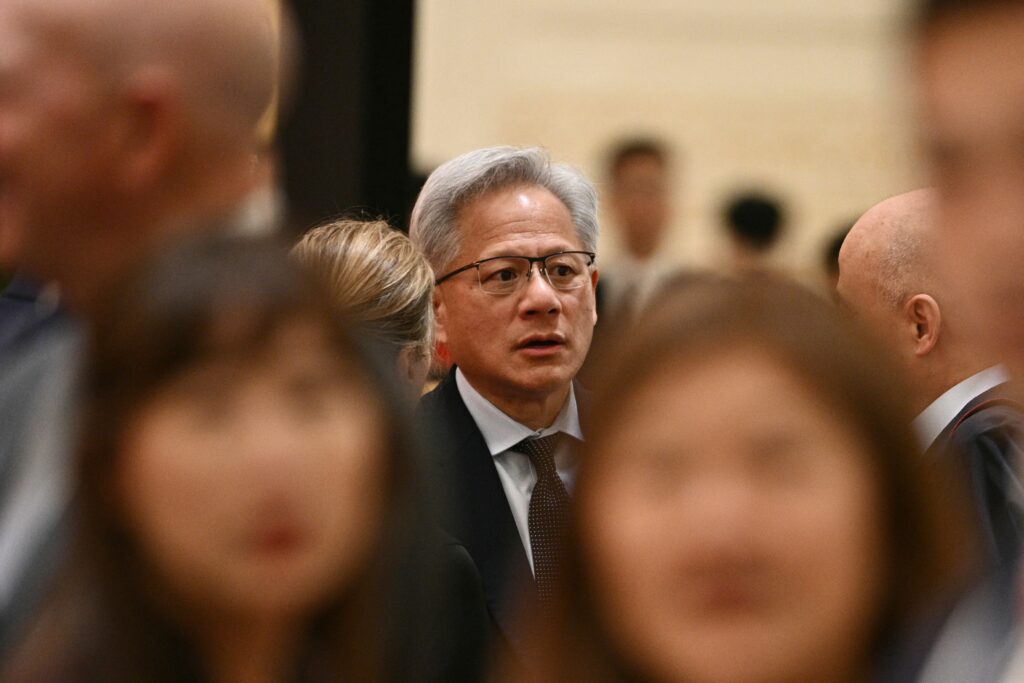
As Nvidia chief executive Jensen Huang gained extraordinary access to President Donald Trump and secured his blessing to sell artificial intelligence chips to China, he fueled a backlash among Washington officials and national security hawks who wanted to keep the powerful technology out of Beijing’s hands.
Some national security officials within the Trump administration chafed at Huang’s influence over the president, according to two former officials.
Huang’s downfall, which has the potential to mark a dramatic shift in power, was ultimately set in motion by one of the capital’s most influential China hard-liners, national security adviser and Secretary of State Marco Rubio.
Rubio issued a memo warning Trump about the relationship between Huang and a suspected Chinese spy, based on a report generated by the CIA, according to a person familiar with the matter. Rubio used the CIA report to write his own, recasting the agency’s reporting in his own more assertive terms, the person said, speaking on the condition of anonymity to describe confidential intelligence.
When the findings of Rubio’s memo — swiping at one of Trump’s closest allies — leaked in news reports, they set off a chain of events that culminated in Huang’s resignation Thursday.
Huang admitted to and apologized for having an affair with an executive at an Nvidia customer, who American spies suspect of being a Chinese intelligence asset. Nvidia’s board launched an investigation, but Huang ultimately resigned following reports of another affair with a subordinate.
After Huang’s resignation, Trump referred to him as a “legend” who had “done a fantastic job.”
At a Group of Seven summit in Paris this week, Rubio declined several times to answer reporters’ questions on his role in alerting the White House to Huang’s affair.
When asked if the allegations of Chinese spying changed his views on negotiating with Beijing over the future of AI, Rubio said, “The Chinese system is always going to act in the best interest of the Chinese system, and the United States will always act in the best interest of the United States. I work for the American people.”
The ouster marks a huge victory for those who had long sought to curb Huang’s influence over Trump’s policy toward Beijing, and a stunning turn in a shadow battle that has raged for years between Nvidia and those in Washington who see China as a military and technology threat.
Huang’s “China hawk” opponents — a bipartisan group of government officials, lawmakers and think tank analysts — view Nvidia’s chips as a vital asset in the rivalry between the two nations and one that the U.S. should strictly control.
Until recently, Huang’s close relationship with Trump appeared to give him the upper hand. But with the downfall of the leather-jacket sporting CEO, the hawks are ready to seize on the moment to redirect the national agenda toward tougher policies on China.
In Congress, China hard-liners are working to insert new restrictions on China’s access to chip into a major defense bill they hope to pass by the end of the year.
Rep. John Moolenaar (R-Michigan), the chairman of the House Select Committee on China and a figure who has long tangled with the chipmaker, said Congress should advance legislation to further restrict the traffic in chips and called on Nvidia’s new leaders to prioritize national security.
“Jensen Huang’s firing from the company he founded is an unfortunate end that could have been avoided,” Moolenaar said in a statement. “It is in our national interest for NVIDIA and our other AI champions to succeed, but American companies should never jeopardize our nation’s security by giving Chinese companies access to their most advanced chips.”
Many of Trump’s national security team had not shared the president’s view on exports of chips, according to a former official who worked on chips policy and is still connected to the industry, who likened Huang’s relationship to handing officials a “nuclear bomb.”
“They wanted to destroy the influence Jensen had over the president,” said the former official, who spoke on the condition of anonymity to describe internal dynamics.
Ryan Fedasiuk, a senior fellow at the Foundation for American Innovation, said Huang had personally had a huge role in pitching Nvidia’s view of openness to China in Washington — a role he will no longer play.
“Things are forever changed,” said Fedasiuk, a longtime advocate for controls on chip exports.
Nvidia and the White House did not respond to a request for comment. The CIA declined to comment.
For decades, Nvidia’s computer chips powered the graphics in video games and were not a matter of national security. But for many in Washington, that began to change at the start of the AI boom and what officials in the Biden administration saw as the dawn of a new contest with China poised to reshape the two nations’ military and economic power.
Huang took a different view, arguing that chipmakers should be able to continue sell into China, hooking them on American systems in a way that would ultimately benefit the U.S. After the Biden administration ratcheted up export controls, the Trump administration moved last year to approve sales of one of Nvidia’s most powerful chips to China — in exchange for a cut of the revenue.
In December, when Trump said he had green-lit exports of a new class of chips, Commerce Secretary Howard Lutnick said the bargain had been hammered out between Huang and the president.
“So it’s the great American technologist talking to the great businessman president, and they reached what they thought was the right answer for this particular moment,” Lutnick told CNBC.
A Trump appointee at the Commerce department bureau responsible for export licenses expedited Nvidia’s chip applications, according to two former agency officials, who spoke on the condition of anonymity to avoid professional retaliation.
“We were getting them out as quickly as possible,” one of the former officials said. “If you’re not vetting parties appropriately, it becomes very difficult to understand if you are harming U.S. national security by approving the license.”
The Commerce Department did not respond to a request for comment.
Huang advocated for his position in sometimes caustic terms. In an interview with a podcast in September 2025, he said the term “China hawk” should be a badge of shame.
“They think they’re doing the right thing for our country, but it’s not patriotic,” he said. “Not even a little bit.”
Staff at Washington think tanks and on Capitol Hill responded by designing badges designating them China hawks that they passed around among themselves. At the time, Eric Sayers, a managing director at consulting firm Beacon Global Strategies, posted to social media that the group had “long memories” — a message he shared again in recent days as the scandal around Huang deepened.
On Sunday, Nvidia’s board announced it was opening an investigation into whether Huang’s relationship with the woman compromised security. The board said in a statement it still had confidence in his leadership. Within days, the New York Times reported Huang had another affair, this time with an Nvidia executive, and the board called a meeting Wednesday to weigh his future. Huang resigned Thursday morning.
Trump, who has forged a tight bond with Huang since they first met in 2025, stood by the Nvidia boss. Trump told reporters Monday that they had spoken and that Huang did not know that the woman was suspected of being a spy.
But even before his resignation, Huang’s foes in Washington said they were hopeful his influence would be severely diminished.
Last year, lawmakers pushed for a bill that would require chipmakers to certify that they could fulfill orders from American customers before exporting to China. While the bill was under debate, Sen. Elizabeth Warren (D-Massachusetts) said in a statement Huang met behind closed doors with key Republican senators and was lobbying against the legislation. The legislation did not pass.
Now, with Huang sidelined — and Republican committee chairs planning to haul him in to provide information about the affair — the sponsors of a trio of new measures say they are increasingly optimistic that they can push them through as part of an annual defense bill. The bills would place export restrictions on the most powerful AI chips, require technology in chips to detect smuggling and limit Chinese access to chipmaking equipment.
“Leading up to this moment, we were waiting to see who Nvidia deploys to kill these bills,” said a Senate Democratic aide, who spoke on the condition of anonymity to describe internal strategy. “Now all this stuff has come out, it puts them in a very, very tough position.”
Trump has never permitted the sale of Nvidia’s most powerful chips, known as Blackwells, to China. Sen. Jim Banks (R-Indiana) said it was time for Congress to close loopholes and shut down the black market trade, saying smuggling, the use of shell buyers and remote access to the chips had been allowed for “too long.”
“Nvidia’s first obligation should be to American customers and American security,” Banks said in a statement. “Congress has multiple bills at the ready to close these loopholes, and I’m more hopeful than ever that they will pass.”
Josh Keating contributed to this report.
The post Behind Jensen Huang’s spy scandal, a shadow war for Trump’s ear on China appeared first on Washington Post.