The makers of “E.T. The Extra-Terrestrial,” “The Chronicles of Narnia” and “The Care Bears” probably meant well when they told children magical fantasies about befriending magical creatures and going on adventures, but those stories all have a problem. After the wonderment ends those kids have to go back to their normal lives. They have to put up with people who say aliens don’t exist, there’s no such thing as an enchanted wardrobe, and that bears don’t talk or shoot happiness lasers out of their chests. It’s fun to imagine getting superpowers, fighting monsters and saving the world. It’s scary to imagine going back to your homework and house chores afterwards.
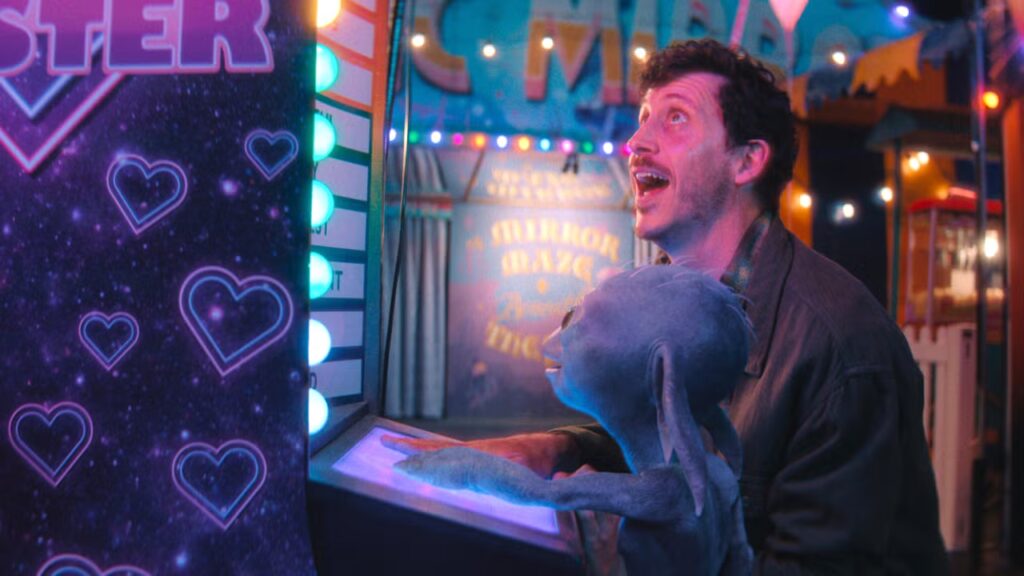
That’s enough to drive a normal person mad, and that’s what Daley Pearson and Jeffrey Walker’s “Allen” is about. T.J. Power stars as Petey, who met a cute space alien as a child and formed a deep, personal bond with the creature. When the alien, named Allen, gets pulled back into his mothership and whisked away, Petey spends the next 30 years trying to contact Allen in outer space. He’s afraid to move out of his childhood house in case Allen comes back and can’t find him. He doesn’t have a job, a goal or any meaningful relationships. He’s trapped in the past, unable to imagine a future that doesn’t revolve around his childhood escapism.
“Allen” paints nostalgia as a trap, irresponsibly sprung on little kids, who eventually lose their ability to imagine a life outside of the box. To survive, they eat the bait which doomed them in the first place. It’s a cynical take on the old Amblin movies and “Teenage Mutant Ninja Turtles” franchise but it’s not wrong. Since the 1980s the fantasies we bought as children — or more accurately, the ones we convinced our parents to buy for us — have been repackaged, year after year, as though they were the solution to our problems as opposed to the cause.
The twist is that Allen does return, and acts like nothing has happened. Thanks to the theory of relativity Allen thinks he’s only been gone a little while, except Petey grew up, grew old, and grew miserable. They have less in common now than they used to, and Petey’s joys of reuniting with his alien buddy are short-lived. Especially after he finds out why Allen befriended him in the first place, which wasn’t entirely on the up-and-up, and threatens to transform “Allen” from a quirky sci-fi comedy into a gross-out horror movie.
Daley Pearson and Jeffrey Walker directed “Allen,” and they know how to mimic all the old magical friend movie vibes, with kooky small town Australia energy for good measure. With its beachfront setting “Allen” has visual parallels to the recent “Lilo & Stitch,” a semi-competent remake of a superior animated movie which also had a subversive, though less acidic take on alien buddy flicks. Weirdly, the cinematography in Disney’s live-action remake was drained of its vibrancy and friendliness, which it was actually trying to convey, while director of photography Toby Oliver (“Get Out”) uses bright colors and cheerful compositions to amplify the genre’s unpleasantness in “Allen.”
The film doesn’t go into detail, mercifully, but eventually it also calls into question the whole premise of an extra-dimensional being who zeroes in on children, and forces them to keep a secret for the rest of their lives. This interpretation is so dark it makes Pearson and Walker’s film hard to watch, and by the time they backtrack, their attempts to liven the mood feel awkward. If “Allen” opts for a cheerful conclusion, we fear, it will play like the filmmakers are in denial.

“Allen” is an effective piece of film criticism that uses comforting storytelling conventions to make us uncomfortable, but those subversions make telling the actual “story” part of the story more difficult. The film is best before Allen even returns, a melancholy low-budget character study about pathetically clinging to childhood dreams. Those quirky independent sensibilities are appropriate until the plot develops, throwing “Allen’s” characters into familiar, adventurous situations that make it difficult to focus on what really matters. We may want everybody to save the world, at least in principle, but the narrative contrivances distract from what makes this film unique within the magical friend genre: Its suspicion and rejection of genre’s whole concept.
“Allen” takes a lot of risks from a screenwriting perspective. Daley Pearson and co-writer Sophie Miller mostly get away with it, adhering to familiar tropes while shifting the context in unexpected, sometimes disquieting directions. But they’re fighting their own story, and eventually the concessions “Allen” makes towards fitting the Amblin family-friendly mold are in direct conflict with the reason the film makes such an impression. It’s a sci-fi comedy with big ideas, informed yet simultaneously held back by its own influences, and might have benefitted from throwing out the rulebook altogether by Act Three.
Instead of going there, “Allen” goes a little awry. I suppose that’s fitting, in a way. A film undone by arrested narrative development, about a man is undone by the usual kind. That’s a clever idea. Maybe a little too clever for its own good.
“Allen” is now playing on Netflix.
The post ‘Allen’ Review: Quirky ‘E.T.’ Riff Treats Nostalgia Like a Lifelong Disease appeared first on TheWrap.