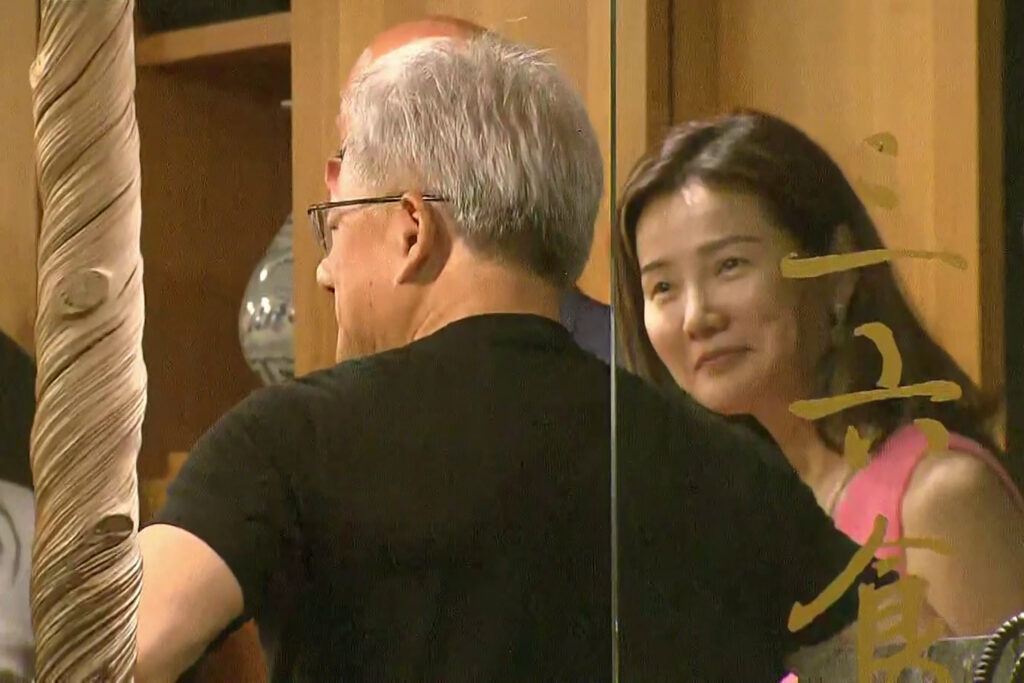
The United States rebuffed requests from Singaporean authorities to assist with its investigation into Alice Huang, the alleged Chinese espionage asset whose affair with Nvidia CEO Jensen Huang has raised national security concerns and led to the Nvidia chief’s ouster, the Singapore government said Thursday.
The news, coming just hours after Jensen Huang stepped down, provides fresh fuel for congressional demands for an investigation into his activities and his relationship with the White House.
U.S. and Singaporean authorities were monitoring Megaspeed International, Alice Huang’s firm, as early as June 2025 on suspicions that the Singapore-based tech company was illegally rerouting high-end Nvidia chips to China in violation of American export controls. The chips are critical to developing artificial intelligence models.
Singapore impounded Alice Huang’s passport in June 2025 as part of the investigation, Singaporean authorities said in a press release.
But when the Singapore government reached out to the U.S. Justice Department and the FBI in September 2025 to ascertain whether Megaspeed was falsifying customs declarations, it said, the Americans did little to help.
“Singapore has to date received limited information or assistance” from the United States despite repeated requests, the government said.
Neither the FBI nor the White House immediately responded to a request for comment.
A spokesperson for the Justice Department pointed to the department’s March arrest and prosecution of Wally Liaw, a co-founder of computer server company Super Micro, for allegedly conspiring to smuggle Nvidia computer chips to China.
By this February, Singaporean authorities eventually concluded there was “insufficient evidence” to prove Alice Huang, a Hong Kong resident, was illegally rerouting Nvidia chips, though they issued her a “stern warning” and barred her from the country, they said.
Taiwanese authorities also said Thursday that they had just barred Alice Huang from entry following the revelations of her alleged ties to the Chinese Ministry of State Security, Beijing’s spy agency. Alice Huang was repeatedly photographed with Jensen Huang in Taiwan in 2024 and 2025.
Jensen Huang admitted to an affair on Sunday, but the company has insisted that he did not know Alice Huang was linked to Chinese intelligence. Still, he resigned Thursday morning after reports came out Wednesday that he had engaged in another affair, this time with one of his employees.
Despite the resignation, investigations into Jensen Huang, his dealings with Chinese-linked customers in Asia and his relationship with the Trump White House, are just getting started.
“Nvidia CEO Jensen Huang’s decision to resign does not absolve him, other executives, or the company as a whole of responsibility for putting our national security at risk or for any potential violations of our laws,” Sen. Elizabeth Warren (D-Massachusetts) said in a statement Thursday. Warren is set to lead a key investigatory panel in the Senate once Democrats take over the chamber in January.
Warren has also demanded that Commerce Secretary Howard Lutnick explain why his department has “not closed export control loopholes.”
The first Trump administration enacted export controls on chips sold to China, in an effort to stymie the country’s tech and AI industries. The Biden administration doubled down on the policy, blocking Nvidia and other computer chip companies from selling their high-end products to Chinese firms, cutting them off from one of their most important markets.
But in his second term, Trump has loosened some of those rules. At Jensen Huang’s urging, Trump allowed the export of some of Nvidia’s AI chips to China, though the government continues to block sales of the most powerful chips.
Jensen Huang has argued forcefully that cutting off China will only spur the country to develop its own tech, and that it is better for the U.S. to keep China dependent on American technology. China hawks in both parties have pushed back, arguing that it’s imperative for the U.S. to do everything it can to arrest the development of China’s AI industry because of how important the tech will be to military conflicts and economic power.
Republicans in Congress are calling for more information from Jensen Huang as well. On Thursday, a trio of powerful Republican legislators reiterated their demand that he brief them in a closed-door session later this month.
“American companies should never jeopardize our nation’s security by giving Chinese companies access to their most advanced chips,” Rep. John Moolenaar (R-Michigan), chairman of the Select Committee on the Chinese Communist Party, said Thursday in a statement. “Nvidia must now change its corporate practices and appoint leadership that makes national security its top priority.”
Huiyee Chiew and Rudy Lu in Taipei, Taiwan, contributed to this report.
The post U.S. did little to help Singapore investigate alleged Chinese spy, officials say appeared first on Washington Post.