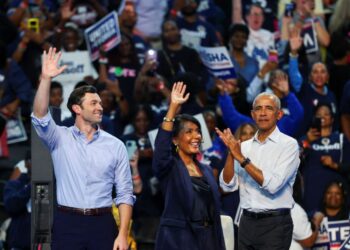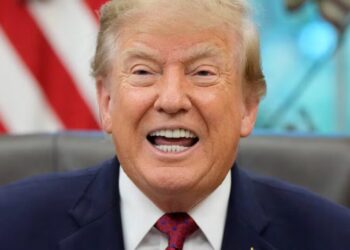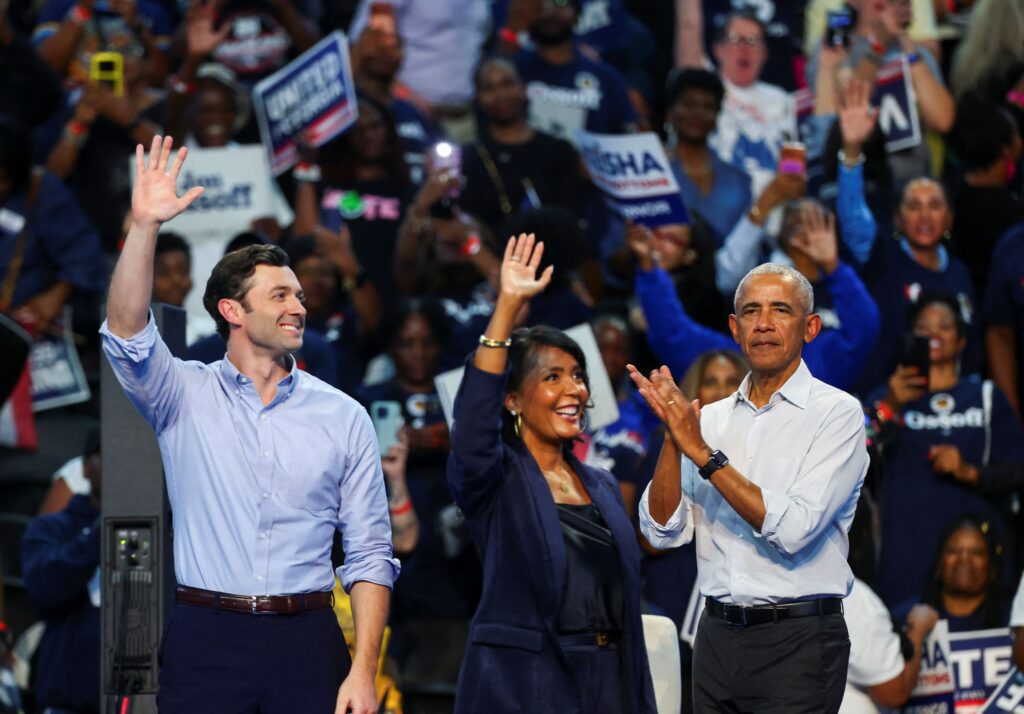
Rising Democratic stars like Pennsylvania Gov. Josh Shapiro and Georgia Sen. Jon Ossoff are sometimes accused of copying Barack Obama’s speaking style on the stump. The echo is noticeable, but the comparison runs deeper. In both rhetoric and policy, many of this year’s Democrats sounded an awful lot like the 44th president. After a 10-year interlude, the party seems to have returned to what might be called Obamaism.
“There is not a liberal America and a conservative America: There is the United States of America,” the 42-year-old from Illinois famously proclaimed in his breakout speech at the 2004 Democratic National Convention. That resonated in two presidential elections, but in the years after Obama left the Oval Office, political tastemakers wrote that style of politics off as déclassé. Donald Trump steered Republican messaging in the opposite direction, while many progressives likewise dismissed Obama-era positivity as naive. Like the GOP, they wanted their party’s standard-bearers to adopt a more aggressive posture.
The 2026 class of frontline Democrats, however, took a different approach, winning largely by reaching across the aisle and reviving the former president’s more optimistic flourishes.
“We are not a red state. We are not a blue state,” Wisconsin Gov.-elect David Crowley said in his election night remarks. Just as Obama used his 2004 keynote address to encourage a “politics of hope,” Texas Sen.-elect James Talarico declared in his victory speech that voters were hungry for a “politics of love.” Iowa Gov.-elect Rob Sand led his supporters in singing “America the Beautiful” during the campaign and closed his victory address by urging listeners to “go find somebody that voted differently than you and ask them why” in an effort to “rebuild the social fabric of our state” through conversation.
Such a revival hasn’t merely been rhetorical. Joe Biden spent his four years in office in a not-so-subtle competition with his former boss, pledging to be more transformative as he pushed the Democratic Party to the left on immigration, climate, LGBT rights and other issues. Whereas the Democratic platform in 2008, during Obama’s first campaign, proclaimed that “those who enter our country’s borders illegally, and those who employ them, disrespect the rule of the law,” the platform in 2020, under Biden, didn’t include even a token nod to the importance of border security.
This year, Democrats sounded more like 44 than 46. Talarico called himself a “border-security Democrat.” South Carolina Sen.-elect Annie Andrews said she is “willing to work with President Trump to secure the border.” Michigan Sen.-elect Abdul El-Sayed rebuked Biden’s border stance as a “failure.”
Just as Obama moderated on immigration (earning the nickname “deporter in chief” from progressive activists), he sought to occupy the center on the LGBT issue of the time (declining to endorse same-sex marriage in 2008) and on climate (supporting an “all-of-the-above energy strategy”). Many of this year’s Democrats made similar moves, opposing transgender athletes playing in girls’ sports and expressing support for oil and gas. Their campaigns could be seen as critiques of the last 10 years of political divisiveness — and of the Democratic Party’s reigning ideology.
These candidates aren’t quite carbon copies of Obama. Many are more economically populist, and some are more adept at articulating Democratic values in the language of religion, particularly Kansas Sen.-elect Adam Hamilton (a minister) and Talarico (a seminarian). While Obama came to power in a time of techno-optimism, the new generation is almost uniformly skeptical of artificial intelligence and data centers.
Their rise comes after the Democratic Party spent most of the post-Obama decade unlearning the lessons that fueled his success, replacing a charismatic outsider with three consecutive presidential candidates who were feeble speakers and career politicians plucked from within the party establishment. Democrats moved to the left on issues where Obama had moderated. They sometimes tried to revive his unifying rhetoric, but the party’s obvious disdain for Trump (and, occasionally, his supporters) seeped through.
In some cases, these leftward swerves were partially of Obama’s own doing: As a lame-duck president, he abandoned many of his notes of moderation. Progressive activists then led the party toward a more comprehensive rejection of Obamaism during the first Trump term (aka “Woke 1”). Many in that group continue to view Trumpian aggression, not Obama-style conciliation, as the more fruitful path to power.
Through it all, however, Obama has remained the most popular political figure in the country. It should come as no surprise, then, that returning to his rhetoric and issue profile gave the Democrats their largest congressional and state-level majorities since his time in office. According to Gallup, no president since Obama has had higher than 50 percent approval for longer than six months. Perhaps that’s less because the country is rife with division and more because voters have yet to have another president who has been able to communicate unity effectively.
There may be an enduring “paranoid style” that runs through American politics, as the historian Richard Hofstadter has written and as Trump demonstrates daily. But if so, the reverse is also true: The public frequently rewards appeals to what Lincoln called the “better angels of our nature.” Perhaps, in other words, “hope and change” isn’t so out of style after all.
The post The return of the Obama Democrats appeared first on Washington Post.