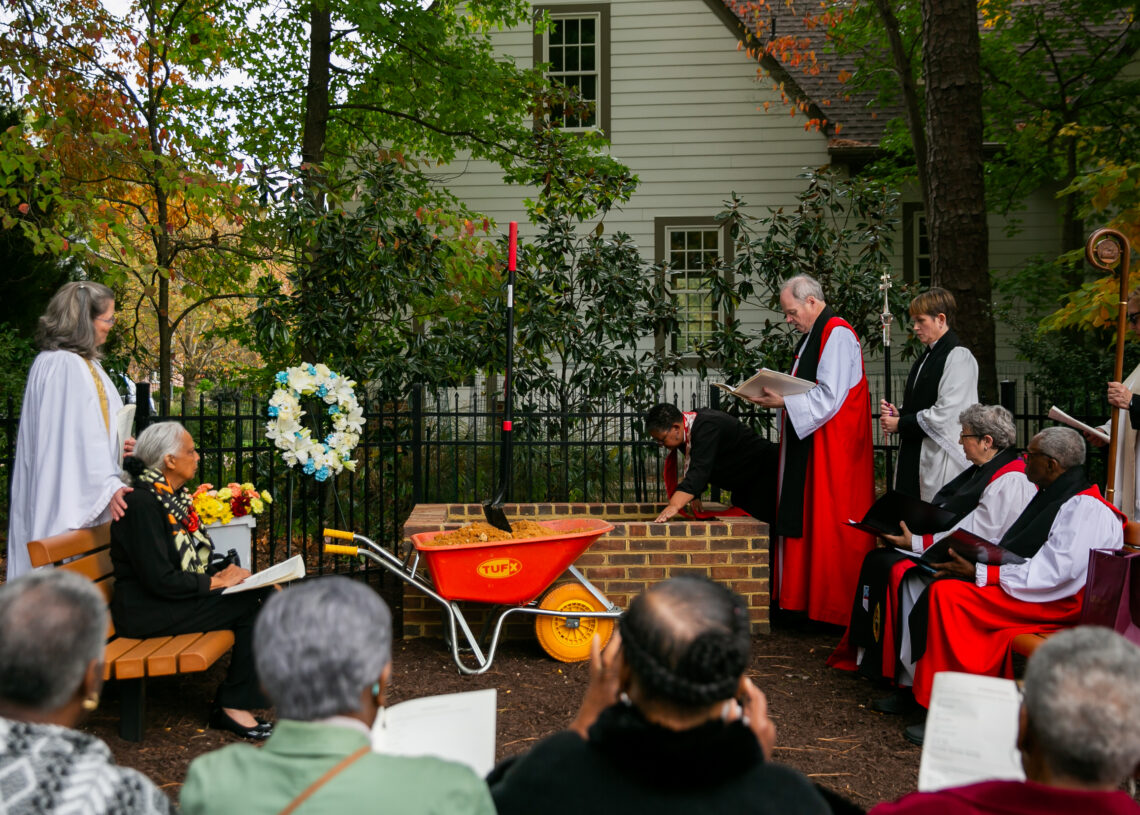
WILLIAMSBURG, Va. — The Right Rev. Michael Curry spoke while standing above a brown casket containing the remains of three enslaved African Americans. They were removed from their graves decades ago and were about to be reburied.
“We honor their memory by changing the world,” Curry boomed from the 311-year-old Bruton Parish Episcopal Church.
The remains were the cranium of a woman, the fleck of a boy’s tooth and a temporal bone of a young man.
Their casket was then carried in a motor procession through Colonial Williamsburg to the Utopia burial site in a residential and resort community called Kingsmill, a former plantation, where they were reinterred earlier this month near a marker with the words “FREE AT LAST.”
“They were returned home with dignity,” said the Rev. Jan Brown, a priest in the Episcopal Diocese of Southern Virginia, who advocated for the return and honorable reinterment of the enslaved ancestors.
But there is more to do. The remains of dozens more enslaved people also need to be reburied, said Brown, who has been combing the Bruton Parish Church records of past enslavers, including George Washington.
In 2006, the Episcopal Church formally apologized for its complicity in slavery. Early this year, the Right Rev. Susan Haynes, bishop of the Episcopal Diocese of Southern Virginia, lent her support to Brown and her work examining the church’s role in slavery and racism.
Soon after, Brown said, she was flabbergasted to learn that remains of three — and subsequently 38 more — enslaved African Americans that had been removed from Kingsmill were being held by the Smithsonian Institution in Washington. “Once you know that, you cannot unknow it,” Brown said.
Brown, taking the role of detective, turned her focus to history. The land where the remains of the three enslaved people were found was first purchased in 1619, the year the first Africans arrived in Virginia. (That year, England also granted a nearby parcel of land to Richard Kingsmill.)
“In 1628 John Utie took over the claim and named it Utopia, a pun on his own surname and on Thomas More’s book,” Brown wrote in a summary of her findings.
In the 1970s and 1990s, archaeologists working at Kingsmill, on the bluffs of the James River, excavated the remains of 25 enslaved people and artifacts tied to the traditions of West Africa. Most of the remains were reburied. But the remains of three enslaved people were sent to the Smithsonian for study.
Brown and descendant families have now brought those remains home. The names of the three people are unknown. All were given new West African names, which were used by the descendants at the Nov. 2 reburial service. It took place on All Souls’ Day, when prayers are given for the souls of the dead.
“Sia” is the name of the woman’s cranium, which dates as far back as 1670.
“Obi” is the name given to the fleck of a tooth from a boy who was about 3 to 5 years old. Also recovered were Venetian glass beads that had been placed around his neck.
The temporal bone, from the side of a young man’s skull, was given the name “Amara.” Unlike the others, his remains weren’t discovered in a grave.
“We just learned they were found in a trash pit at the Utopia site,” Brown said.
The historical work on Sia, Obi and Amara helped church members uncover the 38 other ancestors they believe deserve a similar resolution.
Those remains were removed from a site at Kingsmill known as the Pettus Plantation in about 2000. They were taken from among about 140 grave sites while a private home was being built, Brown said.
Brown and the descendants have filed a formal request with the Smithsonian for the return of the remains. She hopes the process will be completed by year’s end, although the original burial site isn’t available. It’s not clear where they might be put to rest instead.
The Smithsonian said in a statement that the 38 remains from the cemetery at the Pettus Plantation “were on loan from the Virginia Department of Historic Resources [for] analysis starting in 2000.” They were legally transferred to the Smithsonian National Museum of Natural History “for preservation, analysis, and permanent curation in 2018,” according to the statement.
Under a 2024 policy governing the returns of remains of non-Native Americans, “a request for the respectful return of individuals from the Pettus cemetery is now being reviewed,” the statement said.
Meanwhile, the search goes on in Bruton Parish church records, stretching back to 1674, for clues about the 38 unburied enslaved people, “whose names are recorded across the diocese’s history through pew assignments, church boxes, registries and vestry books,” the church said. So far, researchers have found little about those individuals, but they are learning about the history around them.
One source is the records of enslavers. Bruton Parish has name plates on some pews honoring prominent colonial worshipers, including Washington. Entries in Bruton registers include “Colonel George Washington” under “Baptisms of Negro Children.”
One reads: “1764: owner George Washington, mother Daffny, a boy, William, Born 10 Septr., baptized October 7.”
The Thomas Bray family owned Utopia from 1700 to 1750, when the burial ground there was mainly in use.
Bruton Parish itself owned enslaved people, records show. “Thomas Son of Molly Belonging to the Bruton Parish” (1767),” read one of them.
“The church did not only baptize enslaved people,” Brown said. “It owned them.”
For Brown, the reburials are about telling the truth about the past treatment of enslaved African Americans. “It is very hard, and the truth still needs to be told,” she said.
At the burial service, the word “Lament” was added ahead of an Episcopal Church message on slavery.
“Repent, Reconcile, Heal,” Brown said. “We have apologized. We have never lamented. And we cannot repent of what we will not name.”
The reburials are especially meaningful to descendants.
Loretta Burwell of Atlanta threw the first shovel of dirt at the Utopia memorial site. She sat weeping on a nearby bench as others took the shovel in turn.
Burwell, 82, is a descendant of people enslaved by the Burwell family at Kingsmill in the 1700s.
“They are all my bones, named and those whose names I will never know. I honor them all,” Burwell said. “This work of Rev. Jan Brown means that I can do this in a public way. It is a priceless gift. It brings my people to peace at last.”
The post Remains of an enslaved man, woman and boy reinterred in Virginia appeared first on Washington Post.