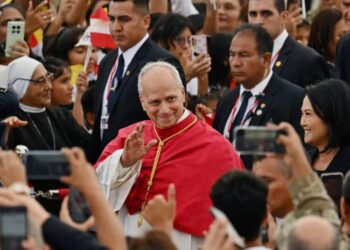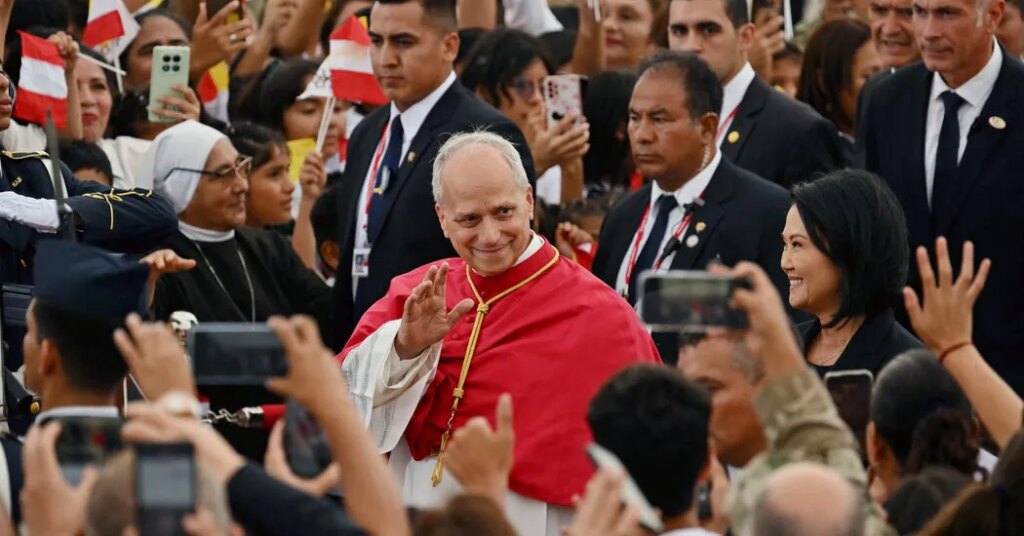
Just a year and a half into his papacy and less than a month after surgeons removed a lobe of his right lung, Pope Leo XIV, the first pontiff born in the United States, touched down in his homeland on Wednesday.
Yet instead of setting foot on American soil, he arrived in Peru, where he spent two decades as a missionary, priest and bishop and became a citizen in 2015.
“Today I understand how much of this land remains with me and how much of my own story also belongs to you,” Leo said, speaking on Wednesday evening to Peru’s president, civic leaders and diplomats at the Gran Teatro Nacional, a theater and concert hall in the country’s capital, Lima. One of his biggest applause lines was when he referred to Peru as “my homeland.”
Having turned out record crowds at Masses in Argentina, the pope flew from Buenos Aires to Lima on Wednesday afternoon, reaching the final country of his 12-day tour of South America. The pope emerged at the top of the stairs next to a sign on the side of his plane that read “Pontifex Maximus,” and was greeted by Peru’s president, Keiko Fujimori, and a chorus of singing children on a red carpet at the Callao Air Base near Lima.
As his motorcade made its way through city streets under gray skies, about 3 million people lined the roads, according to local authorities, holding up cellphones as they waited for a glimpse of the pontiff.
His choice to visit Peru so soon after becoming pope — while deferring a visit to the country of his birth — underscored the deep emotional ties he feels to the place that formed him as a priest.
“That’s a connection that he doesn’t even have in Chicago at that level,” said Raúl E. Zegarra, assistant professor of Roman Catholic theological studies at Harvard Divinity School, referring to the city where the pope spent his childhood and attended seminary.
A ghost of the pope’s past hovered over his meeting with Ms. Fujimori, who was the first woman to be elected president in Peru in June and is the daughter of Alberto Fujimori, the dictatorial leader who ran the country for a decade and was convicted in 2009 of human rights violations, including murder.
When the pope was a young priest named Robert Prevost in Trujillo, in northern Peru, Mr. Fujimori dissolved Congress and suspended the Constitution. The Rev. John Lydon, a fellow Augustinian priest, served with the pope in Trujillo in the 1990s. He recalled that Father Prevost helped organize pro-democracy protests and recruited people to sign a petition supporting the 50th anniversary of the United Nations Universal Declaration of Human Rights.
As a bishop in the city of Chiclayo, where Leo will return on Friday, the pope told Father Lydon — now director of a leadership institute at Villanova University, the pope’s alma mater — that Mr. Fujimori “‘needs to ask pardon for all that he did.’” Mr. Fujimori died in 2024.
Standing at a podium on Wednesday next to Mr. Fujimori’s daughter, the pope seemed to hint at that history. “Past events deserve to be treated with justice and sensitivity, leaving room for harmony to grow and for differences to be addressed with respect,” he said.
In her welcome remarks, Ms. Fujimori, too, acknowledged the country’s painful history. Pope Leo’s visit “also calls us to reflect on our most urgent and pending task: national reconciliation,” she said. She added: “to move forward, Peru needs to reconcile. No country can live as a prisoner of its own wounds. We must learn to look back with truth and justice, but also with mercy and compassion.”
Unlike in the United States, where the pope voted in the midterm elections by mail, he did not vote in the Peruvian presidential election because “it was not possible,” he said to a reporter on the flight from Rome to Uruguay, the first leg of his trip.
Ms. Fujimori was elected this year as a conservative representing the political movement founded by her late father.
Marcela Rios Tobar, a political scientist and director for Latin America and the Caribbean at the International Institute for Democracy and Electoral Assistance, said Ms. Fujimori was a pragmatist who would “try to take as much advantage of this visit.”
Ms. Fujimori’s approval ratings have already fallen in the nearly five months since she was elected president, as voters have expressed dissatisfaction with the economy and crime. “She needs all the help that she can get to have her image boosted,” said Ms. Rios Tobar.
By the time the pope arrived in Lima, the visit had already become politically sensitive for the president. The opposition attacked her for announcing plans to leave for an economic summit in China on Sunday, missing the pope’s departure from Peru next Monday, and opposition lawmakers threatened to block her from leaving the country.
Ms. Fujimori told reporters in Lima on Tuesday that “it would never occur to me to slight our Pope,” but added that she could not miss a scheduled meeting with the Chinese leader, Xi Jinping, on the sidelines of the Asia-Pacific Economic Cooperation summit.
“My heart remains in Peru, but as president, I have state obligations to fulfill,” she said.
In Leo’s speech in Lima on Wednesday, the pontiff was not as pointed as he had been in Buenos Aires, when he seemed to implicitly criticize the economic austerity measures of President Javier Milei.
But he called on Peru’s government to recognize the dignity of work, the need for accessible health services and exhorted all members of the country’s democracy “to cultivate honesty, integrity, and a willingness to engage with others.”
Throughout his papacy, Leo has generally avoided direct criticism of governments, though he tangled with the Trump administration this year over the government’s conduct of the war in Iran.
Mr. Zegarra said that he was not surprised that the pope would temper his words in Peru. As a bishop, Leo was able to express his unvarnished opinions or protest publicly, but, Mr. Zegarra said, “what the pope tries to model as the head of the Catholic Church is to be a figure that can speak to all with decency, but also firmly.”
“He’s taking some distance from his documented history,” he added, “to try to be a bit more of a bridge builder.”
The post Pope Leo XIV Goes Home, Meeting Ghosts of His Past appeared first on New York Times.