From the start, foreboding envelops James Gray’s “Paper Tiger” like a thick, dangerous fog. As a filmmaker, Gray likes hanging out in the dark, especially in those shadowy corners where everything is obscured, including relationships. Like some of his influences, he has an affinity for intimate crime stories that speak to larger truths, like his 1995 feature debut “Little Odessa,” set in a darkly cloistered immigrant world of predators and prey. Whatever the grift or the stakes, though, Gray’s crime movies are often also family melodramas in which the ties that bind — including to the American dream — sometimes throttle.
“Paper Tiger” opens on a sweeping view of New York in 1986 and, like several other of Gray’s movies, narrows in on two brothers, the Pearls. The eldest, Gary (Adam Driver), is a retired New York police officer who has since made bank as a security consultant. He’s got swagger and flash, a Mercedes and hair as slick as his man-about-town glad-handing. Physically imposing, he walks and talks like a guy who rarely lets anything or anyone get in his way, and is accustomed to basking in the glow of other people’s admiration. When he visits the home of his younger brother, Irwin (Miles Teller), Gary doesn’t walk into the house. He storms it.
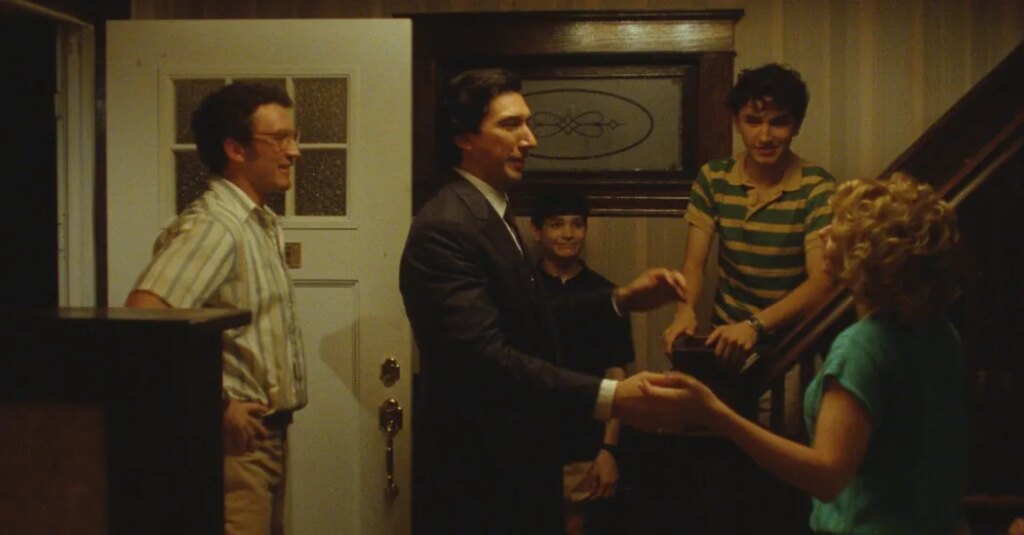
Gray sets the tone quickly and efficiently, dropping you into a richly textured, immediately convincing world of real people living in real places. When Gary swans into Irwin’s modest home in Queens, wowing his brother’s family with a steak dinner, you see both the love and the small, cramped lives. As Irwin and his wife, Hester (Scarlett Johansson), bustle about helping with the meal, Gary chats up their sons, the teenage Scott (Gavin Goudey) and younger Benjamin (Roman Engel). Gary also thrills the kids by flashing his gun, a portentously freighted piece that he wears tucked in an ankle holster. Not long after, he is dazzling Irwin, too, with a business proposition that sounds, and proves, as risky as the gun.
Both brothers are under great financial strain, which Gray suggests with telegraphing detail, is symptomatic of the economic pressures in Ronald Reagan’s America (one of the director’s stomping grounds). Driven by Gary’s arrogance and aided by Irwin’s naïveté, the brothers blunder into violence. The city has begun cleaning up the Gowanus Canal, a once-busy commercial channel turned future Superfund site. Gary wants in. He proposes that he and Irwin consult for an outfit run by Russian immigrants that’s doing the dirty work but struggling with regulations, a sketchy outfit that’s actually a front for a criminal enterprise.
The grandchild of Jewish immigrants from what is now Ukraine, Gray asks big questions in his work, and he recurrently returns to the costs of social inequity and the ravages of capitalism. Some filmmakers turn themes into sermons; Gray turns ideas into genre movies, a great American tradition that encompasses family-oriented gangster films from William A. Wellman’s “The Public Enemy” (1931) to Francis Ford Coppola’s “The Godfather” (1972). He owes a debt to Coppola, and “The Godfather” (a favorite of Gray’s) has imprinted strongly on him. You can see the earlier film’s influence in this one’s penumbral lighting and engulfing darkness, in its tenderness, harrowing violence and even a brotherly embrace.
As the brothers’ gangland ties deepen, Gray continues to fill in the characters. Driver is comfortable playing unlikable, morally ambiguous men, and he doesn’t try to win the audience over when he does. The surprise here is Teller, who can be a gratingly showy screen presence but has been productively tamped down. As a simple man unexpectedly swept up in extreme violence, Teller has to do a lot with relatively little, partly because Gray is more interested in Gary’s ethical failings — and his hubristic bravado — than in the homey Irwin. The influence of Sidney Lumet is evident in some of the scenes of Gary palling around with his old copland buddies, a tribe that serves as a counterpoint to the gangsters.
Gray has tried to dowdy down Johansson. It’s unnecessary. Wearing oversized glasses and a head of fat curls, and working a nasally accent that brings to mind mahjong and old Warner Bros. cabbies, Johansson reminds you of what a formidable actress she is. Her Hester is a font of warmth yet briskly no-nonsense, and you intuit from the performance that this woman has shouldered many of the family’s burdens. The actress slides into the role of Hester convincingly, giving substance to a character who, in the hands of another director, might have been a caricature or afterthought. As in other of Gray’s films, the shifts between the private and public spheres are as much a political argument as a storytelling strategy.
Gray has a soulful preoccupation with the ways life can brutally test love, and a cineaste’s passion for genre film. He is as steeped in the Hollywood of the 1930s as the ’70s, though a mesmerizing shootout in “Paper Tiger” that turns into an abstract canvas of poses and sweaty desperation, suggests that he’s also an admirer of Michael Mann. Like Mann, Gray has the preoccupations and the kind of intense, unapologetic seriousness — intellectual, philosophical, cinematic — that can make him an anomalous figure in the trivializing climate of mainstream moviemaking. Gray doesn’t always satisfyingly integrate all the parts in “Paper Tiger,” but each is more memorable in and of itself than many movies are in their entirety.
It’s a sign of his seriousness, for his ambitions as well as for the medium, that he opens “Paper Tiger” with a quote from Aeschylus’ “Agamemon.” It takes nerve to open any movie with a nod to classical Greek tragedy, even one as apt as this one: “Let there be wealth without tears; enough for the wise man who will ask no further.” The line serves as a kind of guidepost to what follows, including for the way Gray wants you to understand his characters. This is, in many respects, a familiar story of how ambition can bleed into avarice, desperation into violence, dreams into nightmares. His characters are ordinary men and women, not gods and heroes, yet their fates are no less tragic and the very stuff of American myth.
Paper Tiger Rated R for language and violence. Running time: 1 hour 55 minutes. In theaters.
The post ‘Paper Tiger’ Review: An American Tragedy appeared first on New York Times.