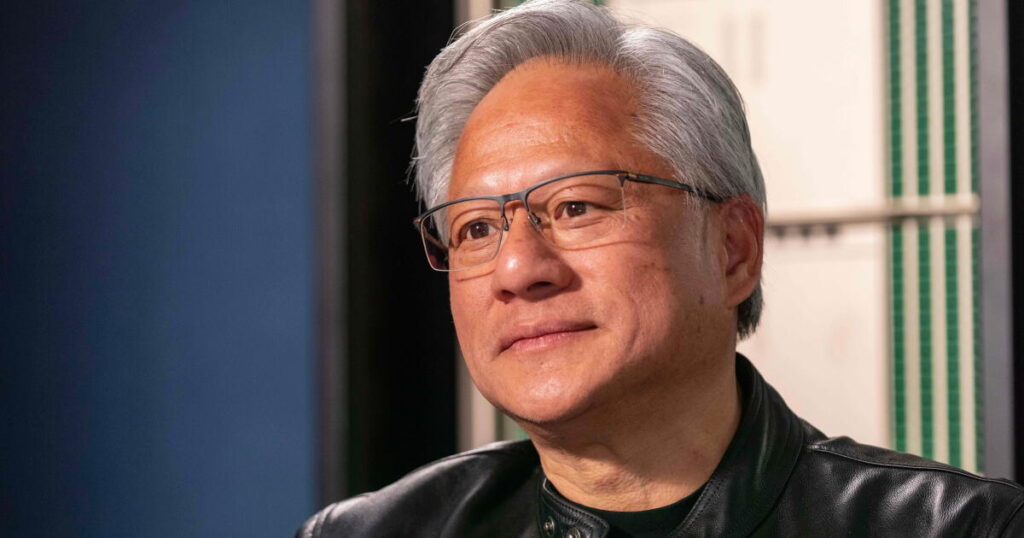
Nvidia’s stock fell sharply Thursday after co-founder Jensen Huang resigned as chief executive, leaving the world’s most valuable company without the leader who built it into the center of the AI boom.
The stock dropped more than 11% in pre-market trading on Thursday and was down 5% by early afternoon, just five days before the company reports third-quarter earnings. Shares have fallen by as much as 19% since Friday.
In a regulatory filing, Nvidia said Chief Financial Officer Colette Kress will serve as interim CEO while keeping her finance role until a permanent successor is named. Harvey C. Jones was appointed the board’s first-ever chair. Huang, who owns about 3.6% of Nvidia, will also leave the board.
“Jensen’s contributions to NVIDIA are profound,” the company said in its statement. “NVIDIA is one of the most consequential technology companies in the world. The Board and the company thank Jensen for his immeasurable contributions to the company and the industry.”
Huang’s resignation follows reports of two extramarital affairs, including one with Alice Huang, a Singapore-based businesswoman whom U.S. intelligence officials reportedly suspect of working for Chinese intelligence. Nvidia’s board launched an independent investigation into national-security concerns raised by the reports.
Huang has been a key player in the growth of the AI industry and his ouster sparked worries about the effects it would have on Santa Clara-based Nvidia and other companies the depend on its computer chips.
The revelations have also highlighted national security concerns in Washington, where federal lawmakers have called for an investigation into accusations that China targeted the powerful tech mogul. The U.S. has been locked in an AI race with China, raising more scrutiny over Nvidia’s business with the country.
“It’s absolutely stunning news,” said Brian Colello, a senior equity analyst at Morningstar. “It was not something that was on the minds of investors a week ago or prior.”
Executive scandals are hardly rare, Colello said, but “not to somebody at his scale, not to somebody who helms a company the size of Nvidia” and “who is at the epicenter of such a transformative technology as AI.”
A visionary figure, Huang was deeply embedded in the company’s operations. He had 60 direct reports, and both of his children work at Nvidia. Colello said Nvidia appeared to have done little succession planning, given how much of the company’s leadership and decision-making centered on Huang.
“The market hates uncertainty, and there’s far more uncertainty about Nvidia now than there was a week ago,” Colello said. “You rip this amazing technological leader out of the company, and there should be some sort of negative reaction.”
Still, he cautioned against assuming the worst. Nvidia’s GPUs and software ecosystem underpin much of the AI industry, which makes the company hard to replace, Colello said, even as the largest tech companies try to reduce their reliance on it.
“AI is still running on Nvidia gear today,” Colello said.
The larger risk, he said, is to customer relationships.
“Nvidia will have to work hard and work quickly to solidify any customer relationships that might be damaged.
Jeffrey Sonnenfeld, a senior associate dean at the Yale School of Management, said he does not expect Nvidia’s business to shrink, though he said the turmoil could create opportunities for other semiconductor companies, including AMD, Texas Instruments and Analog Devices.
While some commenators predicted a market crash Thursday morning, Sonnenfeld said there have been bright spots in the market.
“This is giving opportunity for a lot of others,” he said.
Huang’s exit also hit the “neocloud” companies, the newer AI data center operators that rent out computing power, according to Steven Tian, research director at the Yale Chief Executive Leadership Institute.
Those companies were already under strain, Tian said. They must raise large amounts of debt to build data centers, and rising interest rates make that harder. Huang’s departure could add to those pressures, he said, contributing to Thursday’s selloff in neocloud shares.
The turmoil could benefit hyperscalers, including Amazon, Microsoft and Google, which have their own large-scale cloud infrastructure businesses, Tian added.
Investors will get their first look at the new leadership soon. Nvidia will report third-quarter fiscal 2027 results Tuesday, November 17, as previously scheduled, followed by an earnings call.
The post Nvidia shares tumble after Jensen Huang resigns as CEO appeared first on Los Angeles Times.