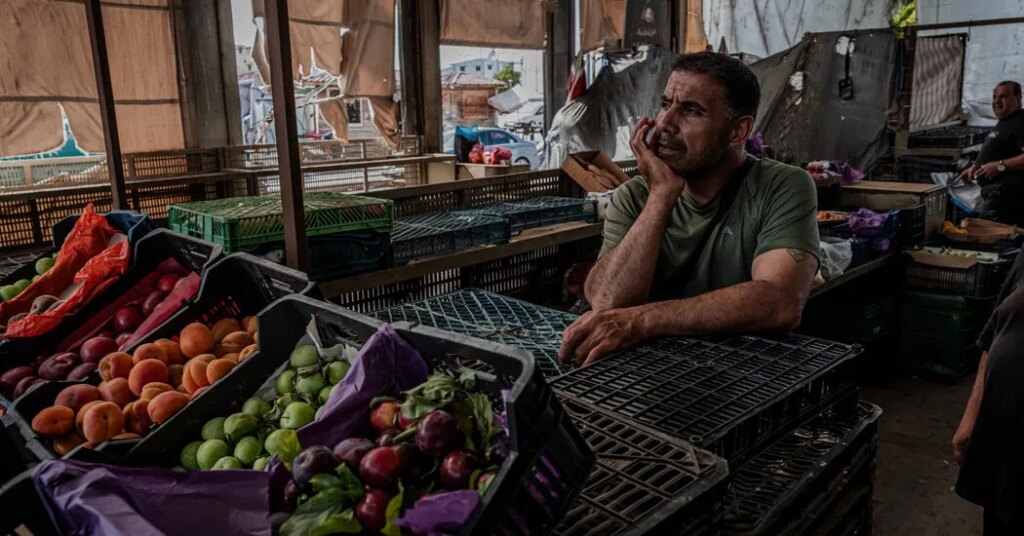
For decades, Abdelnaser Ossman has grown grapes at his family’s expansive farm in Lebanon’s Bekaa Valley, tilling the soil through years of drought, war and economic turmoil.
But this year the pressures have become overwhelming. His costs have soared and profits have plunged since the war between Israel and Hezbollah, the Iran-backed Lebanese militant group, began in March. Fuel and fertilizer prices have doubled and labor costs have quintupled, while the price his harvest fetches has dropped by half. Mr. Ossman, 55, has rented out part of his land to help make ends meet and is considering selling parts of his farm.
“This year has been a catastrophe,” he said. “This is the hardest year of them all.”
Lebanon is facing a deepening economic crisis caused by years of mismanagement and exacerbated by a conflict that has killed thousands, displaced hundreds of thousands more and left entire towns in ruins. The U.S.-Israel war with Iran that began in February has only added to the economic challenges.
The data is stark. The World Bank forecasts inflation as rising more than 17 percent in Lebanon this year, driven by supply disruptions, higher shipping costs and soaring fuel prices. It also predicts that the economy will contract by 6.4 percent.
For many Lebanese, economic survival is the overriding concern, as they struggle to afford basic necessities and fuel amid joblessness and low wages. The crisis threatens to derail the fragile progress made by Prime Minister Nawaf Salam, who took office last year with ambitions to overhaul the economy. The government faces mounting public anger, unions threatening to strike and growing demands for a lasting overhaul of financial policy.
“It is a difficult time, and it is also a deeply frustrating one,” Amer Bisat, the minister of economy and trade, said in an interview. “Lebanon does not deserve this.”
Decades of Crisis
The shocks to Lebanon’s economy stem from years of systemic problems that have hollowed out the country since the end of the civil war in 1990.
A political and economic elite, dominated by sectarian power brokers and wealthy business interests, has enriched itself through cronyism and self-serving policies, creating a deeply unequal society. Corruption remains deeply entrenched, with Transparency International, an anticorruption watchdog, ranking Lebanon among the world’s lowest-scoring nations.
The consequences of that rot came to a head in 2019, when Lebanon’s banking system collapsed, wiping out billions of dollars in savings, sending the Lebanese lira into free-fall and pushing large parts of the population into poverty. The Covid-19 pandemic compounded the damage, and then the Beirut port explosion in 2020 devastated entire neighborhoods and caused billions of dollars in losses.
Just as Lebanon struggled to absorb these blows, another round of conflict started. In 2024, Hezbollah opened a new front against Israel in Lebanon after the Hamas-led attacks on Israel on Oct. 7, 2023. That triggered a war that inflicted further destruction and displacement.
The repeated crises have weakened Lebanon’s fragile state and public institutions, leaving the economy dominated by established elites and Hezbollah. Networks of politically connected bankers, major business owners, financiers and dynastic political families exert outsize influence over key sectors, sustaining a system of patronage, inequality and political paralysis.
“Despite operating according to very different logics, both are fiercely resisting change,” said Sibylle Rizk, the director of public policies at Kulluna Irada, a Lebanese civic advocacy group, referring to the elites and Hezbollah. “Because what is at stake is not just their own survival, but the survival of the political and financial order they have sustained together.”
The scale of hardship is vast.
Large parts of Lebanon are expected to remain short of food into next year, as the war has disrupted farming and cut off income.
Finding and keeping a job have become harder. An International Labor Organization survey released in July found that one in three private-sector workers surveyed was no longer employed.
Tourism has slowed, particularly among Lebanese expatriates who bring much-needed money into the economy, Mr. Bisat said. Remittances have held up, but he sees signs they could weaken as Lebanese workers in the Persian Gulf face the fallout of the war with Iran.
Lebanon is “a country that has too many good things — from people, education, diaspora, location,” he said. “And unfortunately it’s being stifled. And our job is to try to unlock it, and until we do that, the frustration is there.”
To make ends meet, many families have been forced to borrow money, sell gold and heirlooms, and cut back on essentials like health care and education.
“What you are seeing in Lebanon is a population that is struggling to afford life,” said Ali Abboud, an assistant professor in economics at the American University of Beirut.
“Lebanon is a small and import-dependent country, where the economy is deeply intertwined with the neighboring region,” he added. “So any crisis means the quality of living, along with the health and productivity of the economy, will be impacted significantly.”
Power Problems
Chronic electricity shortages are emblematic of the economic crisis.
Lebanon’s state-run power grid delivers electricity for only a few hours each day, leaving most households and businesses dependent on diesel generators to fill the gaps. That makes them especially vulnerable to increases in fuel prices, like when operators of private generators charge above government-mandated rates and the authorities cannot keep pace with those breaking the rules.
Rayah Sakr, owner of the Submarine co-working space in Beirut, has been squeezed by the soaring costs and power cuts.
As temperatures climbed this summer, the company’s monthly generator electricity bill nearly doubled to more than $1,600, on top of the $150 for government-provided electricity. Ms. Sakr, whose business was unprofitable before the power crisis, is weighing whether to raise membership fees or shut down.
“Electricity and its price are where we have a curse and where we hope for a miracle,” she said. “It’s very hard to do business like this.”
Mr. Bisat said the government had stepped up generator inspections, confiscated dozens whose operators were overcharging customers, issued fines and referred violations to the judiciary.
Mr. Salam also said in a speech last month that his government was developing solutions to lower electricity costs, including offering families loans to buy solar panels.
The authorities plan to increase funding for health care and social assistance, raise salaries for public-sector workers, including teachers, and subsidize public transportation, he added. The government would pay for it by imposing levies on yachts and private aircraft and collecting hundreds of millions of dollars in outstanding payments from dozens of companies and quarry operators.
But Mr. Bisat acknowledged these efforts would fall short for a strapped nation facing enormous humanitarian and reconstruction needs. He invoked an Arabic expression that captures the predicament: “The eye can see, but the hand is short.”
Experts say Lebanon needs a long-term plan to tackle corruption, overhaul its institutions and restore confidence in government.
Over the past year, Mr. Salam has advanced legislation to address the banking crisis. But the International Monetary Fund has said that significant hurdles need to be addressed. These include agreeing on who will bear the losses from the collapse of the banking sector, adopting a sustainable 2027 budget and improving the government’s ability to raise money, control spending and manage public debt.
Some analysts say the government has been too slow.
The elite’s aim is to “socialize losses and privatize profits,” said Ms. Rizk of Kulluna Irada, meaning the public will bear the costs while banks and their owners are shielded from liabilities.
Struggling Lebanese like Mr. Ossman are bracing for even harder days. On a recent afternoon, as a cool breeze blew through his vines, he said he hoped the government would finally get a handle on the economy. More than anything, he hoped his generation would not be the one to lose the land his father and grandfather passed down.
“This land is my soul,” he said. But this year, he added, all it had given him was “pain after pain.”
Sarah Chaayto contributed reporting from Beirut.
The post Lebanon Faces Economic ‘Catastrophe’ After War and Years of Mismanagement appeared first on New York Times.