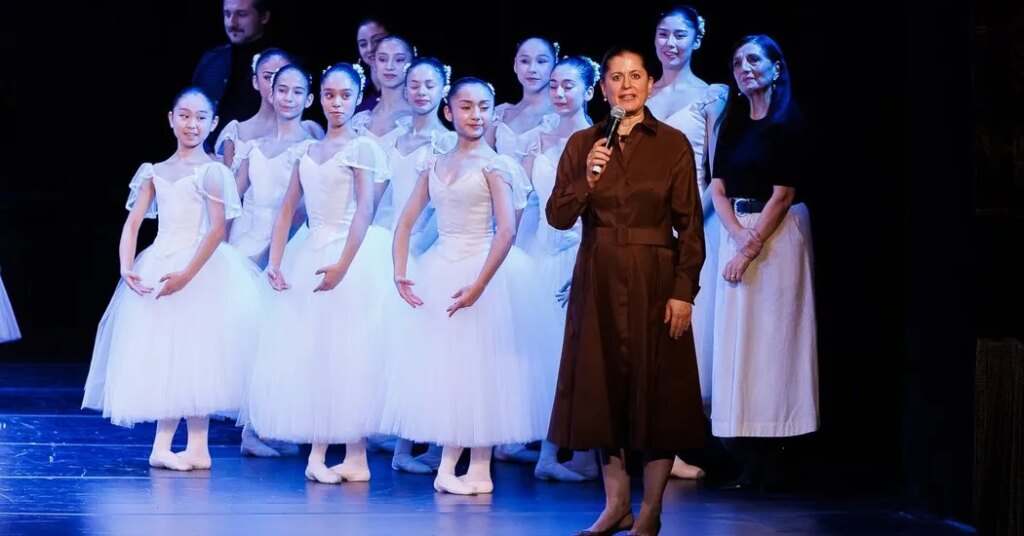
Carmen Gloria Larenas was a 5-year-old growing up in Santiago, the capital of Chile, when she saw a performance of “Swan Lake” on television and decided to dedicate her life to ballet. She went on to study dance at the Teatro Municipal, Chile’s principal opera house, and later join its ballet company.
Today, Larenas runs the 169-year-old Teatro Municipal in Santiago and is making available to its dance students what she herself would have liked to have received: training from the Paris Opera Ballet School.
As part of a multiyear deal between the two opera houses, former stars and instructors from the Paris Opera Ballet are providing intensive training sessions in Chile, while instructors and students from the Teatro Municipal in Santiago are receiving training in Paris.
A highlight of the initiative: the two-week summer course in January, when some 200 students and teachers from all over Latin America gather in Santiago to learn from dance professionals and experts who have flown in from Paris.
“For me, the French school of ballet is the best in the world,” said Larenas in a video interview on a recent visit to Paris. “Thanks to this program, our ballet school in Santiago has been transformed — not just in terms of its technique, but in terms of its way of thinking.”
“We feel that our students can now join the best companies and the best ballet schools in the world,” she added.
Larenas acknowledged that the collaboration with the Paris institution took time, patience and repeated efforts. “Coming from a small country located far from the major international centers of culture, I expected it to be a difficult adventure,” she said. People in her entourage told her that the partnership was unlikely to come together — “the French get bad press, in general,” she said — but she proved them wrong. “The French are very generous,” Larenas said. “You have to work on the relationship with them over time, slowly.”
“There is a lot of depth in what they do,” she added.
The Paris Opera — which puts on more than 400 ballet, opera and concert performances each year for an audience of about 900,000 — is offering artistic and cultural services to institutions around the world in a new paid partnership program. Services range from teaching dance and music to training in costume design, sound and lighting and stage and box-office management. The pilot venture was the collaboration with the Teatro Municipal in Santiago, which initially ran for three years from 2023 and has just been renewed for another three.
The company’s director, Alexander Neef, said in a phone interview that while the institution had long been sharing knowledge and experience, it was now asking itself, “What do we do better than other people?” and offering that expertise as a package.
In its presentation of this venture, the Paris Opera vaunts the merits of the Ballet School, which originated during the reign of King Louis XIV, trains nearly 150 students each year and is the talent pool from which 90 percent of the ballet company’s dancers are recruited.
The Paris Opera is by no means the first French cultural institution to export its skills. In 2007, the Louvre and a consortium of other French museums signed an agreement worth around one billion euros (about $1.3 billion at the time) with Abu Dhabi to create the Louvre Abu Dhabi, which opened in 2017 and presents a program of rotating loans from French institutions, as well as jointly produced exhibitions.
The Pompidou Center in Paris — currently closed for a $500 million redevelopment — is raising some of the money for the redesign by opening outposts and staging exhibitions around the world.
Neef said French museums “have certainly been an inspiration” for the program, though the fees collected by the opera house are not of the same order of magnitude. (The plan is to turn these cultural services into income, but one that is hard to quantify right away, because the scheme is in the initial investment phase, he added.)
He said other revenue streams were “much more important to us today.” The Paris Opera says it raises 60 percent of its annual budget, or a total in 2025 of around $180 million, through activities including ticket sales for stage productions, visits to its original 19th-century Paris headquarters — the Palais Garnier — and sponsorship.
Neef noted another important benefit of such a relationship. “It’s a tool in its own way, a tool of cultural diplomacy,” he said. “It’s what they call soft power.”
An example of that soft power was the January 2024 evening of music and dance in Saudi Arabia in a partnership with Villa Hegra, a French-Saudi cultural institution. Inside a concert hall in Al-Ula — an ancient oasis region that is now a cultural destination — audiences were treated to performances by singers from the Paris Opera Academy, by the Paris Opera Ballet’s former prima ballerina Alice Renavand and by Saudi Arabia’s leading opera singer, Sawsan Albahiti. Costumes from Paris Opera productions were also presented in a mini-display, and some 15 young local musicians attended a workshop on music, singing and dance.
Since last March, the Paris Opera has also teamed with Teatro Colón, Argentina’s main opera house. Experts from the Paris Opera Ballet fly to Buenos Aires to teach master classes, observe the classes being taught at the school and interact with the faculty.
Evelyne Laquit, director of development at the Paris Opera, welcomed the new advisory services, noting that her department had few international engagements, despite the Paris Opera Ballet’s history of global touring and travel. “It’s an opportunity for the opera house to develop its image internationally,” she said.
The program was all the more timely, she said, because the 19th-century Palais Garnier building — where most of the Paris Opera Ballet’s productions are staged — is closing next summer for a five-year refurbishment, and while stage performances there will have to stop, activities like training and schooling can continue.
Neef said that the French technique of dance was one of the Paris Opera’s unique assets, yet one “which we’ve never really exported in a formalized way,” and was an obvious component of the advisory services that the institution was now offering.
The French school of ballet — one of the world’s oldest and most prestigious — places less emphasis on overt displays of physical prowess, and more on elegance and expressiveness. It is a style especially known for its fast and precise footwork technique.
Spreading knowledge of French ballet technique is all the more necessary because, “one of our particularities is that we don’t write it down,” Neef said.
“The transmission is entirely oral,” he explained. “It’s actually a very fragile way of transmitting it. If we can find more people to transmit it to, it becomes a more solid structure for the future.”
“What we’re looking to do at the moment is really to secure the future of the Paris Opera as an institution and to secure the heritage that we have the charge of,” Neef said. By building and training talents around the world — artists, artisans, stagehands, designers — the opera house will better reach “people who can’t come to us” and “diversify the recruitment pipeline.”
The post France’s New Export? The Paris Opera Ballet’s Dance Method. appeared first on New York Times.