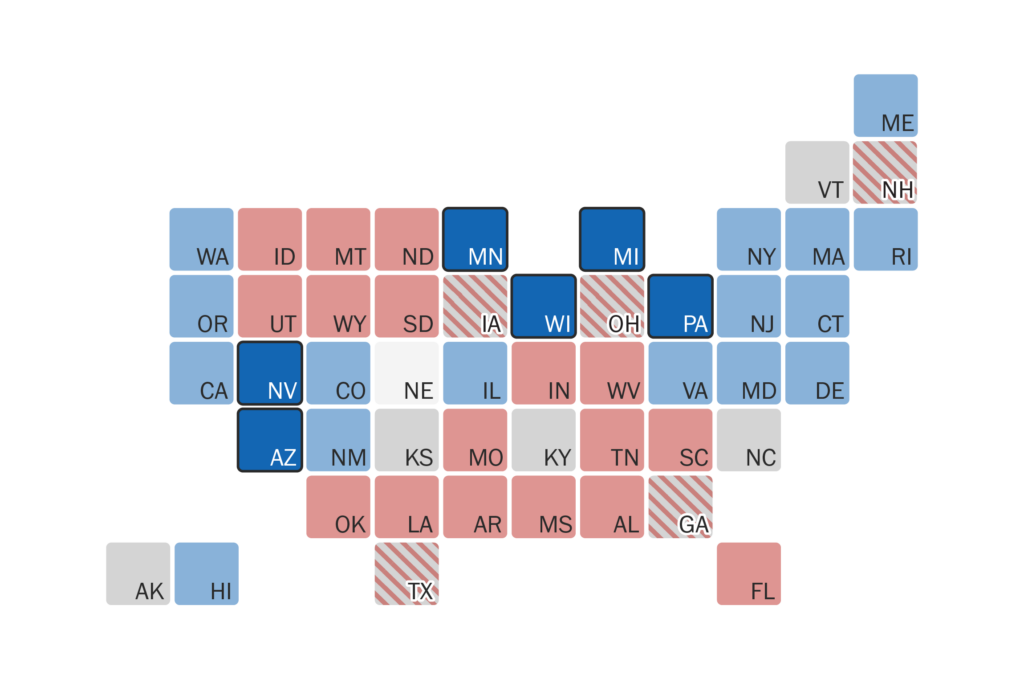
Democrats won sweeping victories at the national level on Election Day, but their victories at the state level may be even more significant for millions of Americans.
Democrats have flipped 12 state legislature chambers and broken Republican supermajorities in 13 chambers. They gained five new governorships and are poised to flip a sixth in Alaska. And six additional states now have Democratic trifectas, meaning control of the governor’s office and majorities in the state legislature: Arizona, Michigan, Minnesota, Nevada, Pennsylvania and Wisconsin.
States have always been the laboratory of democracy, but Congress’ challenges in recent years to pass meaningful legislation — or even to approve the federal budget on time — have made state governments the primary avenue for policy changes that affect Americans.
Democrats’ new state power will allow them to reshape housing, health care, education and child care policies. They can influence how congressional and legislative lines are redrawn, potentially cementing their majorities. The new governors and state officials also form a new bench of political talent for Democrats.
Where Democrats gained new trifectas
Republicans have dominated state politics since 2010, when they flipped more than 700 legislative seats. But this year, Democrats flipped more than 500 seats.
“There’s no universe where I think anybody can say they expected what happened,” said state Rep. Robert Reives, who leads North Carolina House Democrats and is poised to become speaker when his party takes control next year.
Just a year ago, North Carolina Democrats were focused on preventing a Republican supermajority. Now, they are close to having a House supermajority themselves and are likely to be one seat short of control of the state Senate.
Reives said Democrats “were not arrogant enough” to think they would take the majority in the state House and plan to spend the next few months formulating their agenda. Similar conversations are happening in states including Michigan and Wisconsin, where Democrats knew they might reclaim one or both chambers but did not expect the size of the majorities they won.
Leaders of new Democratic majorities say their primary focus is on making life more affordable. Stronger protections for abortion rights, new gun regulations, safeguarded election procedures for 2028, funding for health care and rural hospitals, and the creation of independent redistricting commissions are on the table in various states.
“There are things that states can do uniquely, even absent federal action,” said Debbie Cox Bultan, CEO of NewDeal, a center-left network of state and local officials. “The two things I’m hearing most about from state legislatures across the country right now are bringing down the price of energy, as we head into the winter, and housing costs.”
Republicans are still processing what these legislative losses mean for their agenda, the programs they have recently enacted and the future of their state parties.
Where Republicans lost trifectas
“With the 2028 elections and the next round of congressional redistricting approaching, Republicans must confront the challenges ahead and make a sustained commitment to winning back and defending our majorities,” Edith Jorge-Tuñón, president of the Republican State Leadership Committee, an organization that works to elect Republican state lawmakers, said in a statement. “Democrats made state legislative races a national priority, pouring unprecedented resources into these contests because they understand the power state legislatures hold in shaping policy and building the pipeline for the next generation of leaders.”
State policy shifts
In Texas, Democrat Gina Hinojosa shocked the country by defeating three-term incumbent Gov. Greg Abbott (R), and Democrats also flipped the state House. She has proposed ending GOP programs like the state’s new school voucher program to allow parents to use public funds to pay for private school, which was unpopular in many red, rural communities.
“Profound changes are coming,” said Texas state Rep. Brian Harrison, a Republican who called for a special session to limit the governor’s executive powers while Republicans still control the legislature. Four years ago, Harrison also proposed similar constraints on Abbott’s executive power. “If we don’t limit those, [Hinojosa] may well be able to advance her priorities without passing almost any legislation,” he said Sunday.
While Republicans still retain full control of 21 state legislatures, they lost 13 supermajorities — in some cases losing veto power over incoming Democratic governors such as Ohio Gov.-elect Amy Acton.
Ohio state Rep. Gary Click (R) hoped that Republicans could make changes to expand the state’s school voucher program to include more types of schools in the next session. But he believes such legislation is “DOA now” because Republicans in the House will not have enough votes to override vetoes from Acton, who campaigned on more oversight for the program.
“Democrats are at risk of over interpreting and overreacting to their wins,” Click said in a text message. “It will be a contest over the next two years to see who best interprets the results.”
Michigan state Senate Majority Leader Darrin Camilleri (D) said state Democrats can pass legislation currently hung up in a divided government after winning a majority in the state House and retaining the Senate and governor’s office.
Affordability and health care costs are at the top of the legislative agenda, including a bill to reduce prescription drug prices.
“We now have an opportunity to be a little bit more bold in our agenda because we have some wiggle room,” Camilleri said.
While most Democrats are hyperfocused on affordability, advocates are putting plans in motion to change state policies on issues such as marijuana and abortion. A long-standing proposal to legalize recreational cannabis sales in Wisconsin is now possible with a Democratic trifecta, said state Rep. Jodi Emerson (D). And advocates are urging new state trifectas to expand the types of medical practitioners who can provide abortions, remove existing restrictions on abortion care, fund additional abortion clinics and pass new shield laws protecting anyone who travels to the state to obtain an abortion.
“A trifecta is amazing for us to get in a state with a lot of abortion restrictions on the books,” said Bella Pori, associate director of state policy at reproductive rights nonprofit Reproductive Freedom for All. “It’s just as exciting for us to get a trifecta in a state like Minnesota or Michigan or Nevada, where a lot of the restrictions have been repealed and where there are clear rights to abortion.”
The next redistricting battle
The most unexpected state house flips came in Texas, North Carolina and Georgia, where Democrats overcame district maps drawn to ensure Republican majorities.
After the 2020 census, Republican majorities in many red states drew legislative and congressional lines favorable for the GOP. Wisconsin was ordered to redraw its lines, but Democrats still say they are skewed toward the GOP. Several others, including in Texas, Florida and Ohio, heeded President Donald Trump’s call this year to redraw congressional maps to give their party an advantage in the midterms.
With new majorities, Democrats are hoping they can prevent future redistricting that favors Republicans, redraw lines or establish independent redistricting commissions.
If successful and if Democrats keep majorities after the 2030 Census, the next maps could have a profound impact on the makeup of state legislatures and the U.S. House of Representatives in the next decade.
They don’t have to wait for the census, however. Wisconsin Gov.-elect David Crowley (D) on Sunday said he would sign a bill to redraw Wisconsin’s district lines.
Lawmakers in North Carolina and Georgia, meanwhile, are considering independent redistricting commissions, which would remove redistricting power from the legislature. Supporters say nonpartisan panels ensure maps are fair no matter which party is in charge. After voters’ negative response to redistricting in 2026, some Democratic leaders say a redistricting commission is a more politically palatable than Democrats taking redistricting into their own hands.
“At the end of the day, it is a ridiculous proposition that state legislatures ought to be drawing their own districts,” Reives, the North Carolina legislator, said. “There’s no elected official who’s going to draw themselves out of a seat.”
The post Democratic sweep opens the door for major policy changes at state level appeared first on Washington Post.