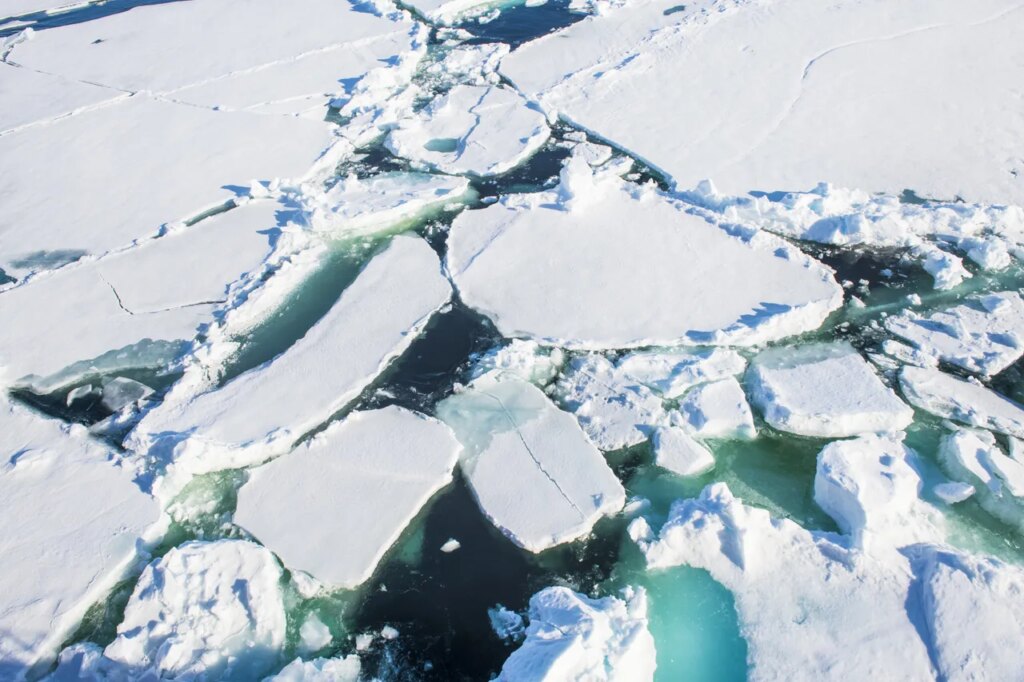
The world is no longer safe for frozen H2O.
New research published in Science on Thursday shows that the conditions that have kept ice, frozen soil, and snow stable are slipping away due to the burning of fossil fuels—and the implications are grave for the entire globe.
The climate of the past 12,000 or so years has been remarkably steady. That’s allowed for all kinds of wonderful things to happen, like human civilization flourishing. But rising temperatures are pushing the climate outside that envelope, and the new research looks at what the team behind the new findings has called the “safe operating space” for the icy, snowy landscape known as the cryosphere.
The scientists looked at changes to polar sea and land ice, mountain glaciers, permafrost, and snow cover over the past 12 millennia to analyze conditions that have allowed both civilization and other ecosystems to thrive. They then identified boundaries on those conditions that, if crossed, would upend the stability and safety humans have enjoyed for millennia.
The results show an “accelerating and partly irreversible loss of cryospheric integrity.” Arctic and Antarctic sea ice have both fallen outside the safe operating threshold, as have snow cover and the area of permafrost—frozen soil laden with carbon. While land ice hasn’t yet fallen out of its safe space, it’s on the brink. And because of warming that’s already been locked into the climate system, it’s likely to also fall outside the threshold in the coming centuries.
While it may feel like the Antarctic ice sheet or permafrost covering Alaska are distant concerns, they’re anything but. The West Antarctic Ice Sheet, which a growing body of evidence shows is nearing the brink of irreversible decline, has enough ice to raise sea levels by 11 feet (3 meters). Permafrost, meanwhile, holds trillions of tons of carbon dioxide. Any degradation means that CO2, as well as even more potent methane, could end up in the atmosphere, accelerating global warming even further. Other examples of major risks abound, including how melting Greenland land ice could slow down or even collapse the ocean conveyor belt that helps keep Europe temperate.
“The consequences of a changing cryosphere extend beyond regions where ice and snow are disappearing,” says Albert Noström, a climate researcher at the Stockholm Resilience Center who co-authored the new paper.
Dipping outside the safe operating space doesn’t mean that the world will see 11 feet of sea level rise in the next year, a trillion-ton CO2 eruption, or a Day After Tomorrow scenario. But it does mean that the odds of crossing dangerous tipping points are rising.
“As we scratch 1.5 [degrees Celsius] and go above it, we are just really gambling with potentially triggering some of these Earth system tipping points,” Noström says. The safe operating space framework also “takes a broader perspective” that assesses slower changes over time and “how far, in this case, the cryosphere is moving away from the conditions that have supported a relatively stable Earth system,” he adds.
Cutting emissions is the most obvious and straightforward way to stop the cryosphere from sliding further outside our comfort zone. But there are a growing number of proposals to pursue more radical interventions that could protect the world’s ice. Scientists have already draped glaciers in the Alps in blankets during the summer to prevent melting. Other researchers have explored techniques to pump cold sea water to the surface to help thicken ice and modeled whether a manmade barrier could stabilize the West Antarctic Ice Sheet.
These geoengineering approaches have the potential to be costly, and there’s no guarantee they would work. They’d also do nothing to stop the root cause of warming: burning fossil fuels. Noström says emissions cuts are the most urgent way to protect ice and snow (and ourselves), but with the cryosphere sliding into a more dangerous space, “in principle, we shouldn’t put the lid on” research for more far-flung interventions.
“The safe operating space is a precautionary framework,” he says. “It ensures that we try to stay as far downstream from the point where these really potentially existential or huge consequences and risks can happen.”
The post Climate Change Has Pushed the World’s Ice Out of Its Safe Zone appeared first on Wired.