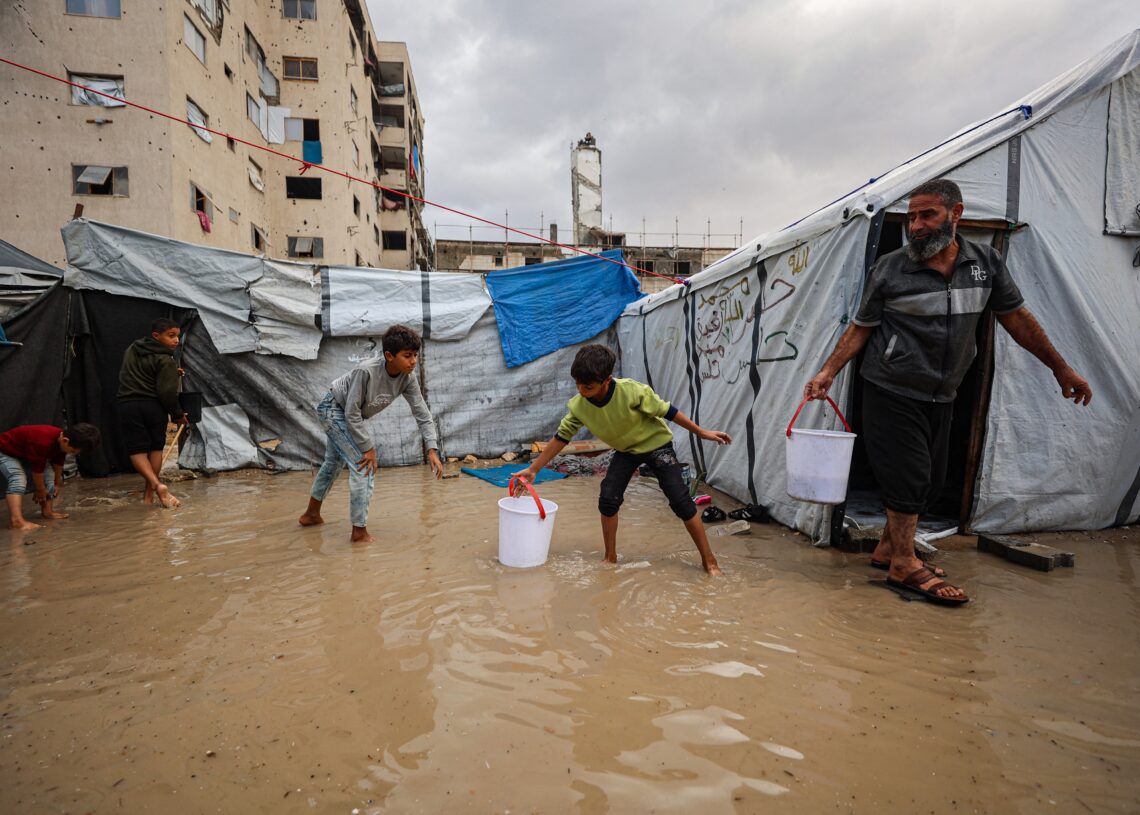
To stay warm, Aya Abu Rayya has covered her children’s bedding with plastic bags. Much of their belongings were soaked after torrential rains flooded their tent this week, and there was little else they could do.
“I am trying to protect them with whatever little I have left,” she said, “but I honestly don’t know what to do.”
This is the case for many in the Gaza, where weekend storms flooded or damaged thousands of tents, killing at least four people and worsening displacement in an area where many are living in deteriorated or makeshift structures ill-suited to harsh winds or cold temperatures. The United Nations estimates nearly a million people are living at sites exposed to medium- or high-flood risk.
Heavy rains also damaged hospitals and learning centers and triggered a landslide south of Deir al-Balah that crashed into tents, killing a woman and three children, according to the Gaza Health Ministry.
Water levels rose to almost five feet in some parts of the enclave, according to Gaza’s Civil Defense, which said it received more than 2,000 distress calls over the weekend.
The disaster has only added to the growing suffering in Gaza one year after a U.S.-brokered ceasefire. Israel still controls more than half of the strip, and attacks continue daily. Israel contends that its strikes are permitted under the peace plan as self-defense against imminent attacks from Hamas. Plans for the militant organization to disarm and for Israel to withdraw have lost momentum, with U.S. attention shifted to Iran and Israel facing the aftermath of an acrimonious election.
Efforts to rebuild Gaza have so far failed. A plan from the Board of Peace — created by President Donald Trump to lead the Gaza peace process — announced in late July would have seen a phased disarmament of Hamas in exchange for gradual withdrawal of the Israel Defense Forces to the “Yellow Line,” where they were positioned when the ceasefire was declared last year. An interim Palestinian government, the National Committee for the Administration of Gaza, would take over, sector by sector, and begin reconstruction. Trump hailed the plan as a breakthrough.
But Israeli Prime Minister Netanyahu rejected the plan in a rare break with Washington.
Board of Peace officials told The Washington Post in October that they have plans prepared for 66 projects in Gaza and at least $280 million to immediately spend on hundreds of thousands of temporary homes, debris removal and hospital repairs.
But the projects cannot begin because the Israeli government has not authorized international troops or newly trained Palestinian police to enter Gaza to begin decommissioning Hamas weapons, board officials say.
Israel has blamed Hamas’s “continued refusal to disarm” as the main obstacle to reconstruction in Gaza.
This week, the board chided Israel, saying the country had not done enough to prepare Gaza for the winter and calling on the government to allow for essential supplies to enter Gaza.
In response, the Israeli prime minister’s office issued a statement saying Israel had allowed “additional humanitarian supplies into Gaza to ease the winter conditions,” blaming Hamas for any shortages. COGAT, the Israel Defense Forces unit responsible for regulating and facilitating aid in Gaza, said that “over 91,000 tents and more than 8,200 trucks carrying winter supplies have entered Gaza.”
More flooding disasters are likely in the coming winter, said Faten Abu Mousa, a Gaza-based aid worker with the International Rescue Committee. She said the lack of a proper sewage system, which was destroyed in the war, will compound Gaza’s problems.
“The most alarming thing now is that this was only the beginning of the winter season,” she said. “When the storm and the rainfall comes back again, we will witness more incidents like this.” She warned that unstable partially destroyed buildings could be a particular danger.
She said since the storm, IRC has received thousands appeals for tents, mattresses and clothes.
Abu Rayya and her family are safe for now, but the floods destroyed what’s left of their few belongings after being displaced. “The hardest part is not just the rain,” she said. “It is being a mother, watching your children shiver from the cold, wishing you could give them warmth and safety, but having nothing left to offer them.”
Gerry Shih contributed to this report.
The post As deadly storms flood Gaza’s tent cities, the displaced fear a worse winter appeared first on Washington Post.