In today’s edition … The life of a newly elected member of Congress … I ask you about Jensen Huang … but first …
The big news
Scott Colom, a local district attorney, officially unseated Republican incumbent Sen. Cindy Hyde-Smith, the Associated Press said Wednesday, a win that my colleague Robert Samuels described as a “breathtaking victory that solidified the Democrats’ ascendance in Washington and the potential for a political realignment in the South.”
Colom is the first Black man popularly elected statewide in Mississippi and its first Black senator since Reconstruction.
More from Robert here.
A new congressman and Democrats’ new priorities
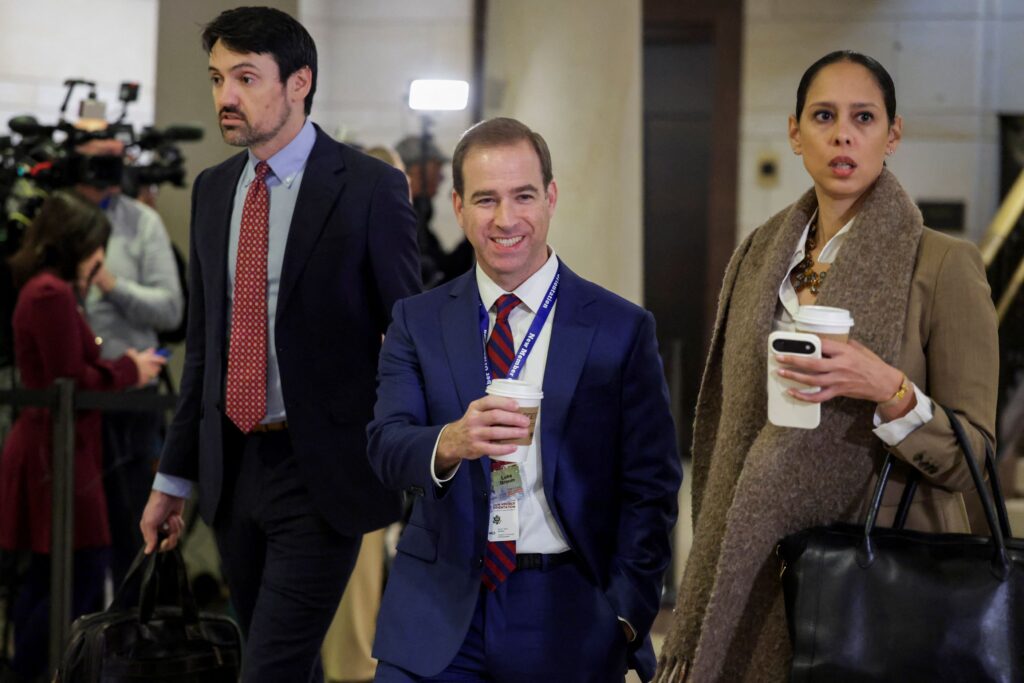
Luke Bronin can’t believe how many new colleagues he has. And the pressure that comes with it.
Bronin, the newly elected Democrat representing Hartford, Connecticut, and its surrounding areas, in the House has basically known since August, when he defeated longtime incumbent Rep. John B. Larson in a contentious Democratic primary, that he was headed to Congress.
But Bronin never thought he would have this many fellow freshmen, calling the size of his class “the biggest surprise” he’s encountered so far in his first few days in Washington.
With the size of Democrats’ majority — which Bronin notes rivals the one the party held when it passed the Civil Rights Act in 1964 — comes incredible pressure, the Democrat said, not only “to shift the political tide” in Washington, but to “restore Americans’ faith that our Congress actually works to do big things.”
One major difference between 1964 and today is that President Donald Trump occupies the White House for two more years, and Lyndon B. Johnson he is not. That shouldn’t matter, Bronin said, arguing that the next two years should show people that Congress is not the president’s understudy but a co-equal branch.
“If we pass bills that would solve problems, and if Trump vetoes those bills, then it’s just more evidence that he doesn’t care about the American people,” he told me, sitting outside the Capitol.
Bronin said he would like his party to focus on passing a broad ban on stock trading, drafting a constitutional amendment to overturn Citizens United, rolling back cuts to food assistance and health care, and tackling affordability issues like high housing costs.
Passing all that legislation is about trying to make good on Democrats’ midterm promises, Bronin said, but also setting the party up for further electoral victories.
“Ultimately one of the most important measures of our success is whether we can help lay the groundwork for a successful campaign to win the White House in ‘28 and give us the chance to make even more meaningful change with a Democratic president and a Democratic Congress,” he said.
Bronin is a Rhodes Scholar, like Maryland Gov. Wes Moore — a Democrat who is openly considering a 2028 run and with whom Bronin roomed during the program. The soon-to-be congressman declined to say whether he has talked to his friend about a presidential run, but said the party has a “deep bench and a great group of candidates” and that he was hopeful to see the kind of “crowded, energetic primary” that the party did not have when Kamala Harris was tapped to be the nominee in 2024.
There will be over 100 new members of Congress when the body is seated next month. And many are in Washington this week for what is effectively a week of onboarding for their new job. Yes, it’s a little different, with party meetings and coalition-building events. But they also have briefings on human resources, getting their new technology, and how to start building a staff.
Each member’s life is changing in unique ways. How do they get home each weekend? Where do they live? What do they do to fill the time when they aren’t working?
Bronin, a father of three, is in the midst of considering all those questions. I asked if he planned to be “Amtrak Luke,” a la Amtrak Joe, and he said it would likely take a “combination of planes, trains, and automobiles” to get back to the district.
Bronin’s primary against Larson was defined by his calls for generational change, a less than subtle reference to Larson approaching 80; the incumbent was running for his 15th term.
The congressman-elect supports term limits — “I think about 12 years is the right amount of time,” he told me — and changes to Congress’ seniority system that allow older members to hang on to power for years. He said he thinks proposals on both are likely coming soon.
“The new class of Democrats that’s coming in is about a decade younger on average than Congress is today,” he said. “But more important than that, this class is bringing in a sense of urgency and impatience [because they] just came out of a campaign where they felt that sense of urgency and impatience among the American people. And that’s going to make this Congress better.”
Want this in your inbox?
Start your day with The Washington Post’s flagship political newsletter. Sign up here.
From across the newsroom
- Democratic sweep opens the door for major policy changes at state level, from Natalie Fertig and Eric Lau.
- The shabby public golf course that became key to Trump’s D.C. makeover, from Rick Maese.
- Millennials had a better housing market than boomers. Then things switched, from Julie Z. Weil.
- Democratic lawmakers apologize after absences on Hegseth vote, from Mariana Alfaro and Anna Liss-Roy.
What I’m watching
Redistricting was a storyline that defined the 2026 cycle. But what about 2028?
The answer is complicated.
Redistricting largely did not work for Republicans in 2026. While they protected certain districts and won a few that were redrawn, the blue wave helped Democrats win redistricted seats in Texas, Florida, North Carolina and Ohio.
But as I reported with Isaac Arnsdorf and Patrick Marley last week, Republicans are defensive about their mid-decade redistricting, arguing the wave would have been even larger without their effort.
Whether it helped or not, it appears that both parties are gearing up for another cycle where redistricting is part of the political arsenal.
Democrats, because of their success in states like Michigan, Wisconsin and Pennsylvania, are in a better spot to redistrict, should they want to. David Crowley, the Democratic governor-elect in Wisconsin, has already said he would sign a bill redrawing the state’s congressional map.
My colleague Gregory S. Schneider reported yesterday that Virginia Democrats are not ready to rule out another swing at redistricting. “We don’t know if we’re going to go back and take a look at that or not,” Democratic House Speaker Don Scott told reporters Tuesday at a briefing to highlight upcoming legislative priorities.
My piece last week highlighted how Democrats expect Republicans to take another bite at the redistricting apple.
“I would want to believe that Republicans would look at a mirror at large and say, ‘This was clearly insane … we shouldn’t do this again,’” said John Bisognano, president of the National Democratic Redistricting Committee, told me before the midterms. “I think it’s more likely that they … turn to gerrymandering in the South, specifically Black districts, to try and take seats back because that’s what they will feel is their only option to try and get back into the driver’s seat.”
As was the case last cycle, one state’s redistricting could kick off a redistricting war. I could see a scenario where a state like Wisconsin, where Democrats have been out of the majority for years, undertakes a redistricting effort, compelling red states in the South to do the same. Or vice versa, with a Republican state kicking things off again.
Either way, I’d prepare for another election cycle partially defined by redistricting.
Programming note
The Washington Post’s fifth Global Women’s Summit takes place today in New York.
The wide array of speakers includes: New Jersey Gov. Mikie Sherrill, Tubi CEO Anjali Sud, WNBA champion Breanna Stewart, astronaut Peggy Whitson, creator Brett Cooper and many more.
You can follow the event here.
In your local paper
Michigan Advance: Data centers have proliferated so broadly that some proposals include putting the controversial projects someplace unusual: underwater.
Tennessee Lookout: A court said this week that Tennessee must continue issuing driver’s licenses to immigrants who have federal work permits. Immigration advocates say hundreds of Tennessee residents have been denied licenses because of their immigration status.
Virginia Mercury: Virginia Gov. Abigail Spanberger and top Democrats unveiled their plans for 2027 this week, pledging action on medical debt and oversight of data centers, all focused on combating rising costs.
From you
Maybe you were skewed by yesterday’s newsletter, but when asked what lawmakers should do next year, many of you said Congress should take action on corruption.
“I have read about it for 2 years. Enough is enough!” wrote Jeannie Meagher. “Let’s make the b—-es pay, go to prison, whatever legal consequence is possible, to make an equal playing field again. … Go get them!!!”
“Americans believe Washington is corrupt, and that it is hurting us all economically. The next Congress needs to address ethics reforms for ALL individuals on the federal payroll, including government contractors,” wrote Bob Miller. “And simultaneously Congress needs to roll back Trump’s tariffs!”
And Jim Whelan was overwhelmed by the sheer number of issues he would like tackled.
“Dems do need to focus on ethics but continue to tie it to how it is costing American voters,” Whelan wrote. “Then they need to extend health care and pass common sense economy fixes. To pay for this, the rich paying their fair share can’t just get lip service.”
Send a reply
I have been fascinated by allegations that Chinese intelligence successfully targeted Jensen Huang, the uber-powerful head of Nvidia, via an affair with a woman believed to be a Chinese spy, and reportedly had a second affair with a Nvidia employee. Should Huang keep his job? With private AI companies holding so much power, how does the government help ensure they aren’t subject to suspected espionage? Let me and your fellow Early Brief readers know at [email protected].
Thanks for reading. You can follow me on X at @merica.
The post A new congressman on the blue wave, 2028 and what Democrats should prioritize appeared first on Washington Post.