
Note: This story contains spoilers from “The Body.”
What is hysteria?
According to Merriam-Webster, it’s “a psychoneurosis marked by emotional excitability and disturbances of the psychogenic, sensory, vasomotor and visceral functions.” More specifically, it refers to behaviors showcasing an abundance of fear or emotion. Historically speaking, it’s a condition that’s long been falsely connected to women. And in “The Body,” a show that centers around a Catholic high school dance troupe’s newbie initiation gone wrong, it’s a phenomenon that seems to be afflicting nearly everyone in a variety of ways.
Netflix’s latest series is part supernatural horror, part queer coming-of-age, part psychological drama, and probably a wee (or a lot) bit blasphemous. There’s also plenty of social and religious commentary throughout. But if that doesn’t bother you, step right in because the water’s just fine. Think “Yellowjackets” meets “Gossip Girl,” but heavy on the Jesus, and sans the big-name stars. And the thing is, it doesn’t need them. Creator and director Quinn Shephard has successfully paired a cast of (mostly) relative newcomers with a wickedly fun storyline that results in a seriously good show.
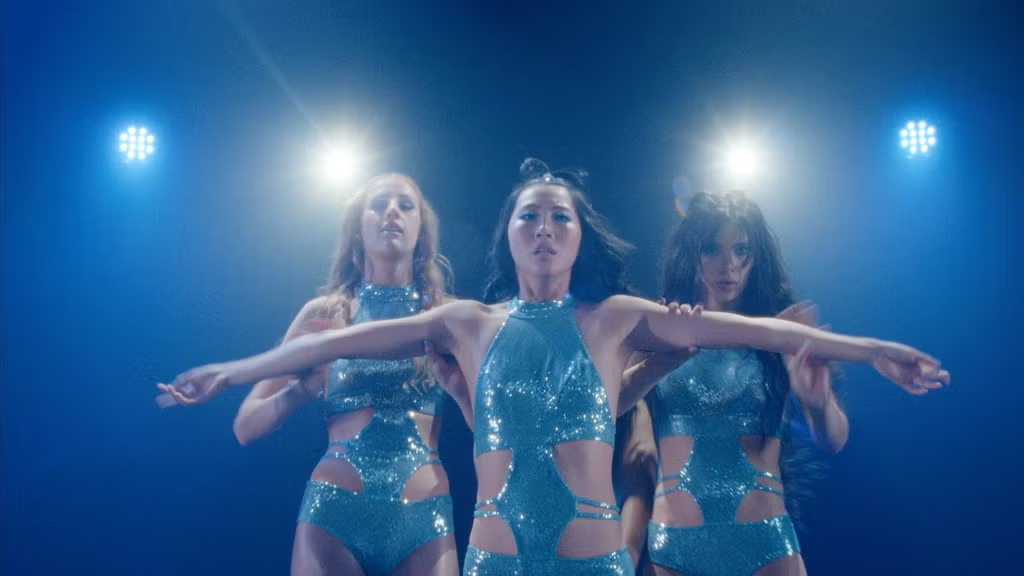
“The Body” kicks off on Halloween 2004, complete with AOL instant messenger, Kelly Clarkson ringtones and Bush Jr’s second term in office. Co-captains Anya Butler (Kristina Bogic) and Elise Zakaria (Sara Boustany) are leading the effort to help find a new member for the Lions dance team before they start competitions. Among the girls auditioning are Grace Franklin (Sofia Wylie), whose uncle also happens to be the school’s “hot” priest, and Lisbeth Anderson (Geena Meszaros), a peculiar new student whose randomly bleached eyebrows make her seem all the creepier.
While both girls end up invited to a Halloween party hosted by the Lions that night, Grace is the only one who gets initiated onto the team. In an impromptu and clearly playful ritual, Anya and Elise offer up Grace to the devil as a “sacrificial virgin,” pressuring her into taking ecstasy with the girls. It all goes well for a while, until it doesn’t. And when Lisbeth figures out she can exploit Grace’s inability to fully join the team, she does so with the fervor and dedication her mother and late father had for their snake-handling church. By the time the first episode ends, you’re already beginning to question what is reality and what is imagined, especially when an impromptu dance number comes into play. It’s perhaps the only moment that took me out of the magic on the first watch (but felt more in place the second time around).
What follows is an exploration of faith and religion, and how much of it can all too easily be manipulated by injecting a little bit of hysteria here and there. It’s also, perhaps on a slightly less explicit note, an excavation of the real harms experienced by queer people simply trying to exist in an oppressive, religious landscape.

There are a few main storylines happening in “The Body.” When Grace is found unresponsive in her bedroom the day after the party by Leo (Lisbeth’s awkward brother whose disturbing drawings of Grace lead many people to assume the worst), questions and speculation begin to percolate throughout the community. This only becomes worse when several of the Lions begin to report having nightmares, and later, “visions” of Grace. Suddenly, it’s not just that Grace has fallen ill in some way. There’s a spiritual component.
Lisbeth, having grown up in an extremist religious environment herself, knows full well that it’s often possible to exploit people’s faith. In her church, she was sought out to place hands on people in order to heal them. She’s witnessed the ways in which her touch managed to cause the faithful to believe she had imbued some kind of healing power over them. While we initially want to believe that maybe there’s some goodness to Lisbeth, it’s clear from her behavior that she’s more than OK with exploiting people’s beliefs for her personal gain. And in this case, what she wants is to belong, specifically with the Lions. From small suggestions to full-on blackmail, Lisbeth manages to gain more and more control over her situation by prompting more and more hysteria among the team and community at large.
Meanwhile, Grace’s other loved ones, including her uncle, her parents and her best friend Maddie, are all having their own crises around what might be happening with her. Father Franklin (Nnamdi Asomugha) goes from wondering if Grace is actually possessed (at one point attempting an exorcism on her) to wondering if she might hold some sort of spiritual power. Maddie, meanwhile, questions why she’s one of the only ones on the team who hasn’t had a vision of Grace. Then, after an incredibly intense scene involving a round of confessions (where Lisbeth appears to be invoking the “Walk of Shame” scene from “Game of Thrones”), Maddie begins to believe she’s been healed by Grace.
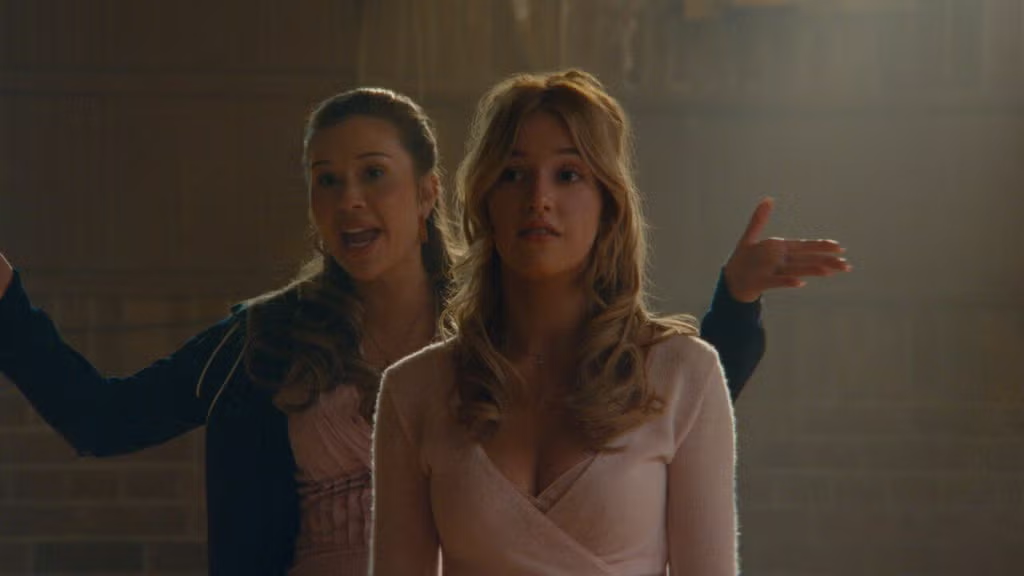
And then there’s Grace’s father, who left the church a long while back and is often the only voice of reason in many episodes. Even he begins to question everything after hearing the testaments from townspeople believing Grace has somehow healed them. It’s almost as if an intense and difficult-to-accept situation (such as Grace’s condition) is fodder for prompting people to believe in all kinds of things they typically wouldn’t.
The other storyline has to do with Anya and Elise. From the start, you can tell that there’s something more than friendship going on between this pair. Yet every time it feels like something more is finally going to happen, Anya pulls away. She uses her boyfriend, Steven (Orlando Norman), as the main excuse. But she also doubles-down on not being gay (because as a Catholic, gay means never getting married or having kids or being “normal”), despite clearly hurting Elise every single time.
In one scene, Anya attempts to have her cake and eat it too, initiating a threesome between herself, Elise and Steven, only to have Elise leave in hurt and frustration while Steven is continuously clueless. It’s only until Elise calls out the extent of the harm that Anya’s lies have caused that the latter begins to recognize the harm she’s doing to herself and her more-than-best friend.
There’s no doubt that a show that confronts both religious hysteria as well as religious coverups is going to ruffle some feathers. This is only compounded by the amount of queer subtext that’s visible throughout — one of the first scenes involves the young dancers helping each other stretch in highly suggestive poses until Elise blurts out, “You guys look like a bunch of dykes!” A bit of playful foreshadowing, perhaps.
Ultimately, it’s the kind of show that keeps you locked in, immediately pressing on “Next Episode” before the credits have started rolling. Don’t expect any massive scares, as it definitely leans less horror and more supernatural. Instead, embrace the mid-aughts vibes and mystery. Because one thing’s for sure: even though we know a lot of the hysteria is fabricated, a lot of questions remain unanswered by the end of this season. And whether there’s more to Grace (or Lisbeth) than meets the eye is something that will hopefully (or even god-willing) be answered with a second season.
“The Body” is now streaming on Netflix.
The post ‘The Body’ Review: Netflix Mixes Dance and the Devil for Wickedly Addicting YA Drama appeared first on TheWrap.