The eagle cam entered my life like most things: through my phone.
It was the middle of winter, the sad dark stretch when the sun seems to set before it rises, when the snow outside is dishwater gray, and I was handling it the way I always do: vegetating under a mound of pillows, poking at my glowing screen, praying that the internet would serve me something good — not the usual toxic fire hose of spam, slop, bots, gambling ads and phishing links.
Finally, my phone buzzed.
You have to check this out, my friend texted. It’s the only thing bringing me joy right now.
And he sent a link to the eagle cam.
It looked promising. Apparently, somewhere out in the wilderness of California, at the top of a very tall tree, two bald eagles were living in a nest, doing their best to survive and thrive and produce the next generation of eagles. The whole adventure was being livestreamed, 24/7, via a camera clamped to the tree. My friend said he couldn’t stop watching.
I clicked.
Instantly, a new world filled my screen. At the bottom, dominating the foreground, was the nest: a big messy tangle of sticks and branches. Behind that, stretching off to infinity, was a panoramic view that looked too good to be true: green forest, blue water, purple mountains. It looked like a Renaissance painting of the Garden of Eden — the sort of sun-splashed paradise the word “sublime” was invented to describe.
The feed seemed to have a good microphone, because as soon as I clicked, all the noises of the forest came pouring into my house: songbirds chirping, ravens croaking, woodpeckers hammering out their overlapping drum rolls — and, over it all, the constant roar of an oceanic wind, a big crashing whoosh that thrashed the treetops, so loud and harsh it sounded like fire.
Just a glance at the eagle cam made me feel lifted, extracted, as if I’d been plucked out of my sad little ground-bound life and set back down somewhere primal and real. (To be clear, I was still under my pillows.) I wanted to live there, in this fresh, wild world.
The biggest surprise was the eagles themselves. It turns out that actual eagles are not like the eagles we see on coins and flags and football helmets. They are fully embodied beings: loud, fierce, clumsy, majestic, grouchy, funny and (I say this affectionately) weird. Real bald eagles have big, round, yellow eyes that make them look as if they’re in a constant state of shock and rage, as if someone has just leaned down and whispered the most scandalous possible secret and they are trying to find someone to murder. They have no sweat glands, so on hot days they open their beaks and pant like dogs. Real bald eagles don’t make epic shrieking noises the way they do in movies — they grunt, honk, purr, squeak and chirp. Above all, bald eagles seem to be obsessed with collecting sticks. They pick them up in their deadly beaks and then clack them around, semirandomly, until they fit into the ever-growing puzzle of the nest.
Animal cams! The world is full of nests and dens and warrens and holes — private spaces full of creatures doing secret things. For nearly all of history, what happened in those places stayed hidden. But modern humans, stuck in our offices and studio apartments, armed with tiny cameras and pocket computers, have breached the boundary. We spy. These days, the animal-cam options are endless: flamingos in Houston, red pandas in San Diego, naked mole-rats in Washington. (The National Zoo even designed bingo cards: Fill in squares for “a mole-rat eats corn” or “a mole-rat kicks bedding around” or “a mole-rat runs uphill in tunnel.”)
Amid this cornucopia of cams, the eagle cam has built up an unusually passionate following. It was installed, back in 2015, by an environmental group called Friends of Big Bear Valley, an area that contains Big Bear Lake. The group hired a wildlife biologist to scale the 150-foot tree using ropes, no spikes, and stand in the nest to attach the cam. During the first few years, its popularity grew modestly. Then the pandemic hit, and — as with many other forms of virtual escape — the livestream took off. A whole global community, numbering in the hundreds of thousands, sprouted up online.
All over the world, the eagle cam functions as a sort of existential screen saver — a positive alternative to the doom and gloom of the 24-hour news cycle. Elementary school teachers often play it in their classrooms. Doctors play it in waiting rooms. Eagle-cam fans flock to message boards to discuss the birds’ lives. They post supercuts on YouTube and buy official merch and study charts cataloging all the activity around the nest: intrusions from pesky ravens, night visits from flying squirrels.
By the time I started watching the eagle cam, its two stars — Jackie (female) and Shadow (male) — had already worked their way through the fragile early stages of eagle procreation. In late February, cam fans celebrated as Jackie squeezed out two eggs: off-white globes roughly the size of human fists. Then people crossed their fingers as the parents took turns incubating the eggs, hunkering down day after day to protect them through rain and snow and hurricane-force winds.
This is what separates the eagle cam from most other animal cams: stakes and intimacy. We are not watching a carefully managed zoo enclosure — we are watching a life-or-death struggle at the top of a tree. Also, the eagle cam makes us feel as if we are inside that nest — almost part of that family. Every year, with each new mating season, the stakes refresh. Will the eggs hatch? Will the babies grow up and successfully fly? Because of the intimacy, those questions don’t feel abstract. They feel personal.
In early April, there was an eruption of online celebration when the first tiny cracks, known as pips, ruptured the surface of the shells — and then more celebration, in the following days, as the eggs cracked open to spill out two gray-white puffballs. Viewership spiked as the babies squeaked and chirped and whistled at their harsh new world, as the parents fed them chunks of fish from the lake, as the puffballs’ bodies began to grow and stretch to gangly proportions, as their feathers turned from gray-white to dark gray to brown. On the livestream, viewers sent constant streams of little hearts floating up the screen.
By late spring, the baby eagles had reached adult size. They looked streamlined and predatory. The nest was getting crowded. Jackie and Shadow spent most of their time perching on nearby branches.
But the babies couldn’t fly. Not yet. This was the next step in the drama, the moment we were all waiting for: fledging.
I found myself opening the eagle cam constantly, especially when I was stressed.
At the moment, the babies were spending a lot of time “wingersizing,” flapping and flapping, building up strength, feeling the wind. But soon they would leap. I became invested in their success. I started to fantasize about going to Big Bear Lake to try to see it happen. I wanted to cross the bridge between the digital and the real, to replace that onscreen paradise with something solid. What if I could be there when the babies finally took off? And then I could crawl into the nest in their place? Maybe all my problems would be magically solved.
The closest you can get to the nest is out on the water. So one morning in mid-June, after flying to Los Angeles and driving 90 miles east up twisty mountain roads to Big Bear Lake, I found myself boarding a pontoon boat for an eagle tour. My guide was Jenny Voisard, the media liaison for Friends of Big Bear Valley, the nonprofit organization that runs the eagle cam. Voisard was basically Jackie and Shadow’s official P.R. rep. Whenever something major happens on the livestream — egg-laying, hatching, fledging — she works round the clock to answer emails, field interview requests and appear on radio and TV.
I asked if she ever got sick of talking about eagles.
“Never,” she said. “It’s my favorite topic.”
I 100 percent believed this. Voisard, it quickly became clear, revered these birds. She started watching the eagle cam in 2022, obsessively, after a series of personal heartbreaks: the death of her first husband, the discovery that she couldn’t have children. The eagles swooped in to help fill that huge space of loss. Watching the eagle cam brought her peace. She loved, in particular, a charismatic baby eagle born that year named Spirit. In 2023, some months after Spirit fledged, Voisard started working for Friends of Big Bear Valley.
Sadly, Voisard said, bald eagle life is not always peaceful and relaxing. It can be ugly and harsh — as tragic as the tragedies we are trying to escape. As it turned out, 2023 was a hard year. Jackie and Shadow’s eggs didn’t hatch. Ravens invaded the nest. Shadow, in particular, seemed to struggle with the loss. He would just stand there, Voisard said, not knowing what to do.
“Jackie helped him,” she told me. “It took a couple days. And then he kind of got back to normal. He started bringing sticks back. And then they started mating again.”
Voisard said that the eagles’ resilience inspired her. If they could get through this stuff, she thought, the rest of us could too. She said she frequently finds herself thinking, in her daily life, What would the eagles do?
On her first in-person trip to Big Bear Lake, Voisard had what she describes as a “religious experience”: Shadow came diving out of the sky, right next to her boat, and snared a fish out of the water.
This is exactly the kind of magic I was hoping to see out on the lake.
The boat motored on until we reached a little cove — and then Capt. Mike Marzell, the Big Bear Valley resident at the wheel, cut the motor.
We sat there, bobbing, several hundred feet from shore. I stared but couldn’t find the nest anywhere. I saw distant gray boulders. A chunk of deep green forest.
Finally, Voisard pointed my attention to a thin trunk poking up, all alone, with a dark smudge at the top. That was the nest.
And at this decisive moment I thought, Hmm. Based on my research, I knew that eagle nests are huge. The word “nest” hardly does them justice. Jackie and Shadow’s nest is roughly the size of a small car — six feet across and nearly that deep, weighing hundreds of pounds. It sits wedged, solid as a bunker, near the top of this tall, skinny tree.
From the water, to my weak human eyes, the nest was just a blob. Above the blob I saw a tiny space — a pinhole of blue sky — which occasionally seemed to flicker in a way that reminded me of a blinking eye.
That, apparently, was the eaglets, Sandy and Luna. (Friends of Big Bear Valley received nearly 64,000 submissions for this year’s naming contest; the winning names were chosen by local third graders.) They were flapping their wings, practicing, building up the strength to fly.
We sat in that cove for a long time. As we talked, fish kept popping out of the water to snag bugs, splashing back down at odd rhythms around us.
Up to this point, my visit to Big Bear Lake was going just as I expected. Big nature, big nest, big feelings. Then things got slightly weird. It started with Captain Mike.
He struck me as a perfect embodiment of Southern California. He was 60ish, with a grizzled white beard that contrasted starkly with his tan skin. He wore a backward baseball cap, plus a Los Angeles Dodgers tank top, plus a pair of those reflective blade sunglasses that appeared suddenly on many Californians’ faces in the 1990s in the same way that hoofs once appeared on certain mammals during the Eocene Epoch. His voice was low and gravelly, but he had one of the purest California accents I’ve ever heard, almost like a Valley Girl in a movie: His vowels were squashed, and his speech rhythms went pogo-sticking up and down in ways I can’t possibly convey without sprinkling in a bunch of diacritical marks like a linguist or a 1980s heavy metal band.
Captain Mike’s tour of the lake was jaunty and loosey-goosey and fun. Early on, when I asked him how fast his boat could go, he answered, cheerfully, “The mile-per-hour thing is broken.”
He steered us past the highlights: the dam, Boulder Bay, multimillion-dollar mansions on the shoreline. He pointed out a spot where the eagles used to perch — until the owners cut the tree down because they got tired of all the eagle poop. We stopped for a while to watch teenagers do cannonballs off a giant boulder. The whole time, we scanned the sky for eagles. But they were nowhere to be seen. We would get excited — but it would turn out to be just a hawk or raven or vulture. (Cam fans have a word for these kinds of false sightings: eagle-lusions.)
As Captain Mike steered, I kept admiring his tattoos: two big portraits of Jackie and Shadow, one on each shoulder. When I asked when he got them, he chuckled.
“Five years ago,” he said. “I was married for 30 years. I got a divorce. And I got these tattoos right after my divorce.”
Over the course of our tour, Captain Mike told us a number of things about his divorce. It seemed to be woven into every other subject, including the eagles. At one point, he said he would like to wear a shirt that says: “I IDENTIFY WITH MR. B.” Mr. B was an eagle that used to live at Big Bear Lake — Jackie’s mate before Shadow came along. Captain Mike spoke about the bird wistfully, like an old drinking buddy.
“He’s the original,” Captain Mike said. “Shadow chased off Mr. B.”
At this point, Voisard jumped in. Technically, she said, Shadow just hung around near the nest, and Mr. B left of his own accord. There was no fight or confrontation.
“As far as I’m concerned, he chased him off, darn it!” Captain Mike said, laughing.
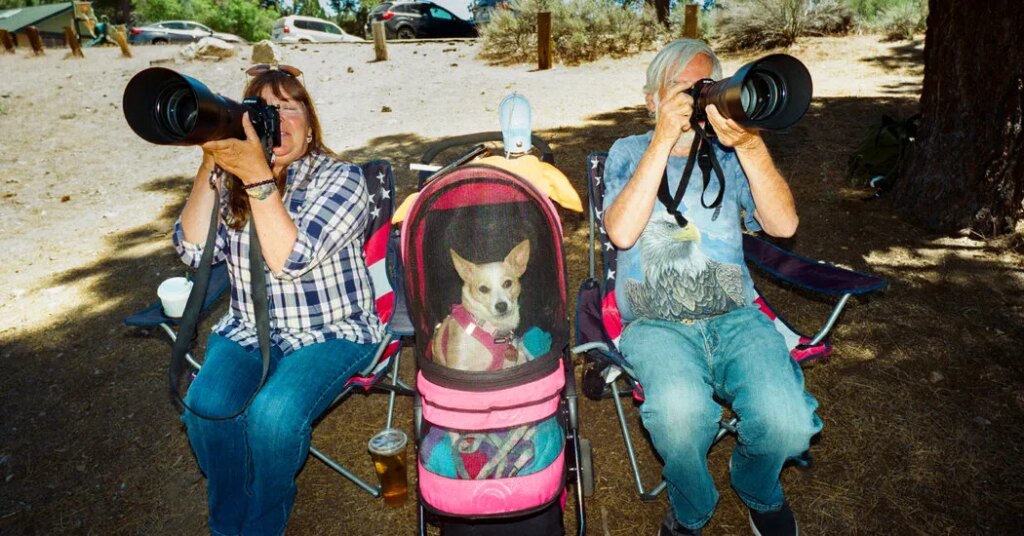
Partway through the tour, we made a brief stop. Voisard wanted to show me Dana Point Park — a local birding hot spot, just off the water, where eagle lovers come from all over the country to congregate and admire the nest. We docked the boat and made our way to an open area, where a smattering of people sat hunkered down with telescopes and binoculars and telephoto lenses the size of Civil War cannons. We were just getting our bearings when, out of nowhere, pandemonium broke out.
The first thing I heard was Captain Mike’s shouting.
“Guys, that’s her!” he boomed. “She’s here! That’s my ex-wife! I can’t be here!”
He started moving back toward the boat.
It turned out we had, unwittingly, stepped right into the teeth of a serious local drama, and the drama seemed to have multiple rows of teeth — because, as I did my best to listen to Captain Mike’s explanation of the complicated and agonizing aftermath of his divorce, an argument was breaking out somewhere off to my right. Mike’s ex-wife was also apparently an eagle enthusiast, and she had some longstanding criticisms of Friends of Big Bear Valley, which she was making known. “We can’t be here!” Mike shouted.
I was stunned. I felt as if I had walked into a meditation class and ended up in the middle of a brawl.
Somehow, a little shellshocked, we all ended up back on the boat. We rode for a while in silence. The eagles did not appear.
Friends of Big Bear Valley was led, for more than 20 years, by Sandy Steers, a fierce environmentalist whose life mission was to stop developers from swallowing Big Bear Lake. Steers was a mystic and a nature-lover — but also a fighter. Everyone I talked to had stories about her. She drove like a maniac. She let wild animals — chipmunks, birds — have free access to her house. She was a shaman and an energy healer. Once, when officials thinned out the forest in the name of fire prevention, Steers walked through the area and said she could feel nature suffering.
She was determined to stop that suffering using every possible tool. And her most powerful tool, arguably, was the eagle cam.
In Southern California, fighting development is like trying to fight gravity. One of the greatest impediments to conservation is that, most of the time, it is hellaciously boring: slow, grinding, legalistic. The eagle cam gave that fight a face — two faces, actually, with sharp, bright yellow beaks. Friends of Big Bear Valley no longer had to ask for help with abstract things, such as donations to defray legal fees that might delay developers from getting permits. They could just say, “Help us save the eagles.” It was a fund-raising bonanza.
But with global attention comes local resentments. In a small territory like this, it’s no surprise that people get territorial. And sometimes the fighting turns nasty.
Late one afternoon, as the sunbeams slanted low over the lake and the eaglets flapped in their nest, I took a break from watching the eagle cam to go interview Mayor Randall Putz, of the city of Big Bear Lake. Although it turns out I didn’t actually have to take a break from the eagle cam, because there are screens everywhere in Big Bear Lake — it feels as if the town is throwing a citywide Super Bowl party, except the football was birds and the game never stopped. Right behind Mayor Putz’s head, on a big flat-screen, was the eagle cam. I kept glancing at it as we talked. One of the eaglets seemed to be watching us, listening in, turning its beak in a way that made its head line up with the mayor’s.
We were talking in the mayor’s shop. You are going to think I am making this up, but I swear: The mayor of Big Bear Lake owns a bird supply store. It’s called Chirp Nature Center, and it offers not only sommelier-level blends of seeds (“tested and approved by Big Bear Lake’s pickiest backyard birds”) but also everything else a birder could ever want: binoculars, field guides, birdhouses, birdbaths, birdbath accessories that make the water warm and bubbly so the birds can enjoy some hot tub action, etc.
Mayor Putz confirmed my impressions of Big Bear Lake. It is, he said, a complicated place, for multiple reasons. One is geography. The place sits up in the mountains, and they are not normal mountains but what geologists call a “transverse” range, which means they run sideways across the map, east-west, on a continent where most ranges run up and down. This produces, among other things, extreme weather. Big Bear Lake is prone to monsoon rainstorms, hurricane-force winds, sudden wildfires, punishing blizzards. Several winters ago, it suffered an event locals remember as “snowmaggedon” — a storm so heavy and sudden and cold that people in the valley actually died.
Big Bear Lake, then, is not exactly the natural paradise we imagine from the eagle cam. Even the lake itself, I learned, isn’t natural: It was first created, 150 years ago, by a San Bernardino Valley citrus farmer who dammed the marshy valley to make himself a reservoir, drowning 9,000 trees in the process. Like much of the rest of Southern California, it is human-made — as artificial, in its way, as Disneyland.
I shouldn’t have been surprised. I mean, this is the lesson of many of the oldest stories in the world: Paradise, the thing we want so desperately, not only does not but cannot exist — not for us, not in this world. And yet we won’t stop running toward it. It is the banana peel we will never stop slipping on.
Complicated places spawn complicated politics. Over the decades, many different cultures have collided in the tiny space of Big Bear — hippies and libertarians and Hollywood moguls — and they all tend to have different agendas. One long-running battle is over the development of a place called Moon Camp, the last undeveloped piece of shoreline on the lake. Steers worked, for many years, to hold off developers.
The fight over Moon Camp was coming to a head that summer. Friends of Big Bear Valley was desperately trying to raise $10 million to help a conservation trust buy the property before a July 31 deadline. Despite their best efforts, they were more than $5 million short.
Sadly, Steers died of cancer in February, just a couple of weeks before Jackie laid her eggs. The eaglet Sandy was named in her honor.
Most Big Bear residents I spoke with love the eagle cam but also complain, good-naturedly, about the side effects of its popularity: traffic from tourists, screens all over town. One afternoon, in the lobby of my hotel, a desk clerk named Bethany was making me laugh. There was a big flat-screen mounted behind the desk, and on the screen the babies were really going for it: sticking their huge wings up into steep V’s, flapping down hard and also jumping up and down as if the nest were a trampoline. It looked to me as if this might be our moment: I might get to see the eaglets fledge right here in the hotel lobby.
Every time the eagles jumped, Bethany yelled at the screen: “GO! FLY! YOU’RE SO CLOSE!”
She was not yelling in the spirit of gentle encouragement you would have heard from most tourists. She was yelling like a parent whose children were irritating the hell out of her in the kitchen an hour before a dinner party.
Bethany told me she grew up in Big Bear Lake and could remember the place before the eagle cam took over. Although she wished the babies well, she was also tired of looking at them. She wanted them out of her life. She said she had an irrational fear of birds, including the eagles: Whenever she drove around the lake with her windows down, she imagined Jackie or Shadow flying into her car, crashing around. As soon as these eaglets fledged, she told me, she would be allowed to switch the hotel TV to something she found more interesting: a live feed of bears in Alaska.
“GO!” she yelled at the screen. “GET OUT OF HERE!”
During my time in Big Bear Lake, I went as often as I could to Dana Point Park. I went partly to see the eagles, but mostly to see the people who were seeing the eagles.
The name Dana Point Park makes the place sound fancy. It’s not. The first time I went on my own, I almost drove right past it. It’s on the wild north side of the lake, near Moon Camp, on a road so narrow and windy I was always imagining 50-car pileups. There’s not much there: a little parking lot, some docks. Right on the dirt, in clearings among the trees, people set up camping chairs. They pull out binoculars and telescopes, aim them at the eagles’ tree and then just hang out for hours. It’s like a family reunion.
I talked to Scott Hicks and Dawn Dimanno, a couple who had driven several hours to set up their big orange telescope, which was now trained on the nest, and were sharing it freely with other eagle watchers. They told me they’ve been watching the cam since 2019, back when there was a baby in the nest named Simba. Remembering him still made them grin. “He was just loud and obnoxious and funnier than anything,” Dimanno said.
Dimanno told me that, during Covid, she watched multiple animal cams at once — but she racked up a such a big cellular data bill that Hicks told her she had to choose just one. It wasn’t a close call. She chose the eagle cam.
Up in the parking lot, I met Alicia Ferraro, an eagle-cam superfan who had driven eight hours from Carson City, Nev. On her dashboard was a yellow rubber duck with its head painted like a bald eagle’s. She said the long drive was absolutely worth it. She got to go to Sandy Steers’s memorial service, where people sang and shared stories. And a couple of days before, for the first time ever, she saw Jackie flying across the lake, chasing a raven. Ferraro said her heart was pounding the whole time.
At Dana Point, I kept asking the eagle watchers a question that wouldn’t stop needling me. Why were we here? Why had we come all this way to visit the eagles in person — to get a worse view of something we could have stayed home and watched up close, in high resolution, on our screens?
“When you’re looking at it from the camera, you only see the nest,” Dimanno said. “And there’s so much more that goes on around it.”
Just before we talked, Hicks and Dimanno had spotted Shadow bringing a fish into the nest. And as they looked at the eagles through their telescope, the eagles kept staring directly back at them. Dimanno said the birds must have noticed the sun reflecting off the mirror.
“It’s a shared experience,” said Andrea Prince, who was watching the nest through a pair of binoculars she kept on a gold chain. “I feel like I’m here with them. I’m part of that moment.”
Prince lives in Los Angeles but drives to Big Bear Lake as often as she can. She told me that watching the eagle cam helped get her through chemotherapy, when her mind was so foggy she couldn’t concentrate on anything else, even short TV shows. Her kids tease her for coming here so often, but she said the cam is no substitute for the reality of this place. She said it’s like going to a concert instead of just watching a recording.
This was true. The view on the eagle cam is beautiful and close and special and precious. But it’s also flat and disconnected. It lacks context. The view in the background is a just that: a view. It’s not a three-dimensional space. But here in Big Bear Lake, everything was real and interwoven. The fish that jumped offshore, at Dana Point, were the same fish the eagles ate. The wind that ruffled my hair was the same wind that ruffled the eagles’ feathers. You understood, viscerally, where these eagles fit into the world, and where the world fit into the eagles.
In the end, despite staring at the sky until my eyes hurt, I never saw Jackie in person. I saw Shadow, in the distance, perching. But the great mother stayed hidden. On my last evening at Dana Point, I sat alone on a dock, facing the nest, for a long time, hoping to see Jackie flying. Fish kept jumping all around me, and I kept picturing her swooping down, through the dusky light, to snag one before bedtime. But she didn’t. The light was nearly gone; the mosquitoes were eating me. I gave up.
Driving away, back down that twisty mountain, I remember feeling sort of proud of her. Jackie was a wild creature — a real bald eagle. We can surround her and set up cameras and lie in wait all we want. But no human can force her to perform. And that was the way it should be.
When I left Big Bear Lake in late June, the fund-raising for Moon Camp — despite more than 25,000 donations — was still well short of the $10 million purchase price. On July 24, a week before the deadline, Friends of Big Bear Valley announced miraculous news: A $5.5 million donation had arrived to fill the gap. It came from the OpenAI co-founder Greg Brockman and his wife, Anna. Anna, it turned out, was a huge fan of the eagle cam.
Sandy and Luna continued jumping and flapping, preparing for their big moment of flight, until nearly the end of June. People fantasized that they might actually fledge on July 4, America’s 250th anniversary — an irresistible confluence of patriotic symbolism. But they didn’t wait that long. On June 28, the eaglets were exploring the branches just outside the nest — an area cam fans call “the front porch” — when Luna made a misstep and accidentally knocked his sister off the branch.
This happens sometimes — cam fans call it “fludging” (a fudged fledge). Still, it was terrifying. People didn’t know, for a while, if Sandy was OK. They could hear Luna, in the nest, making desperate “squee” noises.
Turns out, Sandy was fine. And, stuck outside of the nest, at this strange lower elevation, distressed and confused, Sandy took the only way out: She flew.
Luna, suddenly alone in the nest for the first time in his life, stared out on that landscape with new eyes. The next day, after testing his wings some more, he leaped and soared.
It was June 29. After all that drama, the nest was empty.
For a few weeks after they fledged, the baby eagles came back to the nest, occasionally, until they got the hang of things. Then they left to explore new territories, to meet new eagles, to build their own nests and start their own families in some other paradise — almost certainly one that would not be on camera.
At Big Bear Lake, meanwhile, the parents’ lives went back to normal. They gathered their strength to prepare for the cold weather. Soon, together, they would start to fix up the nest for the following season.
Except not this time.
In early July, after the big fireworks shows, Jackie fell into a rapid decline. The biggest, strongest eagle on the Big Bear Lake suddenly appeared to be weak and lethargic. On July 12, she flew out of the nest for the final time. Later that week, she was spotted standing on the ground near the water. She had collected some fish, and two younger bald eagles, apparently visiting from another territory, swooped down and tried to take them. Jackie rolled over, fending off the invaders with her talons. Finally, they left. Jackie just stood there, exhausted, unable to fly.
In the aftermath of that fight, Jackie was captured and taken to a bird hospital in Ojai. As the news got out, eagle lovers sent tributes and supplies: letters, water, salmon from Alaska. The doctors did the best they could, but Jackie kept declining. She got weaker and weaker. Then, shockingly, she died. (An autopsy later revealed that she had been suffering from avian flu.)
Expressions of grief poured in from around the world. Jenny Voisard did 22 interviews in two days. The Friends of Big Bear Valley shop sold out of everything. Memorial posts flooded all the eagle-related corners of the internet. Someone posted an elaborate memorial to Jackie in the temple at Burning Man.
Now it was only Shadow.
Soon, however, a new bald eagle was hanging around the area. It perched nearby, not getting too close but also not going away — just as Shadow once had, back in the era of Mr. B. Shadow seemed to tolerate this new bird. Biologists identified it as KD1, a female from the Prado Basin area, roughly 70 miles to the southwest. Soon, eagle cam fans seemed to accept her. They started calling her Kaydee. She got closer and closer to Shadow. On Sept. 12, exactly two months after Jackie left the nest for the final time, Kaydee flew off — and then returned, with a stick in her beak: the first move in the yearly ritual to prepare the nest for next season.
The post I Visited Big Bear Lake’s Famous Bald Eagles and Found Very Human Shenanigans appeared first on New York Times.