With so many midterm campaigns and elections this year, how did The Times decide which ones to cover deeply? And how did we tackle reporting on the Mississippi Senate race — no one’s idea of a battleground a year ago?
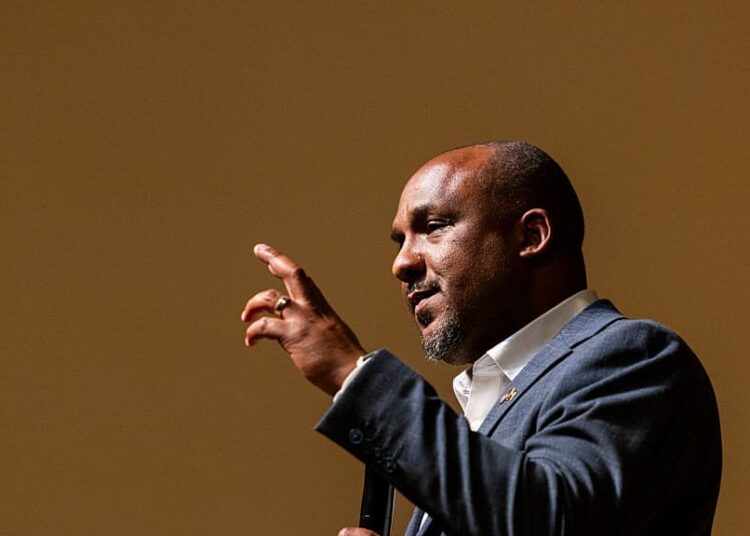
Scott Colom, the Democratic candidate in Mississippi, made history on Wednesday evening with his victory over the Republican incumbent, Cindy Hyde-Smith. The incoming Democratic majority in the Senate is now likely to grow even more than party leaders had hoped, and Mr. Colom will become the state’s first Democrat elected to the Senate since 1982 — and the first Black senator elected from Mississippi since Reconstruction.
This week we discussed how we covered the race and its unexpected twists — and the challenges they posed — with three Times journalists: Michael Cooper, our Politics editor, who oversaw 2026 campaign coverage; Jonathan Weisman, an editor on our National desk; and Emily Cochrane, a Nashville-based reporter who covers the American South.
In the run-up to Election Day, the Mississippi race didn’t get as much constant news coverage by the national media as marquee battleground races. Take us inside your decisions about when and how much attention to give the race.
JONATHAN WEISMAN: Some of our stories were not solely about the race, but they put the major conversations in Mississippi in a larger, national context. Emily, in mid-September, did a story on Black voters and politicians energized by the efforts in the South to dismantle majority-Black districts, and the story highlighted the Mississippi race. On Nov. 1, our politics writer based in Miami, Pati Mazzei, came back with a story on Democrats trying to prove they can still win in the South. Again, the Mississippi race was a part of it. And that story came after Emily trekked to Mississippi for a story just on the Senate race, which ran on Oct. 27.
EMILY COCHRANE: The day of the election, I was pretty restless, going back and forth on whether I had done enough to prepare readers for an outcome that none of us could know. There are definitely some races and ideas that I wish I had gotten to in the region — but there are only so many working hours in the day, and I do feel like we covered Southern Black voters and redistricting thoroughly.
MICHAEL COOPER: In hindsight, I certainly wish we’d covered the race more and spent more time delving into issues, the characters and the circumstances that turned it into a history-making upset. But The Times covered it quite a bit, especially considering it was not seen by either party as one of the most competitive Senate races this year. Carl Hulse, our chief Washington correspondent, wrote about how Mr. Colom was running against a senator who had denied him a seat on the federal bench. We reported that President Trump’s decision to campaign in Mississippi suggested that the race was tightening.
We included the race, and Mr. Colom’s viral ad about the price of beef, in a piece about how economic anxieties were testing the loyalty of rural voters to the Republican Party. And the race was mentioned in one of our final major campaign stories before Election Day, which explored how affordability had come to define the campaign and noted that Mr. Colom had “gained ground with a simple slogan: ‘Higher wages, lower costs, save our health care.’”
Mississippi has been a solidly Republican state for decades. Is there any concern or hesitancy in over- or under-covering a specific race, especially in a state that usually votes one way?
JONATHAN: I wouldn’t necessarily call Mississippi solidly Republican the way, say, Wyoming is, simply because as a percentage, Mississippi has the largest Black population of any state, and Black southerners have historically sided with Democratic candidates. That said, in 2008 and again in 2012, Barack Obama saw a huge Black turnout in Mississippi, and it got him to 44 percent. There was a real question whether white voters would ever vote in large enough numbers to put a Democrat over the top.
I would say there is a concern about over-covering a race that few see as real, because we don’t want to look like cheerleaders. In some cases, we do a lot of stories on a single race because there are lots of newsy twists, like Vivek Ramaswamy’s ad in the Ohio governor’s race, or intraparty friction around Abdul El-Sayed.
How did you assess which 2026 campaigns and races to devote the most reporting resources to?
JONATHAN: We are somewhat captive to people whose living is made handicapping races. We do watch the political prognosticators and how they are shifting their ratings. We also watch fund-raising. And we talk to people in both parties working the campaigns.
MICHAEL: On the Politics desk, we tried to focus our attention on the states that were seen as the battlegrounds most likely to decide control of the Senate. Figuring out just which states was not always easy, and the map changed quite a bit over the course of the year. At the beginning of the year, the conventional wisdom was that Democrats were a long shot to win control of the Senate, since they had to flip seats in so many Republican-leaning states that President Trump had won handily two years ago. The Democrats initially focused on flipping Senate seats in just four states — Alaska, Maine, North Carolina and Ohio — while defending the seats they held, which was seen as posing its own challenges.
By the fall it became clear that they were competitive in many more states. Democrats seemed so likely to flip the North Carolina seat that our polling team decided to focus on other states, and they conducted surveys showing that long shots like Kansas and South Carolina were very much in play. And we watched how donors, the party committees, other pollsters and handicappers were assessing the race.
The Times is sometimes accused of parachuting into a place. Emily, you cover the South from Nashville. What on-the-ground work did you do before Election Day, and how it’s different to cover this kind of story for a global audience?
EMILY: I still find it pretty challenging to wrap my arms around such a big region. We’re lucky that we have some strong local outlets doing great work that I can keep up with. But nothing replaces being there in person and seeing things for yourself. It’s almost always worth the drive.
JONATHAN: Emily loves a long drive, and logged a lot of miles. But we also used local stringers and even partnered with Jackson-based Mississippi Today. We had some sharp eyes on the state.
MICHAEL: Since Mississippi was not front of mind for many pollsters, handicappers or the major party committees, this was a case where The Times benefited hugely from having a National desk with reporters who live in the regions they cover and develop expertise in them.
Emily’s deep reporting from the region helped her recognize the potential early on, and she found a number of key moments to write about the race. She wrote about the tightening race there the week before the election after talking to voters and officials in five Mississippi cities, for instance.
As a reporter from a big city Northeast newsroom, do you encounter suspicion from people in Mississippi that The Times doesn’t understand their concerns?
EMILY: I think there’s sometimes fair skepticism across the South about whether The Times — or any national visitor — will treat the region with care and nuance, given some of the stereotypes that linger. But overall, people are genuinely surprised that I am there and interested that I want to tell a story — and I am also pretty quick to let them know that I came in from Nashville, rather than New York.
With every story I do, I want national readers to walk away with a better understanding of a place they may not know quite as well and I want local readers to feel like I understood them. Even if it’s a story from a more national level, I want Mississippi readers, for example, to feel that I did the work and am not just making assumptions or dashing off quick sentences.
Did the potentially historic nature of the Mississippi race shape your coverage?
JONATHAN: It absolutely did because the race fit into story lines around Black voters, the weakening of the Voting Rights Act and civil rights as a rising issue in general. Mississippi is such a resonant state on such issues. If anything, that drew our attention to a race we might otherwise not have covered.
EMILY: To me, Mississippi was a piece of a bigger puzzle. I knew that the Louisiana v. Callais decision would have ramifications across the South before it landed because of its impact on the Voting Rights Act — and then it came out, weakened the law and these states started to redraw their maps, which I covered. How Black voters would respond was the clear next step in that coverage, and Mississippi was one of the places where that would unfold. The history was just an added layer to that.
Emily and Jonathan, you work on our national desk, which is responsible for our coverage of the United States. Michael, you lead our Politics desk. How do the two differ in the types of stories they are reporting?
Jonathan: Excellent question. The National desk does have certain responsibilities for campaign reporting, governor’s races, state legislative races and referendums. Otherwise, we like to focus on the issues that drive political opinion and the voters. Politics covers candidates and races. It is little surprise that Scott Colom appeared in a story about Black voters. Other National stories explored why Republicans in conservative Western Michigan were breaking with President Trump and the underlying and unique economic factors afflicting Alaska and changing its politics.
EMILY: Being a regional correspondent means I’m also tracking other news, which can also help shape public opinion and issues that come up during the campaigns. It also means I sometimes have to step back — I had plans to drive to Jackson for the state’s last public redistricting hearing, but ended up staying in Nashville when Tennessee botched Christa Pike’s execution.
MICHAEL: The Politics desk focuses most closely on the campaigns that will decide who wields power in Washington. During the midterms our focus is on the House and Senate races that will determine who controls Congress, and we always have our eye on the next presidential election. We aim to introduce readers to candidates and issues, follow the money and explore how campaigns are waged. That means collaborating closely with our colleagues on the National desk, in the Washington bureau, on election data analytics, graphics, video and really all around the newsroom.
The post How We Covered a Senate Race That Unexpectedly Became a Nail-Biter appeared first on New York Times.