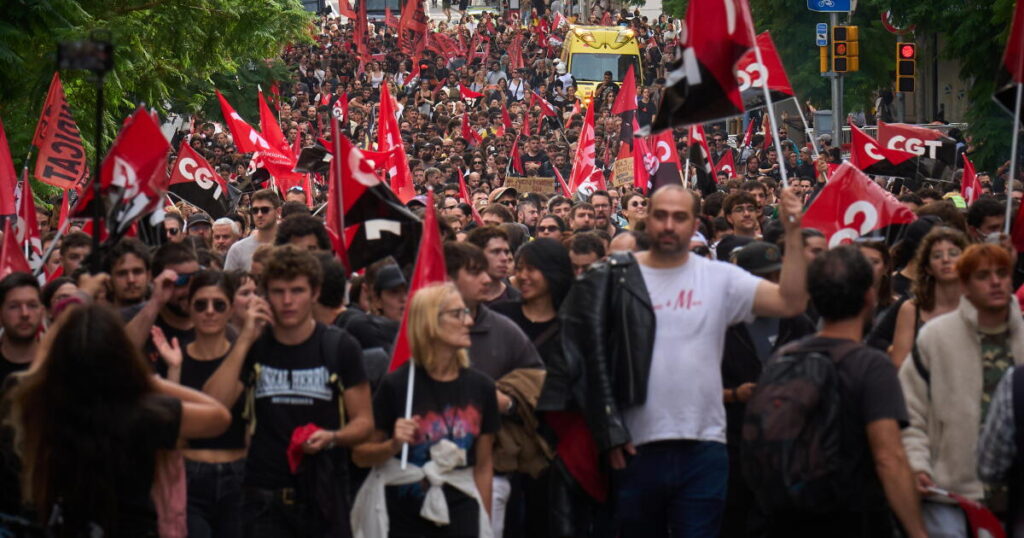
BARCELONA, Spain — Millions of Spanish workers shut down businesses and public transportation across the eurozone’s fourth largest economy on Wednesday before thousands took to the streets of major cities in a nationwide protest over soaring rents and real estate prices.
Housing activists hope the massive show of force will lead to more regulations to protect tenants and crack down on real estate speculation, while Spain’s left-wing government is seeking to mobilize voters ahead of a national election later this month with polls against it.
The walkout — under the slogan “Salaries. Housing. Prices” — was the first general strike in Spain in 14 years, and the first whose principal push was born from unrest over housing.
The strike culminated in workers and average citizens gathering in downtown Barcelona and Madrid, along with protests in other cities. Housing activists said 400,000 marchers filled Barcelona, while the city government said 55,000 turned out.
In Barcelona, most storefronts on Paseo de Gracia, a main shopping boulevard, were boarded up in anticipation of potential unrest before thousands of people walked behind a huge banner that said “Live. Not Just Survive.”
After the peaceful march, some apparently younger protesters started to smash storefronts of brand-name stores. Police in riot gear quickly arrived in vans.
Carlos Ferrer, a 45-year-old customer service worker who was trying to get back home to Alicante by train from Barcelona, said that sometimes only “radical measures, such as a general strike” can force a change of course.
“Authorities need to feel pressure from the citizens so they can do something,” he said.
Barcelona’s metro and public buses stopped running outside rush hour. Street traffic was light. Many smaller establishments like coffee shops, however, did open.
Protesters defy rain in Madrid
In Spain’s capital, the wide Paseo del Prado boulevard became a sea of umbrellas as a huge crowd turned out in the evening’s march despite heavy rain.
Earlier, protesters had blocked off Gran Vía, the city center’s main thoroughfare, until police in riot gear pushed them to the sidewalks.
Manuel Gómez, a 19-year-old student in Madrid, welcomed the protests, which he said marked a change for the country.
“In Spain, we have a serious problem, which is that when we don’t like something, we never go out to protest,” he said.
Unions hailed the strike as a success, while Spain’s business owners’ groups said that it had fallen flat. But they agreed that worker participation was higher in heavy industry and transportation, while it lagged in other sectors of the economy like retail and restaurants.
“The strike has exceeded the labor unions’ expectations,” said Unai Sordo, secretary-general of CCOO, one of the two unions calling the strike for a nation of 22 million registered workers.
CCOO and UGT, the other major union organizing the strike, reported significant work stoppages in strategic sectors. They said that the stoppages amounted to 90% in the automotive and port sectors, 85% in the meat industry, 82% in waste collection and 75% in the energy sector. Many schools and universities closed.
About 5% of flights for Wednesday were canceled at airports across Spain, according to the country’s airport operator, AENA.
Miguel Ángel García, the spokesperson for the regional Madrid government, which is run by Spain’s conservative Popular Party, or PP, called the strike a “complete and authentic failure,” saying that just 9% of public sector employees in the region participated.
Minor incidents were reported in the first hours of the strike. Tires were set on fire at roadblocks in Barcelona, and scuffles with police were reported by unions near the main wholesale market on Madrid’s outskirts. Police also used pepper spray against protesters in some places.
In Barcelona, demonstrators wearing masks interrupted the live broadcast of a morning talk show on one of the state broadcaster’s channels. They held up a large sign in favor of the strike before the signal went down momentarily.
Police said they made 29 arrests across Spain for incidents related to the strike, led by nine in Madrid.
More action sought on housing
The average rent in Spain has almost doubled in the last decade, eating into household budgets and upsetting voters.
The anger reached a boiling point following the eviction of an 87-year-old woman from her home in Madrid last month. The subsequent death of Maricarmen, as the woman became known, solidified her as a symbol of Spaniards who can’t dream of owning a home.
Housing activists used the uproar over Maricarmen’s eviction to call for the strike, and soon won union backing.
“The uproar that started over 40 days ago with the eviction of Maricarmen hasn’t stopped growing and has now flooded the streets of our cities,” Alicia del Río, spokesperson for the Tenants Union, said in Madrid.
The housing activists are seeking the automatic renewals of leases as a way to protect renters and other measures. Unions demand more public housing and a new minimum wage agreement.
Left hopes to put focus back on housing
On the back of the housing protests, Spanish Prime Minister Pedro Sánchez called an early election, hoping to earn four more years in power for his left-wing coalition. The vote is set for Nov. 29.
Then, in late October came a high-speed train collision — Spain’s second deadly rail disaster of the year — that killed 69 people. The aftermath of the tragedy has created a drag on Sánchez’s campaign.
The strike now offers an opportunity for Sánchez’s Socialists and other parties on the left seeking to stay in power, analyst Oriol Bartomeus said.
“The Socialists need for the strike to be a success and for there not to be any violence so that the election campaign can swing back to being about housing,” Bartomeus, a professor of political science at the Autonomous University of Barcelona, told the Associated Press.
Sánchez posted a video on X this week, lauding past social policy achievements like the 40-hour work week and national health insurance, which were the fruit of the workers’ movement.
“It wasn’t easy, but they changed Spain,” Sánchez said, warning that right-wing parties would underfund social services if they took over.
Right could benefit if strike turns ugly
PP and the far-right Vox argue that the unions are trying to help Sánchez with months of polling showing voters leaning toward a change.
If the strike descends into violence or has a low turnout, right-wing parties could benefit, Bartomeus said.
“The Popular Party and Vox both want the strike to be a flop and to end in scenes of burning dumpsters and shattered shop windows,” Bartomeus said, so that the next morning, “they can say, ‘This is chaos and we are coming to establish order.’”
Wilson and Medrano write for the Associated Press. Medrano reported from Madrid. AP writer Hernán Muñoz in Barcelona, and Iain Sullivan in Madrid, contributed to this report.
The post Housing protests fill Barcelona and Madrid as Spain’s workers strike ahead of election appeared first on Los Angeles Times.