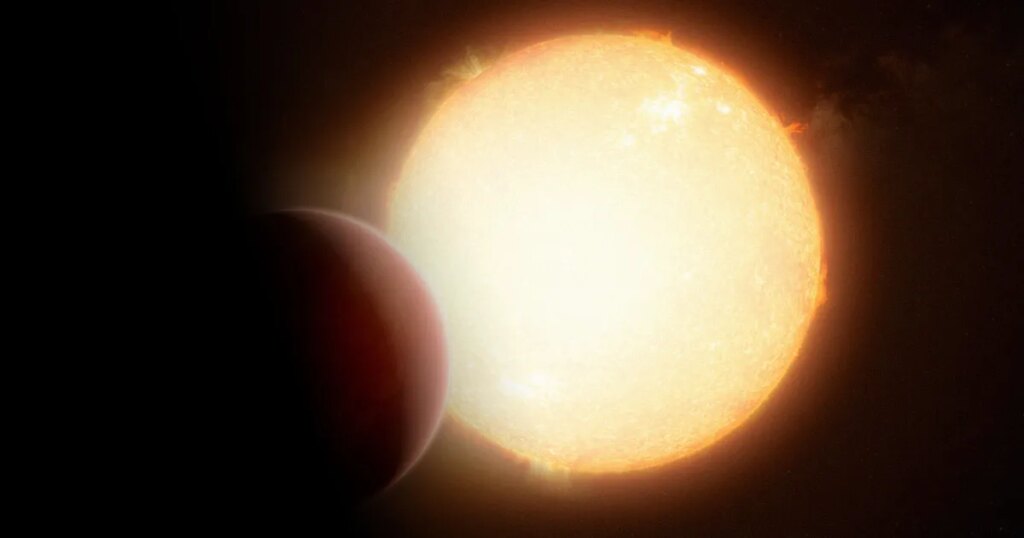
An international team of astronomers were puzzled when an entire gas giant appeared to vanish from the sky.
The disappearing exoplanet, dubbed TOI-2535 b, is located roughly 1,000 light-years from Earth. Since it orbits its host star at an extremely close distance, completing a full rotation in just over eight days, its surface is extremely hot, making it a “hot Jupiter.”
NASA’s Transiting Exoplanet Survey Satellite observed the planet numerous times between 2019 and 2026. But there was something strange afoot: its brightness progressively dipped every time it passed in front of its star, and it also had a tendency to show up far too early or too late. And then, in a cosmic vanishing act, it failed to show up at all this year.
In a new article published in the Astrophysical Journal Letters journal, an international team of scientists dug into the mystery. And they’ve cooked up an explanation for the “disappearing act,” suggesting that a still-unobserved neighboring planet could be messing with TOI-2535 b’s orbit significantly. According to their calculations, the “two planets make each other’s orbits wobble like a top,” causing them to disappear from view as they come out of alignment.
That kind of chaotic arrangement is par for the course in an unpredictable universe filled with oddball star systems.
“We think of the universe as resembling clockwork, where everything is regular, but that’s not true,” University of California, Los Angeles postdoctoral fellow and corresponding author on the paper Samuel Yee said in a statement. “If there are multiple planets in a system, they can affect each other’s orbits. We know of a few systems that are like this.”
“This is the most extreme example we’ve seen because the two planets are interacting so strongly,” he added. “The planet’s orbit is tilting so quickly that its transit disappeared while we were watching.”
TOI-2535 b is one of several hundred hot Jupiters that have been discovered to date. However, they usually aren’t accompanied by other planets close enough to wreak havoc on their orbits.
The latest observation could help scientists illuminate the origin story of these types of extremely hot gas giants, and what brought them so close to their host stars over time. One possibility is that a near-collision with another object caused it to enter an elliptical orbit, during which the gravitational forces of the star reeled it in. A second possibility is that violent interactions within a protoplanetary disc, like that of TOI-2535 b’s star system, resulted in their unusual tilts.
“Because TOI-2535 b has a close neighbor, it probably migrated by slowly spiraling in instead of getting flung in,” Yee concluded. “We may be seeing a formation channel that doesn’t happen very often but is very interesting.”
More on hot Jupiters: This Super Young Jupiter-Sized ‘Hot Planet’ is Puzzling Astronomers
The post Astronomers Puzzled After Watching Entire Planet Wink Out of Sight appeared first on Futurism.