Last week’s midterm elections were perhaps the first major elections fought at least in part over issues related to artificial intelligence. This year saw record donations from tech executives to tech-friendly candidates. And in some cases, A.I. was actually on the ballot: In local ballot initiatives across the country, people voted to limit or prevent the development of data centers. Many newly elected Democrats have promised A.I. regulation.
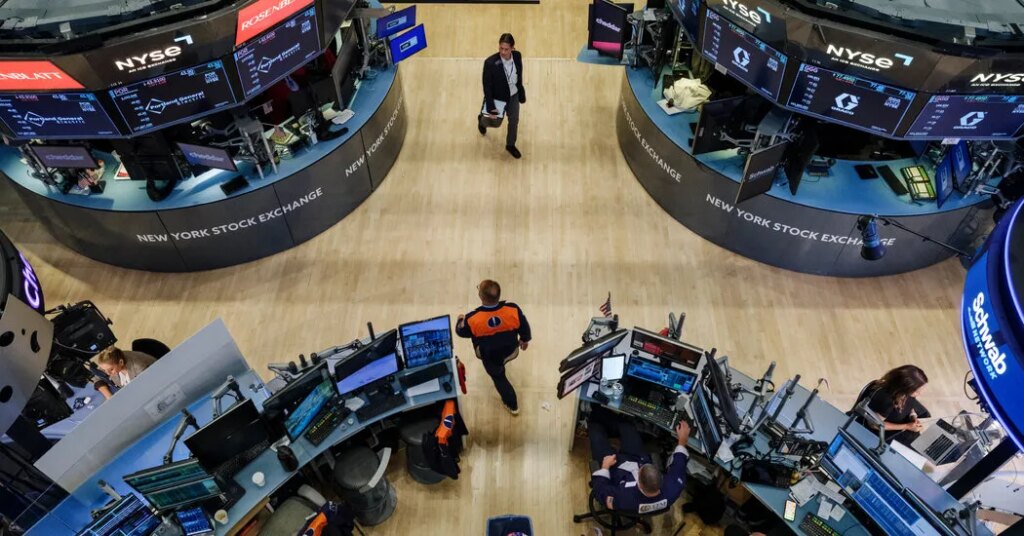
If A.I. has surged to the forefront of U.S. politics, it’s in part because A.I. is at the forefront of the U.S. economy. And stock markets around the world rise and fall with A.I. shares, particularly the multitrillion-dollar behemoths based in Silicon Valley. I spoke to my colleague Joe Rennison, who covers financial markets, about the dramatic swings in tech stocks following the midterms and what they mean — for Americans, and for the rest of us.
Markets up. Markets down. Markets up …?
So, Joe. We’ve seen some serious volatility in the stock market after the midterms. First markets rallied, then they had their worst day in nearly two years. This week, as Nvidia stock plunged because of the Jensen Huang affair, the rest of the market bounced back.
What’s going on, and how much of all this is down to politics?
Certainly some of it is down to politics. The initial rally after the midterms came in part from investors who had parked their cash on the sidelines, in case of some unexpected event — say, a contested election. They bought back in when it became evident we were going to get a clear outcome.
The plunge the next day, though, came after some weaker than expected financial reports from a couple of A.I. companies, and after investors began processing what Democratic control of Congress and some Democratic wins at the state level might actually mean for the A.I. industry.
But markets have rallied since and now seem to be trying to find some equilibrium. I haven’t yet spoken to any professional investor who thinks we’re at the start of a more severe downturn. It’s more that perhaps the first leg of A.I. development, characterized by astronomical growth (and stock returns), may be slowing.
What are investors worried about?
Many people were already worried about the rapid growth in A.I. slowing down ahead of the midterms, and whether the huge amount of spending by A.I. companies would result in big profits any time soon.
Then the midterms hit, and it wasn’t just that Democrats won control of Congress. They won governorships in states that are important hubs for data centers, sometimes by running anti-data-center campaigns. And suddenly people really began to wonder if the rosy assumptions embedded in such lofty stock prices were still reasonable, or whether prices needed to come down a bit.
On regulation, voters seem to want it. But is the U.S. economy now so dependent on a handful of A.I. companies that even Democrats will have to think carefully about regulating A.I.?
I think that dependency is a real concern. Just 10 companies make up roughly 40 percent of the S&P 500, and so swings in the share prices of just a handful of big tech companies can move the entire market.
But it’s worth pointing out that most people who talk about more A.I. regulation or more scrutiny on A.I. tend to talk in terms of slowing down the industry, not stopping it entirely. Some analysts have actually argued that easing the rapid pace of growth would alleviate some of the strains on the American companies driving that growth, and would boost profits and bolster their positions as industry leaders. In other words, a more gradual pace of growth could be healthier in the long run for these companies and for the whole economy, even if it causes some short-term market pain.
How does the upcoming Anthropic I.P.O. fit into all this? It’s another blockbuster. What does its target valuation tell us?
Well, bankers had floated a $2 trillion valuation at one point; ultimately, Anthropic looks to be aiming for just (!) $1.4 trillion, at least for now. So it seems like some of the air has come out over the past couple of months, and that reflects a broader revaluation of public companies. But it’s still a highly sought-after I.P.O., with plenty of investor demand. That’s important because its size means its public debut is not just important to the A.I. industry but to the entire market.
And what about for the rest of the world? Other markets have also had a bumpy ride the last few weeks, right? How much do we all depend on U.S. tech companies, and U.S. politics?
There’s no shortage of examples of the U.S. economy and financial markets driving developments around the world. But in the case of A.I., it’s not just U.S. markets affecting the rest of the world, but also vice versa.
Japanese markets, because of low interest rates, have become a favorite place for investors to borrow money, which is then reinvested in U.S. stocks. Taiwan has the largest manufacturer of chips designed by U.S. tech behemoth Nvidia. And South Korean stock markets have become home to highly leveraged bets on baskets of A.I. companies.
South Korea’s Kospi index fell over 10 percent following the election result, before quickly bouncing back over 7 percent, underscoring how many places around the world have made big bets on A.I., and have a stake in what Democrats do next.
MORE TOP NEWS
The China-U.S. spy war rages
As President Trump and China’s leader, Xi Jinping, prepare to meet next week to discuss trade, the Nvidia scandal has shown that behind their diplomacy is a fierce intelligence rivalry.
Under Xi, the Chinese Communist Party has built a more assertive spy service. At the same time, the U.S. has stepped up its intelligence gathering to include not just military and government targets, but also private Chinese companies. Trump said that he did not plan to raise the Nvidia affair with Xi during their meeting in Shenzhen, China.
My colleague Ana Swanson, who covers trade and economics, explains in the video below how the relationship between the Nvidia chief executive Jensen Huang and Alice Huang, whom U.S. intelligence officials suspect of spying for Beijing, dated back to at least 2023, earlier than previously thought.
TOP OF THE WORLD
The most clicked link in your newsletter yesterday was about Alice Huang, the woman at the center of the Nvidia scandal.
OTHER NEWS
-
Workers in Spain staged a general strike for the first time in 14 years to protest rising rents and stagnant wages ahead of a national election this month.
-
Republicans in the U.S. House of Representatives shelved an effort to impeach Defense Secretary Pete Hegseth.
-
Hundreds of schools in Italy and elsewhere in Europe were evacuated after receiving emailed bomb threats that were determined to be hoaxes.
-
Pope Leo begins a visit to Peru, where the Catholic Church faces increasing competition from evangelical churches.
-
The U.N. secretary general, António Guterres, opened a climate summit that leaders from most developed economies chose to skip, warning that the planet was on a “path to mutually assured destruction.”
-
Russia’s ambassador to the U.S., Alexander Darchiev, died “suddenly,” the Russian foreign ministry said.
-
Iran’s neighbors, primarily Turkey, Iraq and Pakistan, are pushing back against U.S. efforts to step up economic pressure on Iran.
-
The first round of Ukraine talks in nine months ended in Abu Dhabi without a Russian agreement to include Europe in negotiations.
-
Lebanon is falling deeper into economic crisis, made worse by Hezbollah’s conflict with Israel and the U.S.-Israel war with Iran.
WHAT ELSE IS HAPPENING
-
The French writer Michel Houellebecq was placed under investigation for inciting violence and racial hatred because of anti-Muslim comments he made in 2022.
-
One of the greatest ships to sail the seas made its final journey: The S.S. United States was headed off the coast of Florida, where it will be sunk.
GRITTY SPORT OF THE DAY
Beach wrestling
Teenage athletes from all over the world have descended on Senegal this month for Africa’s first ever Olympic event, the 2026 Youth Olympic Games. Making its Olympics debut at the Games is beach wrestling. “We’re going to beat everyone,” a Senegalese wrestler said. “Gambia, Ivory Coast, Germany, the United States — everyone. We’re a country of wrestlers.”
MORNING READ
Max Worsley and his younger sister, Alicia, grew up steeped in their father’s love for Antarctica.
When the father, Henry Worsley, died in 2016, his death left unfulfilled a promise he had made: that he and Max would someday trek through Antarctica together. It would have been Henry’s next expedition, the trip that would solidify their father-son bond. This month, Max embarked on that journey into the lonely land his father loved. Read more about the dream of Antarctica.
AROUND THE WORLD
How anime is reshaping Japan
Over the past decade, anime has transformed from a niche, countercultural art form into a global phenomenon. The cultural boom is quietly reshaping Japan’s economic identity.
Once a titan of consumer electronics and manufacturing, Japan now earns more foreign revenue from overseas content than from traditional mainstays like semiconductors and steel. Sony, one of Japan’s most famous manufacturers, now earns 70 percent of its profits from entertainment, and the new chief executive sees anime as an alternative to the assembly line. Read more about Japan’s anime success.
Can you guess the name of the main character in the anime series “One Piece,” shown in the photo above? Click to see if you’re right.
RECIPE
This glorious mash-up of potato gratin and Hasselback potatoes is engineered to give you both creamy potato and singed edge in each bite. The principal innovation here is placing the sliced potatoes vertically rather than laying them flat to get those crisp ridges on top.
RECOMMENDATIONS
Jam: Have a listen to these 11 new songs from Jhené Aiko and Kendrick Lamar, Shygirl and others.
Read: In a new memoir and interview, Sonia Gandhi recalls her political battles and the assassinations of her husband and mother-in-law.
Try: Here’s a newbie’s guide to renting an electric vehicle.
Gaze: Throughout the world, designers are finding inspiration in folklore.
TIME TO PLAY
Here are today’s Spelling Bee, Mini Crossword, Wordle and Sudoku. Find all our games here.
That’s it for today. See you tomorrow! — Katrin
We welcome your feedback. Send us your suggestions at [email protected].
The post A.I. and Market Whiplash appeared first on New York Times.