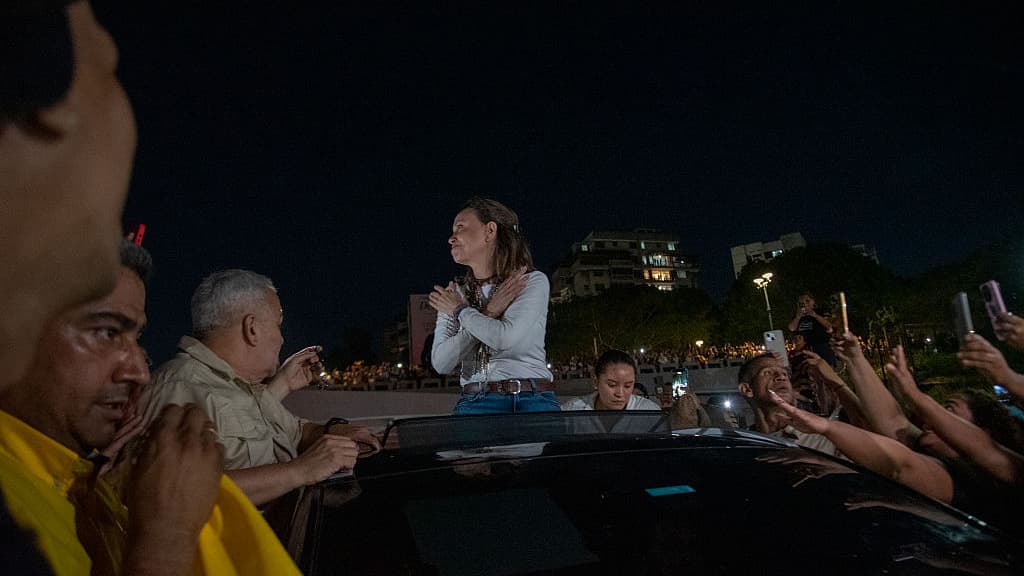
When will Venezuela hold elections? More than nine months after the capture and extraction of the country’s strongman, Nicolás Maduro in a military raid ordered by President Donald Trump, there are still no clear answers. On Oct. 27, María Corina Machado, the country’s most prominent opposition leader, returned to Caracas after about a year in exile, thanked the Trump Administration for removing Maduro, and expressed faith that an election would be held in Venezuela in 2027.
In the predawn hours of Jan. 3, U.S. Special Forces captured Maduro in Caracas and flew him to the United States. With President Trump’s blessing, Maduro’s vice president and longtime loyalist Delcy Rodríguez took power, and the two governments began negotiations over Venezuela’s future. Would the country finally hold free and fair elections, many wondered?
Two weeks after the raid, opposition leader Machado, winner of the 2025 Nobel Peace Prize, presented Trump with her Nobel medal during a visit to the White House, hoping he would push for early elections that she was widely expected to win. Trump, however, maintained that Venezuela wasn’t ready for elections. “We have to fix the country first,” he insisted. He estimated in January that the process could be completed within 18 months.
Then on Aug. 28, the U.S. and Venezuela governments announced an unprecedented agreement to revive Venezuela’s oil industry. The 100-year deal gave the U.S. an ownership stake in 17 oil fields and access to more than 65 billion barrels of proven oil reserves. Under the terms of the agreement, the U.S. Departments of State and War will develop the oil fields with North American Blue Energy Partners, a private company owned by Venezuelan businessman Alejandro Betancourt. The U.S. will have a 35% stake in the venture, with guaranteed access to 20% of the output at cost, giving it an effective share of 55%.
Trump has called it the “biggest oil deal in world history,” one that would give the U.S. control over an additional 65 billion barrels of crude, more than doubling U.S. reserves. He claimed the additional supply would “substantially lower gas prices for all Americans” and deprive China and Russia of their most important ally in the Western Hemisphere. Rodríguez, Venezuela’s interim president, has called the deal a huge win for the Venezuelan people, promising hundreds of billions of dollars in investment and revenue for a country battered by years of economic stagnation. By reviving oil production and improving the country’s economic prospects, the agreement could also help the Venezuelan government restructure its crippling debt.
But there was little talk about elections and democracy. Two weeks before her return, Machado offered the strongest signal that she was running out of patience. The Rodriguez government is negotiating with representatives of the 2015 National Assembly, Venezuela’s last internationally recognized, democratically elected body, but Machado has said she has been marginalized in those talks. On Oct. 15, The New York Times published an interview with Machado in which she accused Betancourt, the oil deal’s Venezuelan investment partner, of “obscene corruption” and blamed him for the country’s persistent electricity shortages. She did not criticize Trump or suggest that, if elected president, she would repudiate the oil deal. She made clear, however, that Betancourt would have no part in it.
The interview marked Machado’s sharpest attempt yet to distance herself from an agreement between a Venezuelan government run by Maduro’s former deputies and a Trump Administration that has become increasingly unpopular in Venezuela. Her dilemma is familiar to leaders around the world: how to remain on good terms with a U.S. president who holds tremendous leverage over their countries’ futures while also exploiting the opportunities created by Trump’s growing unpopularity at home.
Back in Venezuela, Machado seems to believe that Washington will push Rodriguez to hold elections next year. She’ll have to tread lightly. After praising her return, Secretary of State Marco Rubio warned, without naming Machado, that “you’re not going to street-protest your way into a democracy.” Translation: Glad you’re back, but Washington will control the process ahead. Whatever that process turns out to be.
The post Trump and Venezuela’s Elusive Elections appeared first on TIME.