BENONI, South Africa — The political landscape in South Africa is shifting, local election results show.
The African National Congress, or ANC, which has held power since Nelson Mandela’s victory in the country’s historic 1994 election that ended the white minority rule, received less than a third of votes cast in last week’s local elections, according to announced results, its lowest-ever showing.
While the ANC once could count on more than two-thirds of the vote, it remains the country’s largest party, in control of the largest share of the thousands of municipal and district council seats. But its support is eroding, election to election, amid corruption scandals and widespread failure to provide services.
“We accept that this is how the people of South Africa in our towns, in our cities, in our metros have spoken and this is their verdict and we accept it with humility,” South African President Cyril Ramaphosa told reporters Sunday.
The party won 53 municipalities outright, down from 122 in the previous local elections, in 2021. In 2016, it won outright majorities in 161 of 257 municipalities.
The center-left ANC under Ramaphosa, who has been in office since 2018, failed to secure an outright majority for the first time during 2024’s national elections and is governing in coalition with longtime rivals, the centrist and market-oriented Democratic Alliance. After last week’s local election, the ANC would have to govern most of the municipal governments it controls by coalition as well.
The ANC got just over 40 percent of the vote in 2024, down from more than 57 percent in 2019.
The party faced the results with grim acceptance. “A democracy that is maturing is a good democracy, let people fight,” Gwede Mantashe, ANC national chairman, told reporters last week.
The Democratic Alliance, or DA, beat the ANC in key cities such as Johannesburg and Tshwane, with its former leader, Helen Zille, leading in Johannesburg’s mayoral race with over 34 percent of the vote, while the ANC has about 20 percent. Coalition talks are underway. If Zille, a former journalist and anti-apartheid activist, can form a city government, she would be the city’s first white mayor since 1994.
The DA retained Cape Town, with an outright majority.
Overall, the ANC has so far received over 30 percent of the vote in local elections, securing 3,282 council seats, while the DA came second, with more than 24 percent, securing 1,722 council seats.
Former president Jacob Zuma’s uMkhonto weSizwe Party came in third, with about 10 percent of votes cast. Zuma became president in 2009 on an ANC ticket, but fell out with the party after years of corruption scandals and power struggles that led to his resignation in 2018.
The far-left Economic Freedom Fighters party, led by Julius Malema, got just over 6 percent of the vote.
The results come amid a diplomatic and economic rift between South Africa and the Trump administration, which has falsely accused the country’s Black majority of trying to wipe out White Afrikaners.
But by most accounts, the issues that drove the election were closer to home: crime, corruption, unemployment and spotty government services, as some communities complain of dry taps, long power outages, pooling sewage and uncollected trash.
Earlier this year, high unemployed and general dissatisfaction fueled violent anti-immigrant protests. ActionSA, a party that takes a hard line on immigrmation, won just over 5 percent of the vote in the municipal elections, more than doubling its share.
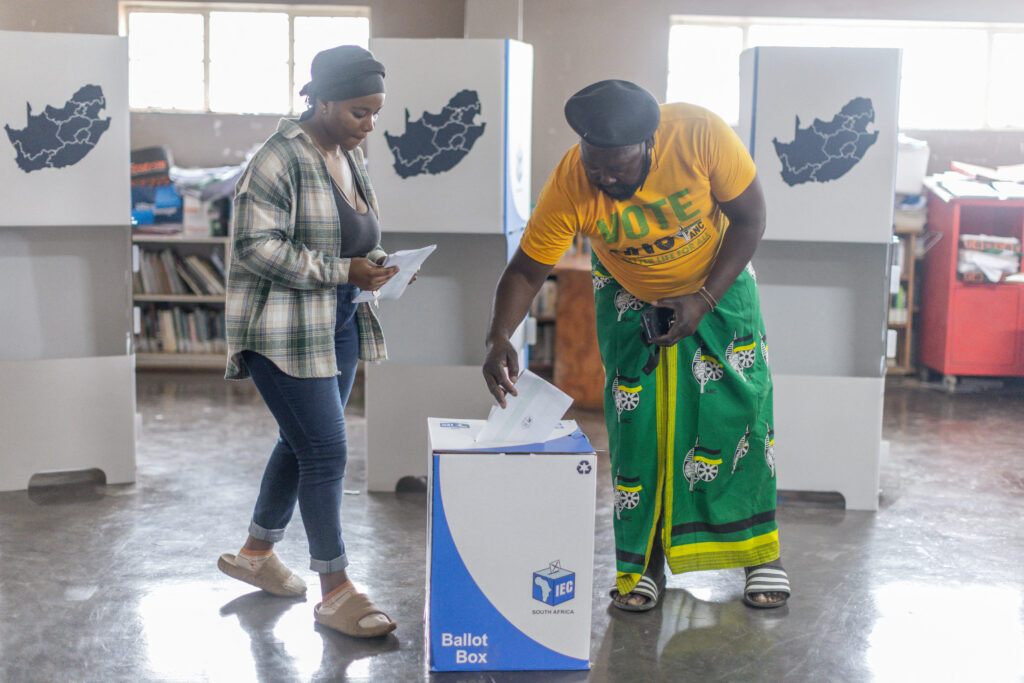
In Benoni, a city east of Johannesburg, few voters, both those who supported the ANC and those that did not, showed little surprise at its struggles. In the broader municipality that includes Benoni, the DA won a narrow plurality, while the ANC came in second, and ActionSA third.
Raymond Mulaudzi, 39, a security guard at a residential complex in Benoni, said he did not vote. “There was no point, because I always voted for the ANC. It’s either them or nothing, but the problem is that they are crooks and arrogant,” he said, adding that he was not surprised that they lost support.
“I know many people in my township who didn’t vote, in protest. The ANC needs to pull its socks up,” he said. “At the next national elections, I will vote ANC because I still want to see them in power, and Ramaphosa is a nice guy. I partly blame him for the loss; he is too soft on corrupt leaders.”
Thembinkosi Tshaka, 50, an unemployed ANC voter in Benoni, said he too would continue to support the party. “This is a self-inflicted wound,” he said of the ANC’s campaign shortcomings.
Shaun Langa, 28, a personal trainer, said she did not vote, because no party deserved her vote.
“My biggest surprise was that the ANC was still the majority in some municipalities: Now you can see why I have no interest in voting. What have they done? People are miserable; they are hungry. It’s sad,” Langa said.
Ombuor reported from Nairobi.
The post Mandela’s party, long dominant in South Africa, is bleeding support appeared first on Washington Post.