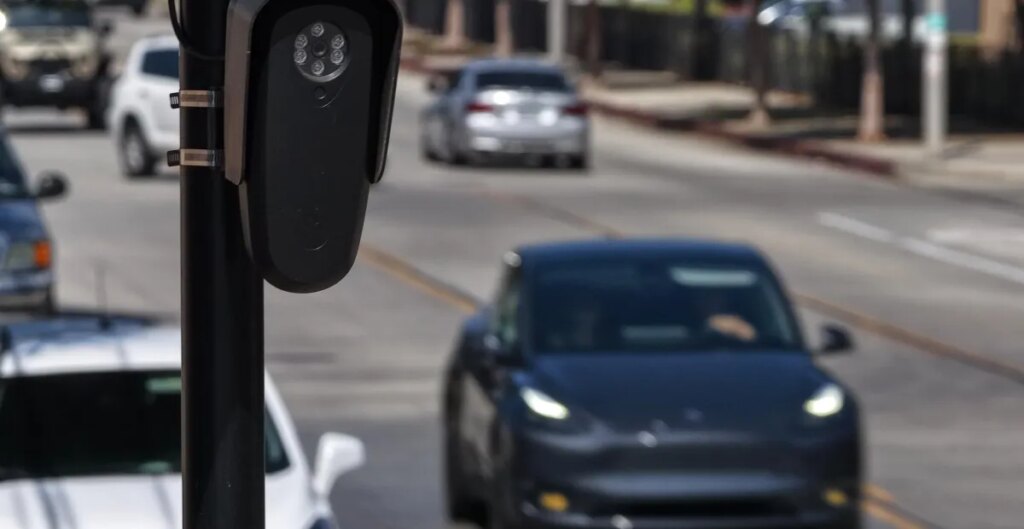
As Flock cameras have quietly multiplied across the country in recent years, public concern about privacy, surveillance, and abuse of the technology by law enforcement has sparked nationwide backlash. This led to a number of cities pausing, not renewing, or canceling their contracts with Flock Safety, the leading company behind the controversial AI-enabled automated license plate readers, this year.
And now, citizens have voted on the issue.
Towns in two states, Texas and Maine, voted on midterm ballot measures concerning Flock. And in both cases, the people ruled against the tech.
While these are just two communities out of the thousands that use the cameras — hardly enough to dismantle the nationwide surveillance network — these results show the real possibility of taking on mass surveillance and winning.
But one issue remains: Even if the initiatives that passed on Tuesday inspire similar civic resistance in future elections, the fight against the problem that Flock represents is just beginning for those who don’t want their every move tracked.
Nongovernmental entities — such as college campuses, homeowners associations, even supermarkets — have started purchasing and deploying Flock cameras of their own and sharing the data with law enforcement.
Now, the fight will need to go beyond the ballot box.
An end to the status quo?
While some advocates for Flock systems argue that the company’s AI-enabled automated license plate readers (ALPRs) may make solving certain crimes easier, public attention has been drawn to overt misuse of the technology by current and former law-enforcement officers. Even some police leaders have expressed concerns about Flock’s ability to target people who have not been accused of a crime, potentially raising serious constitutional issues.
Both York, Maine, a small city of about 14,000, and the midsize League City, Texas, took the issue to the ballot box.
In York, residents were asked to consider a citizen initiative called the “Stop ALPRs Ordinance” that made the ballot after receiving over 100 residents’ signatures. Its residents decisively rejected the surveillance cameras, with 5,386 votes (73 percent of the vote) in favor of the ordinance and only 2,043 votes (27 percent) against. Effective immediately, the measure bans ALPRs in the town of more than 14,000 and requires voter approval before the town installs any such tech in the future.
Meanwhile, in League City, Texas, voters decided on an advisory question, Proposition A, which asked: “As a nonbinding statement of voter preference, should the League City Police Department continue using automated license plate reader cameras at fixed locations on public roadways for law enforcement purposes?”
Voting “yes” on the measure meant approving the use of ALPRs at fixed locations on public roadways for law enforcement purposes, while a “no” vote would oppose such uses. Though the ballot question was technically non-binding, League City’s City Council committed to act on the vote’s outcome. The measure passed with 54 percent of the vote.
In response to a request for comment about these two measures, a Flock spokesperson told Vox, “We’re grateful to both York and League City elected leaders and community members who engaged in this conversation. Flock technology has had a real impact helping to solve crime in those cities and across the country.” The company added, “While we’re disappointed in the outcome, we respect the decision voters made and will work directly with the city on next steps.”
To privacy advocates working in the surveillance space, these wins signify a shift.
“The status quo for the longest time has been that cities and law enforcement agencies have been able to approve and award massive contracts for surveillance tech and rarely have any sort of trouble passing them,” said Reem Suleiman of the digital rights group Fight for the Future, which advocates against mass surveillance and hosts the site StopALPRs.com. “In 2026, this isn’t the case.”
“People feel and understand that they do actually have a stake when it comes to surveillance tech and how it’s used.”
The backlash has been building for some time, Suleiman said, pointing to the nonprofit Secure Justice’s tracker of nearly 500 actions by cities over the past year to pause or terminate Flock contracts. She also noted that the fight has moved beyond city councils — a Senate Judiciary hearing in late September showed bipartisan interest in reining in license plate readers, and federal and state proposals are multiplying.
Because these decisions to employ ALPRs and other surveillance technologies have typically been made without public input, Suleiman said, putting the question to voters reflects a meaningful change: “People feel and understand that they do actually have a stake when it comes to surveillance tech and how it’s used.”
Voting against local city use of Flock cameras, however, may be just the tip of the iceberg.
Where the fight goes next
The uptake of Flock cameras by non-government actors presents a separate accountability challenge that may complicate the efforts of anti-surveillance activists. Homeowners associations, hospitals, schools, and big retailers are contracting for the same technology, with no council meetings for citizens to pack and no ballots to vote on.
According to reporting by Inc., of the approximately 12,000 customers using Flock cameras, 5,000 are private-sector entities. These private buyers can opt to have the data generated by their cameras automatically shared with law enforcement. Many of them do just that, including commercial chains such as Home Depot and Lowe’s, and Simon Properties, the US’s largest network of shopping malls.
According to Flock’s website, if these private customers choose to share data with local law enforcement, they can allow the system “to notify authorities when a flagged license plate is detected, without requiring action from the camera owner.”
One of Fight for the Future’s current targets is Lowe’s, which Suleiman described as one of the largest commercial buyers of Flock cameras. “I don’t want anybody to live under a false sense of security because, unfortunately, there are so many different ways we are exposed to surveillance and to these cameras,” she said.
Critics of license plate readers also fear that cities are swapping out one vendor for another without addressing underlying concerns about data privacy and surveillance. For instance, Axon, a $48 billion company that produces a slew of law enforcement technology, has capitalized on Flock’s recent PR challenges by swooping in to replace its competitor in at least seven municipalities across five states.
In that context, even more ballot measures might not be enough to address the concerns of privacy advocates. Suleiman still has thoughts about what ordinary people can do to push back against increasingly privatized networks of surveillance technology.
“Get involved in those fights,” Suleiman said. “There is a lot of power that consumers have in terms of voicing their values and insisting from the places they shop and the brands that they love that they’re not going to be complicit in the surveillance network.”
The post Two cities just voted to get Flock cameras out. It’s only the beginning. appeared first on Vox.