The Department of Justice’s birthday was not in 1776, when America first declared independence as a nation, or 1788, when the U.S. Constitution was ratified. It was in 1870, when the law creating the department was signed. The Department of Justice is not a creature of the U.S. Constitution; it is a creature of Congress.
Before America had a Department of Justice, the attorney general was a sort of general counsel for the president and his administration. After the Civil War, it was Congress that gave the attorney general a whole new department of government, the U.S. Justice Department, so he would have the means and the manpower to serve a broader clientele, and a broader remit.
The Reconstruction Amendments, ratified in the years before the department was established, abolished slavery, gave Black men the right to vote, and prohibited any state from denying equal protection of the laws to all Americans. Properly conceived, the new Justice Department was to make sure that the promise of the newly amended Constitution extended to real life: “One of the most powerful peace-time forces known to our country,” as Attorney General Robert Jackson memorably put it in a speech. “This authority has been granted by people who really wanted the right thing done,” and who “wanted the best in our American traditions preserved.”
And indeed, when the Justice Department has inserted itself between citizens denied their equal rights and the forces denying those rights, it has been a potent use of the U.S. government. Equally, though, when the Justice Department has inserted itself on the side of those denying others their rights, it has been a force multiplier for powerful interests. Short of the U.S. military, there is no greater coercive power that is brought to bear by the government against its citizens.
[Quinta Jurecic: DOJ’s try-anything approach]
How DOJ has used its power has been the great shaper of America’s character as a nation. It determined the shape of the peace following the Civil War, and the shape of the economic system as the country industrialized. It shaped the perimeter of acceptable political expression and association as Americans settled, uneasily, into a competitive two-party democratic system, and it shaped how first- and second-tier citizenship were allocated so strictly by race.
With DOJ on the case, wholly and without reservation, almost anything is possible. Without it, almost nothing is. When the Department of Justice neglects its unique responsibility and unique capacity to ensure that Americans are equally protected by the law, no substitute force can make up the difference.
Over the course of its century and a half of existence, the Justice Department has been noble; it has been feckless; it has been corrupt. But now, in the midst of a full-fledged authoritarian challenge to the constitutional republic, the Justice Department has entered a whole new phase it has not been through before. It’s a phase you might call “gone”: missing, presumed dead.
In Donald Trump’s second term, the federal agents shooting protesters, tear-gassing nonviolent crowds and whole neighborhoods, breaking down doors without judicial warrants, grabbing people in courthouse hallways, and even menacing election officials are, for the most part, agents of the sprawling Department of Homeland Security, not the Department of Justice. Homeland Security’s various three- and four-letter agencies have essentially dissolved into an amorphous, masked, pro-Trump secret police force with as little connection to the Article III legal system as they can get away with. DOJ, meanwhile, is now mostly irrelevant. Broken as it is, Trump’s threats that he would use the department to destroy his enemies have been (mostly) just menacing hot air.
Staffed by C-list podcasters, QAnon-adjacent influencers, weirdo cable-news gadflies, and the kinds of friendless indoor boys who try to choose their own nicknames (see Trump’s first acting U.S. attorney for the District of Columbia, a man no one ever called “Eagle Ed”), the Justice Department has at last been emptied out and deconsecrated. Trump’s efforts to prosecute people for political advantage have largely failed. Trump has been able to use DOJ to harass his opponents, and to cost them money in legal fees, but—with a few notable exceptions—not to convict them. Judges, and even grand juries, have laughed the Trump-era DOJ’s amateur legal filings out of courts of every level.
For his first attorney general in his second term, Trump installed Pam Bondi, a former Florida official with whom he had history—he had sent a political committee supporting her campaign a $25,000 check before she punted a fraud investigation into his fake Trump University. Under Bondi, senior career DOJ lawyers with decades of experience in national security, immigration, espionage, antitrust, and other complex areas of law were fired wholesale or busted down to entry-level jobs to demoralize them.
[Read: Inside the plan to send 1,000 DOJ monitors to the polls]
Those who chose to remain soon found that they were required to make a show of their willingness to submit. Assistant U.S. attorneys were told not just to drop a corruption prosecution against one of the president’s allies, but to submit a written admission of wrongdoing for having brought the (well-predicated) case in the first place. The U.S. pardon attorney was ordered to give her blessing for restoring the gun rights of a right-wing actor—a supporter of the president—who had been convicted of a domestic-violence offense. The president’s pardon and commutation powers are absolute under the Constitution; there is no need for a pardon attorney to paper a decision like that, in either direction—that is, unless it’s important to make clear to everyone, including the pardon attorney, that she’s on board with the new regime. Trump and his enforcers have not just torn down the department; they have salted the earth to be sure there will be no uncorrupted survivors.
Even as he has failed to do much of consequence with his warped DOJ, Trump has used the pardon power enthusiastically, and for the most corrupt possible purposes. Despite the existence of a pardon attorney at DOJ to advise the White House, the pardon power is not technically a use of the Justice Department; it’s more a means of negating the department’s past work. And the negation of the Justice Department overall appears to be the larger political project that Trump, and the Trumpist movement, have set as their course.
If the Justice Department, for all of its flaws and failures, is the means by which Americans effectuate the protections of the U.S. Constitution, then a revolutionary effort to end those constitutional protections must also end the Justice Department, or at least render it comically inept. But that doesn’t make it inert. The DOJ is dangerous now in the way a defective firework or a broken gun is. It can still kill, just not in the manner or at the time you might intend.
The great political freedoms enshrined in America’s founding documents—the freedom of speech, the freedom of assembly, the right to petition the government for redress of grievances, the right to vote—perhaps inevitably lead to the rise of political movements seeking to end those freedoms for others. But here, too, the Justice Department retains a singular purpose: With its unmatched power and unique remit, it can ensure either that the Constitution protects all Americans or that some are excluded from this protection.
Against a determined enemy, DOJ can wield hard power, as its first attorney general, Amos T. Akerman, was unafraid to do against the Ku Klux Klan and its protectors, and as Assistant Attorney General John Doar carefully but forcefully ensured in the 1960s during the civil-rights movement. Against a determined enemy, DOJ can also fail. It can fail, as the robber-baron-era attorney general, Richard Olney, did in the 1890s, to find the right side at all. Or it can simply fail to deliver, as it did in its aborted efforts to prosecute American fascists before World War II, or as the interregnum Justice Department did between Trump’s two terms, bringing low-level prosecutions of the January 6 rioters (which were all overturned by pardon on his first day back in office) and failing to proceed to federal trial at all for the ringleader himself.
[Read: DOJ’s collapsing probe into a supposed anti-Trump conspiracy]
The special counsel assigned to investigate Trump’s role in the insurrection plot, Jack Smith, spoke in April about the concerted attack against DOJ and its career personnel in Trump’s second term. “To erode the rule of law in our country, you need to attack these people, and that is what we have seen since January of 2025,” Smith said. “And let me be clear: This attack on public servants—it’s not a byproduct of the attack on the rule of law. It is a central component of it.” In so many words, if what you’re planning is a crime spree, it’s not an irrational strategy to try first to disable the cops.
Many career Justice Department personnel—fired and forced out by the thousands in Trump’s second term—have found new careers, and new patriotic purpose, in helping defend the protesters, political opponents, and immigrants against whom Trump has sicced their former department. It says something important about DOJ’s promise and prospects for reinvention that so many of its attorneys who were ousted when Trump set fire to the department nevertheless found ways to remain at the job of ensuring that justice will be done.
Trump’s return to office offers nothing so much as clarity. He seeks, bluntly and inarguably, to rule indefinitely and by fiat, and to end all barriers to him doing so. The Constitution, of course, aims to protect citizens from rule by fiat, and more broadly from the whims of a tyrant. The Justice Department is how the country makes those protections real. In the fight of despotism versus democracy, small-d democrats must wage an asymmetrical war, using democratic means to fight off their opponents, while authoritarians don’t have to be so picky. In America, however, would-be tyrants also know that when they commit crimes, they may be pursued by the component of government that is responsible for policing and prosecuting violations of the Constitution. It should not surprise us that the first shots fired in this authoritarian revolution were intended not merely to degrade or corrupt the U.S. Justice Department, but to end it.
For that reason, when Trump’s reign ends, the first order of business in the country will be to found a new Department of Justice. And properly this time. For good.
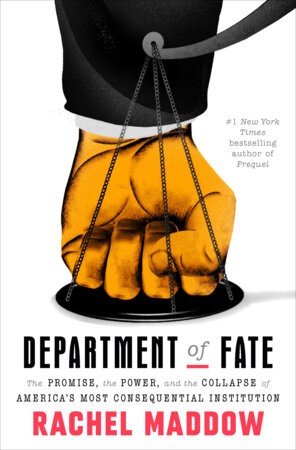
This article has been adapted from Rachel Maddow’s new book, Department of Fate: The Promise, the Power, and the Collapse of America’s Most Consequential Institution.
The post The Collapse of America’s Most Consequential Institution appeared first on The Atlantic.