The Supreme Court on Monday cleared the way for construction to resume on one of the longest and most controversial sections of President Donald Trump’s security project along the Mexican border.
The more than 500-mile stretch of road, cameras, vehicle barriers and sensors planned to cut through Texas’s iconic Big Bend National Park has generated significant backlash. It includes segments where a 30-foot border wall will be built, although the administration has backed off plans for a wall inside the park.
The justices’ ruling allows work to continue while a legal challenge filed by an environmental group, preservationists, and a river guide and landowner plays out in court. Only Justice Ketanji Brown Jackson noted her dissent.
“Respondents claim that construction in the Big Bend Sector will diminish their ability to use and enjoy the area,” the majority wrote. But the Illegal Immigration Reform and Immigrant Responsibility Act of 1996 “reflects a clear preference for expeditious border construction over the very harms respondents assert.”
A federal judge in Texas halted work on the project in October, siding with the challengers, who argued that the Trump administration violated the Constitution by waiving dozens of laws to speed construction. The high court lifted that block after the Trump administration appealed.
U.S. District Judge Kathleen Cardone had ruled that the administration would have to comply with the laws before construction could resume.
“As Plaintiffs have demonstrated, without an injunction, they and the public at large stand to permanently lose protected wilderness that benefits tourism, recreation, farming, ranching, spirituality, aesthetic sensibilities and education,” Cardone wrote in her opinion.
In its appeal of that ruling to the Supreme Court, the Trump administration said the project was urgently needed to stop the flow of migrants and illegal drugs across the border.
“Plaintiffs’ environmental, recreational, and aesthetic interests do not outweigh the harm to the public,” the government wrote in court filings.
More than 89,000 people were apprehended trying to enter the United States between 2021 and 2025 in the area known as the Big Bend Sector, according to government court filings. About 15 percent of drugs seized along the border in recent years were recovered in the sector.
Citing the flow of migrants and drugs, then-Homeland Security Secretary Kristi L. Noem found earlier this year that the administration did not have to comply with dozens of mostly environmental laws because there was “an acute and immediate need” for the barrier.
The plaintiffs questioned whether the accelerated timeline was necessary.
They pointed out that the Big Bend Sector had by far the least number of migrant apprehensions of any of the border’s six sectors, accounting for about 2 percent of the total number. The drug seizures amount to less than 1 percent of all non-marijuana drugs.
Anna Claire Beasley of No Big Bend Wall, one of the groups opposed to the project, said she was dismayed by the high court’s decision.
“The consequences of this decision are not theoretical. Every road cut into the desert, every stretch of land cleared, and every barrier built changes this landscape in ways that may never be undone,” Beasley said. “Big Bend is not an empty stretch of border waiting for development. It is a living landscape, home to communities, wildlife, cultural history, and a globally significant natural environment.”
The Trump administration is building hundreds of miles of new border wall across California, Arizona, New Mexico and Texas, after Congress included $46.5 billion in funding in last year’s One Big Beautiful Bill. The Big Bend sections total $1.7 billion.
Conservationists fear that the administration’s move to bypass environmental laws during construction will damage otherwise remote wilderness and irreversibly alter iconic landscapes enjoyed by outdoor enthusiasts.
The wall expansion originally included plans to build a barrier through Big Bend National Park, the most-visited national park in Texas with more than half a million people entering in 2025.
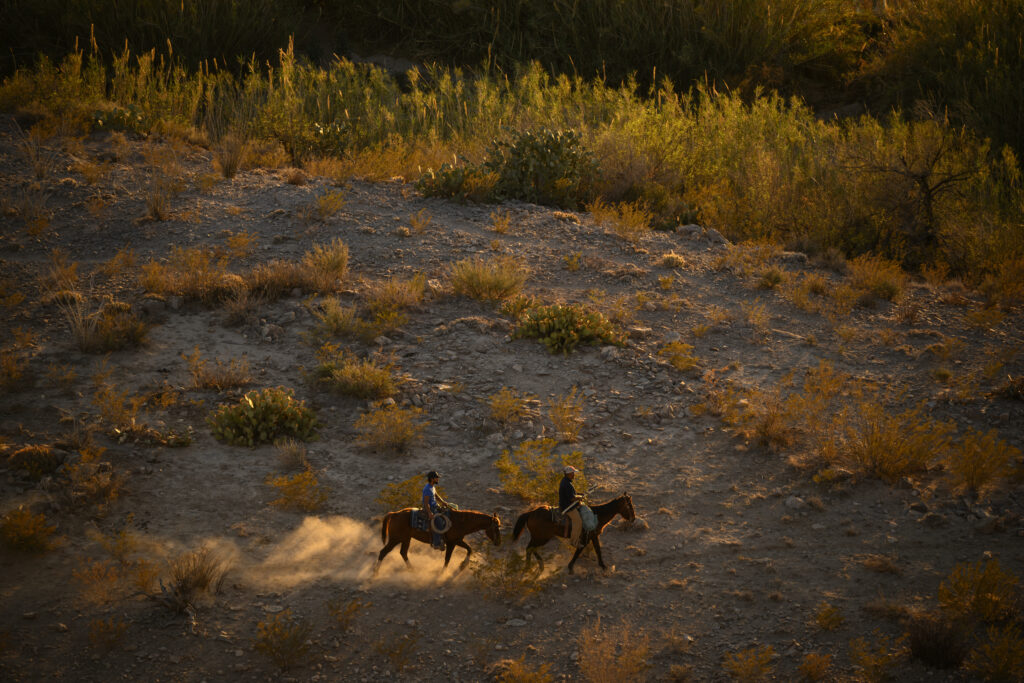
The park, which consists of 800,000 acres in southwest Texas, is renowned for its views of the mountains and steep cliffs that descend to the Rio Grande, drawing hikers and kayakers.
But in the face of outcry from local landowners, tourism businesses and politicians, the administration reversed course, opting instead to build patrol roads through the park and install vehicle barriers and additional surveillance technology.
Conservation advocates argue that even building a road would require blasting through the mountains with dynamite, although Customs and Border Protection denies that.
In the wider Big Bend region, the administration still plans to build more than 150 miles of the 30-foot wall, according to the CBP website.
The construction has moved forward rapidly in many areas thanks to the 2005 Real ID Act, which granted the Department of Homeland Security the ability to waive some environmental laws for building a border wall. That has allowed it to forgo reviews of potential damage to the environment and archaeological sites, which can often delay projects months or years.
Inside the national park, contractors in August began bulldozing scrubland along the Rio Grande to clear a path for the new patrol road. That land would typically be protected by the Endangered Species Act as the Fish and Wildlife Service has designated it as critical habitat for the yellow-billed cuckoo.
Following local outcry, CBP Commissioner Rodney Scott paused that work to consult with local stakeholders.
Efforts to oppose the wall elsewhere have been less successful. In Arizona, activists blocked wall construction for more than two months by occupying a giant tree along the border, before a dramatic raid by more than 50 CPB agents ousted them and downed the tree. Construction preparations are also moving ahead on Arizona’s nearby Tohono O’odham Nation, after a judge denied the Native American reservation’s request for a preliminary injunction.
The post Supreme Court allows major part of Trump’s border security project in Texas appeared first on Washington Post.