When Jacob Baskin bought a Brooklyn brownstone, he wanted to replace the old gas stove and oven with an up-to-date induction range that runs on electric power. But his contractor told him his electrical panel couldn’t handle an oven in addition to his air conditioner and the clothes dryer. If he wanted his induction range, he would have to get a new, larger electrical panel at a cost of $4,500.
Baskin decided to skip it, a decision he still regrets eight years later. If he could have installed the induction stove without upgrading his panel, he said, “I would have done it in a second.”
Unbeknownst to him at the time, he probably could have.
Outdated industry practices and in some places outdated electrical codes are regularly resulting in the recommendation that people need to upgrade their electrical panels if they want to add appliances such as induction stoves, heat pumps and electric-vehicle chargers.
The expense — at a median of $3,500, and triple or quadruple that in some settings — is deterring some energy-efficient upgrades and making the projects far more costly for those who proceed.
But some researchers say panel upgrades are almost always unnecessary. One report this year found that 98 percent of homes with 100-ampere panels, the smallest common size, have room to add popular electronic devices.
In Brooklyn, Baskin recently looked up how much of his 100A panel he had been using. Examining a year’s worth of data provided by his utility company, he saw that the most power he ever used was 1.19 kilowatt-hours in a 15-minute period — which translates to less than 20A of his 100A panel. By that math, he had more than enough room for the stove he had always wanted, which would heat water faster, avoid setting a kitchen towel on fire and save him from paying a monthly gas bill.
In the majority of cases, “even at peak demand, we see there’s not much cause for concern,” said Jenny Low, who works with a group called POWER that seeks to help people electrify at a lower cost. “If you’re trying to add these appliances to your home, the money should be invested in the appliances. You don’t want to put it toward something that’s not needed.”
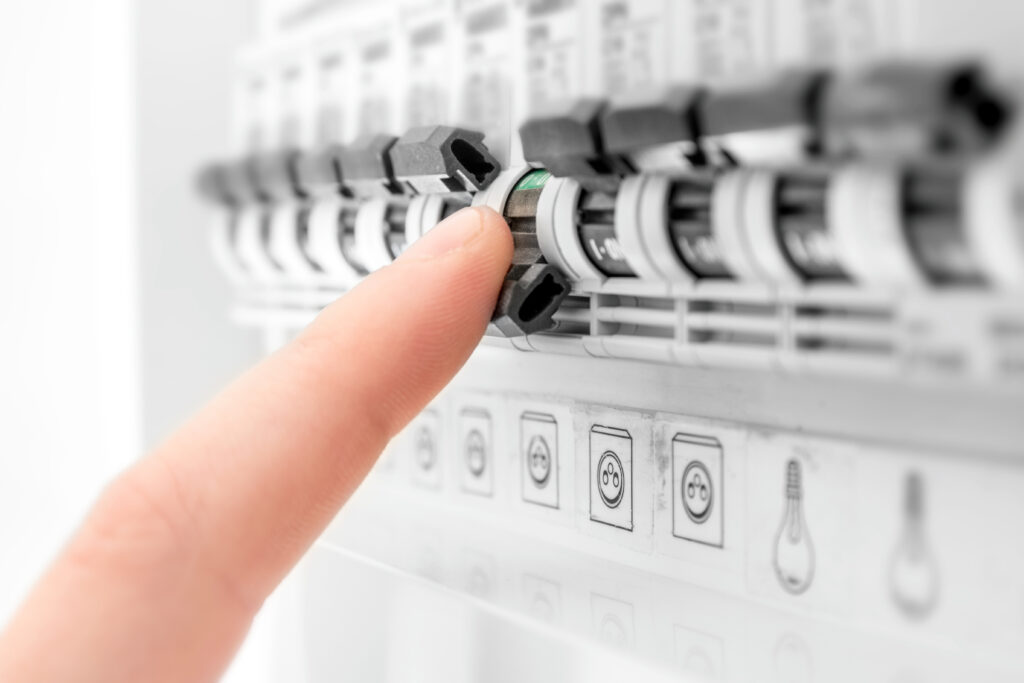
Most homeowners probably only think about their electrical panel — that big metal box of circuits — on the rare occasions they need to turn one of the circuits on or off.
While just over half of American homes have large panels of 200A, almost 1 in 3 homes — generally older ones — have 100A panels, the size that typically prompts contractors to tell homeowners to upgrade. The smaller panels are more often found in colder states, which can be a problem for people who want to install electric heat pumps. Almost half of the homes in New York, the state with the highest portion of small panels, have 100A panels or smaller, according to a recent research paper.
When a homeowner wants to install a major new electrical device, their electrician generally needs to calculate whether they have enough room on their panel for the new tool.
The National Electrical Code — a set of standards overseen since 1897 by a private organization, the National Fire Protection Association, and adopted in whole or in part as a requirement by every state’s legislature — offers two ways to calculate whether a panel can safely power all of the devices in a house.
One method, which experts say is by far the most common, involves adding up the maximum amount of power that the label on each device says it uses. If your air conditioner and your laundry machine and your other machines were all running at full blast at once, could your panel handle the load?
The other, less common method assesses actual power usage. For homeowners like Baskin who have access to granular data on their energy use, the code allows a building inspector to find the hour of the year that the house used the most power, and then basically declare that the house needs a panel that can handle 125 percent of that amount.
Research shows that calculations based on actual usage are on average 40 percent lower than estimates based on labels, a massive difference that could spare millions of homeowners from needing to upgrade.
One analysis of more than 22,000 homes of varying size and age in Northern California by the energy-saving program HomeIntel showed that 86 percent of the homes used under 50A at their hour of highest energy usage.
The more common calculation method in the electrical code “ends up being wildly conservative and just wrong a lot of the time, because previously we didn’t have the data,” said Greg Pfotenhauer, a consultant at Artemisia Energy who has worked with HomeIntel. “Now we have the data, but we’re not leveraging it.”
The experts who write the National Electrical Code recently adjusted it to account for new research, including from Lawrence Berkeley National Laboratory, showing they were requiring more amperes than necessary. For instance, now that the vast majority of people have switched from incandescent lights to energy-efficient LEDs, the code calls for 2 watts for lighting for every square foot of a house, instead of 3 watts.
“As technology progresses, the National Electrical Code … is making it more accommodating to at least give an opportunity for those panels to be utilized without necessarily upgrading,” said Corey Hannahs, who leads the electrical engineering division of the National Fire Protection Association.
But changes to the code can take years to be adopted by states. Only six have adopted the latest code. Michigan is still using the 2014 version for residential buildings.
It can take even longer for some code edits to influence longtime industry practices and change the transactions happening between electricians and customers.
Bill Hyman, a Maryland electrician, said his company upgrades at least one or two electrical panels every week, most in the D.C. suburbs, at a cost of about $6,000 to $13,000 per house. He said he believes the National Electrical Code is, in fact, too lax in its judgments about how many amperes homes should have. He’s seen enough lights flickering and circuits blowing when someone plugs in their hair dryer to be skeptical about how much power an older panel can handle.
“If they tell me they have central AC and an electric dryer, I know it’s overloaded. If you’ve been doing this as long as I’ve been doing this, we know,” Hyman said. “If we followed the code on everything we did, we would have problems. It’s the minimum standard, and minimums are not necessarily the right thing to do.”
Christopher Friend replaced the 100A panel for his three-bedroom Massachusetts condo with a panel twice as large. He had wanted to accommodate a charger for his electric car and to replace a broken water heater with a heat pump. And with a toddler in the house, he worried about the health effects of his gas stove and preferred electric.
Friend was slightly skeptical about the need to upgrade his panel, but after consulting at least five electricians who all said he needed a new one, he saw no way around it. “It’s not like I can do the work myself,” he said.
The new panel cost him $6,000. He obtained an interest-free loan from the state of Massachusetts meant to subsidize climate-friendly upgrades, so he’s paying off the work in installments for seven years.
State funding for panel upgrades in the name of going green is somewhat controversial. The District, for instance, tells homeowners they probably don’t need a larger panel but still offers rebates of up to $2,000 if they do.
Pfotenhauer said it makes sense that states have cut back on these subsidies: “We shouldn’t be dumping money into a problem that doesn’t exist.”
California-based energy engineer Tom Kabat said his research shows that appliance ratings are often much too high. A heat pump water heater that says it draws 5 kilowatts of power actually uses 1 kilowatt, and induction ranges that the National Electrical Code tallied as adding 3.6 kilowatts actually used at most just half a kilowatt at a time.
“The real relief is coming from the power-efficient design movement starting to make appliances with smaller nameplates on them, so you can fit them onto the distribution grid with smaller impacts,” he said.
Electric vehicles are a major area of power-efficient innovation, including cars that don’t just draw power but return power to the home. Some companies are also designing devices that modulate their power usage based on other demands.
Using less power has real benefits for the overall grid, Kabat noted. It’s not just a mathematical gimmick for homeowners tallying their usage.
“Can you fully electrify a house on a 100A panel?” said Andrew Browning. His company, Copper, makes a stove with a battery that is supposed to cut the power demand from 50A to 6A. “The answer is that you can almost always do it for almost every house in the country. But you probably need to do one or two power-efficient decisions, like our stove or a fancy EV charger.”
The post People are paying thousands for a home upgrade that’s often unnecessary appeared first on Washington Post.