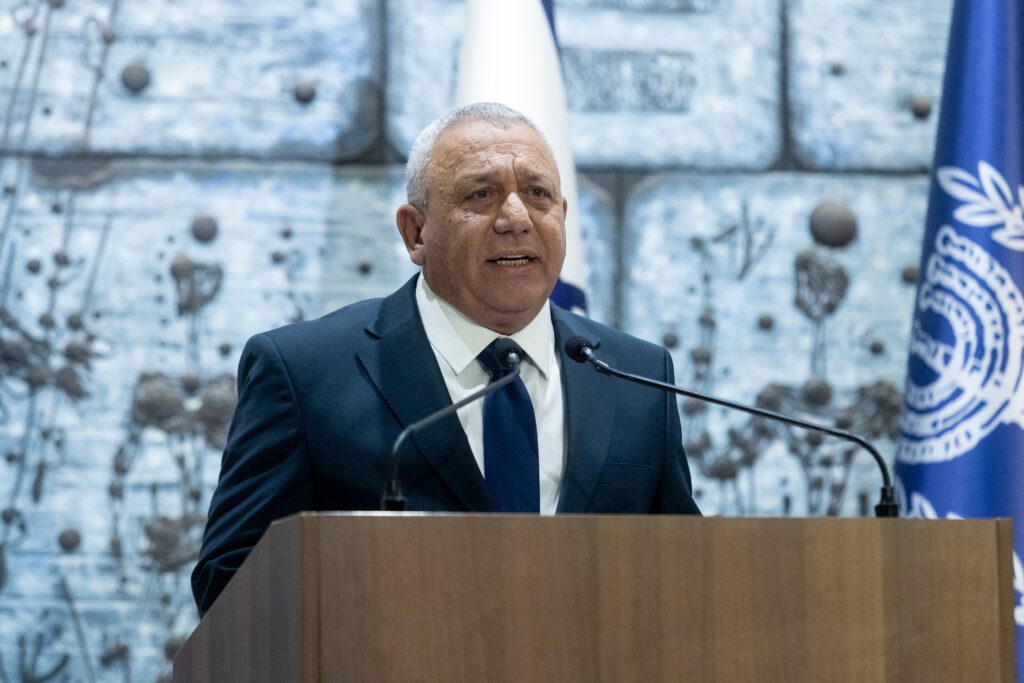
Former Israeli military chief Gadi Eisenkot said Sunday his country was facing a “devastating” loss of confidence among its “closest friends and strategic allies” and urged a swift replacement of Prime Minister Benjamin Netanyahu and his government.
“We are in a state of emergency, approaching a point of no return for the State of Israel,” Eisenkot said in a speech in which he formally accepted Israeli President Isaac Herzog’s mandate to form a new government. “We must form a national emergency government. This will require creative and unconventional political steps.”
Eisenkot, Netanyahu’s main political rival and a centrist on the Israeli political spectrum, has 28 days to successfully build a coalition government through alliances, with a possible two-week extension.
Eisenkot and Netanyahu both fell short in last month’s elections of achieving majority governing coalitions. Herzog gave Eiskenkot the initial mandate to form the government. If Eisenkot fails to meet the deadline, Herzog will likely give Netanyahu the next attempt. If neither succeeds, Israel could go into another election.
Eisenkot said most members of the Knesset “no longer have confidence” in Netanyahu nor does the Israeli public.
“The public has spoken. This is the people’s verdict. We must do everything in our power to respect it and carry it out,” he said.
The task ahead is daunting. Eisenkot must achieve a 61-seat majority in the 120-seat Knesset. In last month’s election, Eisenkot’s Yashar party won 21 parliamentary seats, and his opposition bloc 48 in all.
Eisenkot said he will issue a formal invitation to “every Knesset faction” to form the government.
He said parties are welcome as potential partners if they agree to his “four principles”: recognition of Israel as a Jewish and democratic state, acceptance of the Declaration of Independence’s values, mandatory military service for all, and recognition of Hamas as a terrorist organization and commitment to destroying its power.
Two key Arab-led parties — Ra’am and the Joint List, together holding 19 seats — offered initial support for the retired general’s effort to replace Netanyahu.
Allying with Arab parties could be a key to forming a government, but some of Eisenkot’s coalition partners, including hard-line former defense minister Avigdor Liberman, have ruled out the prospect.
Eisenkot said new leadership could bring Israeli society “back to safe harbor” and restore “sanity.”
“Israeli democracy is at one of its most vulnerable moments,” he said. “If we continue on our current path, we risk sliding into darkness and approaching a point of no return.”
The post Israel’s Eisenkot, tasked with forming government, moves to oust Netanyahu appeared first on Washington Post.