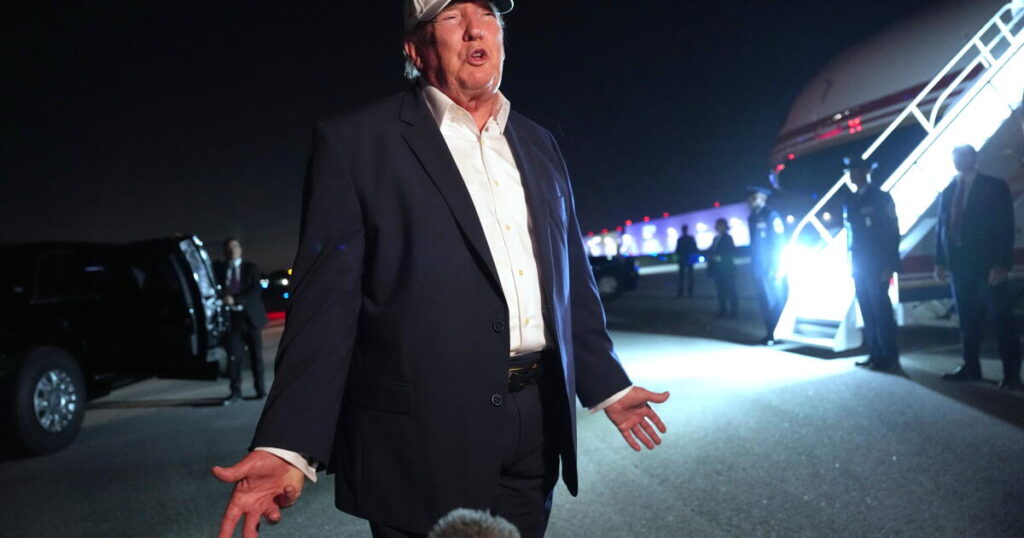
After initially congratulating Democrats on their midterm wins, which he said he was “absolutely willing to accept,” President Trump posted a baseless missive to social media about not trusting early ballot totals or voting machines.
“Does anybody really believe that this ‘Election’ was honest. How could the Polls be so wrong???” he wrote.
The post was a return to the unsubstantiated election denial that has animated his political career since its inception. It was also the latest swing in public messaging from the president and his administration since Republicans lost control of both chambers of Congress and key governorships across the country last week.
Trump — notoriously hard to pin down and prone to meandering tangents — has waffled for nearly a week now on several key policy positions. Other leaders in his administration have split on the same issues, further confusing the public.
On Friday, Trump named Stephen Miller — chief architect of his administration’s sweeping immigration crackdown — as his new chief of staff, which many took as an unambiguous sign that Trump intends to double down on those policies through the second half of his term.
In a “60 Minutes” interview taped the same day and aired Sunday, Trump said that some of those same policies were “too tough,” and that he was open to working with Democrats to find a pathway for undocumented but law-abiding immigrants to remain in the country legally.
On Monday, Trump said he hadn’t told Miller to change his approach, that his administration has a “very strong deportation policy” and that there would be “no amnesty, no anything” for undocumented immigrants, though the administration will be focusing on “the worst of the worst.”
“My policy hasn’t changed,” he said. U.S. Immigration and Customs Enforcement posted, “If you are here illegally, we will find you, arrest you, and DEPORT you.”
After Vice President JD Vance last week blamed the party’s stunning losses squarely on the Iran war, Trump acknowledged that the war — and the spiking gas prices it caused — probably hurt his party at the polls.
But he has since dismissed growing calls from both sides of the aisle for Defense Secretary Pete Hegseth to be fired, claimed the war has already been “won,” and suggested Americans’ displeasure with the economy was based on little more than bad messaging on the nation’s economic “numbers,” which he claimed are strong.
Hegseth said he wasn’t going to get into a “finger pointing exercise” over Vance’s remarks, but that the war “doesn’t have to be necessarily popular” to be necessary.
The White House did not respond to a request for comment on Trump’s shifting postelection messaging.
Leading Democrats, smelling political blood and preparing to take control in Washington, have seized on Trump’s vacillations and doubling down on unpopular positions to paint him as badly out of touch and stubbornly resistant to the will of the American people.
After his Friday appointment of Miller, for example, California Gov. Gavin Newsom wrote, “The American people just delivered Donald Trump a historic rejection. So naturally, he hands keys to the architect of his most cruel and inhumane policies. Absolutely disgraceful.”
After Trump’s post Monday about voting machines, Senate Minority Leader Chuck Schumer (D-N.Y.) wrote, “Donald Trump’s pathetic return to election denialism was inevitable. He can whine all he wants, but nothing will stop this inescapable truth: For the last two years of his presidency, Trump will face the largest Democratic congressional majorities in decades, all because he has been an unprecedented failure.”
Experts who have long studied the president’s rhetoric said it should come as no surprise, as it is perfectly in line with his mantra of never admitting defeat, never accepting blame and never showing weakness — even in the face of an overwhelming defeat.
“He is caught between a rock and a hard place,” said Robert C. Rowland, a professor of rhetoric at the University of Kansas and author of “The Rhetoric of Donald Trump: Nationalist Populism and American Democracy.” “He’s seen the anger of the country, but he’s trying desperately to blame someone else — when all of the data says that this was mostly about him and the results or failures of his policies.”
After Republicans suffered substantial midterm losses in 2006, President George W. Bush acknowledged his party got a “thumping” and immediately fired Defense Secretary Donald Rumsfeld, who was closely tied to the unpopular Iraq war. After Democrats suffered losses in 2010, President Obama acknowledged what he called a “shellacking” and also recalibrated, becoming less “post-partisan” in his messaging and more pragmatic, Rowland said.
Trump’s message about working with Democrats on certain issues could be seen as his own attempt to pivot, if only slightly, Rowland said, but it has been completely undermined by his moves to elevate Miller and reject accountability from Hegseth and others tied to the Iran war.
More than anything, Rowland said Trump’s baseline instinct is to project masculine power and deny culpability for any political failings, in part to hold on to his MAGA base, which is “pretty much all he has left,” and in part to resist any move by Republican moderates to reclaim power in the party.
“He doesn’t want to send any messages of weakness that would allow the remaining Reagan Republicans to kind of stick their heads back up and try to become involved again in conservative politics,” and is loath to “fire any of the men who screw up for him” lest he undercut his message of masculine power, Rowland said.
Trump is ultimately desperate to leave a mark — as evidenced by his ballroom and other vanity projects in Washington — and cares less about substantial policy accomplishments than “his name being in lights in historical terms,” Rowland said.
In his “60 Minutes” interview Sunday, Trump repeatedly avoided accepting blame. Instead, he suggested those who disagreed with him were wrong or misunderstand the reality before them.
He said the American people’s displeasure with the economy, for instance, was due to “bad messaging,” which he blamed in part on the press not covering “positive news for Republicans.”
Others in his administration have also dug in on pre-midterm messaging about the Trump administration being on the side of the American people, ignoring the fact that the electorate clearly and resoundingly rejected its policies last week.
Miller took an immediately combative tone after his promotion to chief of staff was announced, writing on X that Trump has saved the nation “from those who would destroy it,” and that the “mission now is more clear than ever: Fight with all of our soul to support our President and defend this magnificent Republic.”
On Monday, Homeland Security Secretary Markwayne Mullin wrote on X, “While Americans enjoyed their weekend, the patriots of [ICE] worked around the clock to arrest and remove dangerous criminals from our communities, including murderers, pedophiles, and sexual predators.”
Over the weekend, Hegseth posted a video to U.S. military troops, telling them, “Don’t blink. Ignore the noise. Never hesitate.”
“You see, all this is politics. You do real things. You stay the course. And as always, President Trump leads the way. And I’ll assure you, we have only just begun to fight,” Hegseth said.
Whether such bravado will hold is unclear.
On Monday, Rep. Thomas Massie (R-Ky.) filed articles of impeachment against Hegseth, calling for his ouster on eight charges, including for “waging the Iran war despite no declaration of war, statutory authorization, attack on the United States, or imminent threat”; for launching “extrajudicial killings” against alleged drug smugglers in offshore boats; and for the “kidnapping of a sovereign foreign leader,” a reference to the U.S. capture of now-former Venezuelan President Nicolás Maduro.
About the same time, Trump posted an AI-generated video of Ultimate Fighting Championship Chief Executive Dana White serving as White House press secretary, telling reporters to “sit down and shut up.”
Hours later, he and White were actually in the White House briefing room — where Trump defended the Iran war as “won” by the U.S., called Massie a “loser” and said he will “stand by” Hegseth even if he’s impeached.
“He won two wars,” Trump said.
The post In search of post-midterm message, Trump waffles on trusting election, immigration policy appeared first on Los Angeles Times.