As Democrats return to Capitol Hill after stunning midterm victories, one of their first tough decisions is whether to back a sweeping, contentious plan to make it easier to build power plants, gas pipelines, transmission lines and other energy infrastructure.
The Senate is scheduled to take an initial procedural vote on Monday evening on the bipartisan permitting-reform bill, which would overhaul longstanding environmental laws to speed development of fossil fuels and renewable energy alike.
Business groups, energy developers and labor unions all back the legislation, as does President Trump. The United States is struggling to build enough power sources to keep up with soaring electricity demand, especially for A.I. data centers. Cutting red tape, proponents say, could increase supplies and lower electricity prices.
Yet the 494-page bill has divided Democrats, whose votes are needed in the lame-duck session. Supporters say the bill would bolster clean energy technologies that could reduce planet-warming emissions. But environmentalists have sharply criticized provisions that would benefit oil and gas and make it harder to sue to block polluting facilities.
Last week’s “blue tsunami” could complicate passage. Some Democrats have said the party should negotiate a new bill next year, when they’ll have large majorities. Others counter that this bill took years to negotiate with Senate Republicans and the White House, and a better deal is unlikely anytime soon.
“We don’t have more years to lose as clean energy projects sit on the sidelines, and there’s no guarantee Congress would ever find another compromise that would be able to pass the Senate,” said Senator Sheldon Whitehouse, Democrat of Rhode Island, one of the authors of the bill. “Democrats ran and won on affordability, and this bill lowers costs for families and will allow us to start delivering on our election promises. It’s a bird in the hand. We’d be fools not to take it.”
Here’s a rundown of the bill’s major provisions.
What is the legislation trying to fix?
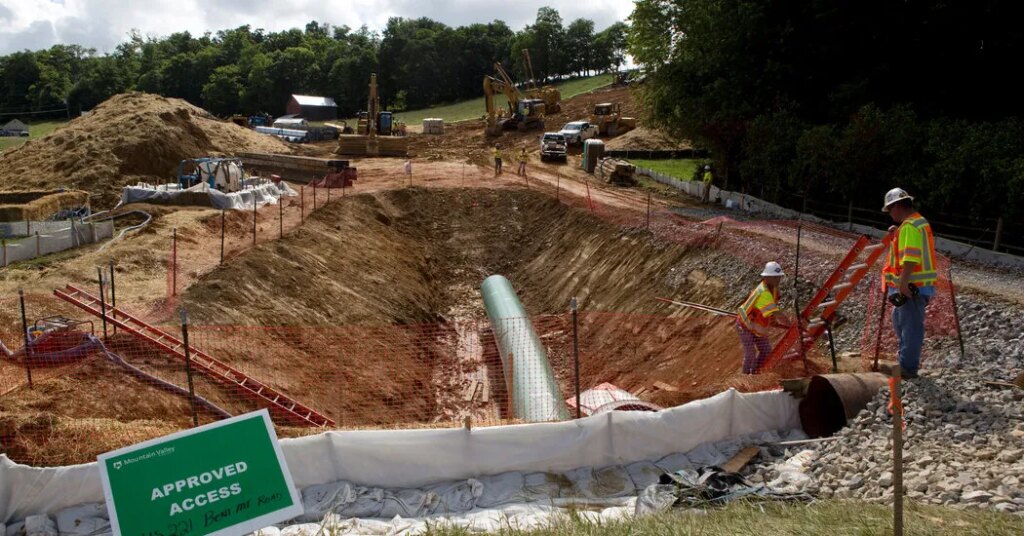
Many energy companies have complained that it’s gotten increasingly difficult and expensive to build large infrastructure in the United States. A giant wind farm and power line in New Mexico took 17 years to complete after numerous lawsuits and route changes. Regulatory challenges delayed a 303-mile natural gas pipeline through Virginia and West Virginia for a decade.
Some experts say federal environmental laws are one major factor. Big energy projects often have to navigate a thicket of rules that require extensive reviews and allow lawsuits that can cause unpredictable delays. These laws were enacted in the 1970s to encourage public participation and transparency. But some politicians say they have become too restrictive.
Energy has also become increasingly partisan. Democratic-led states like New York have used clean-water rules to block natural gas pipelines, while the Biden administration tried to stifle oil drilling on public lands. The Trump administration has sought to revoke permits for offshore wind and bury wind and solar projects in red tape.
The permitting reform bill — known as the Bipartisan American Affordability and Jobs Act, or BAAJA — would streamline federal approvals and make it harder for presidents to unilaterally block energy projects.
The complex measure was negotiated after months of closed-door sessions between senators from both parties and the Trump administration. While Republicans have long favored shrinking environmental regulations, a growing number of Democrats like Mr. Whitehouse now say it’s impossible to reduce planet-warming emissions without being able to build many more long-distance power lines or large solar arrays. That requires permitting changes.
How would it speed permitting?
The legislation would overhaul several landmark environmental laws to make it easier for the federal government to approve all sorts of projects, from gas pipelines to subway expansions.
“This bill would certainly be the biggest change to environmental permitting in decades,” said Michael Gerrard, director of the Sabin Center for Climate Change Law at Columbia.
For example, the National Environmental Policy Act of 1970, or NEPA, requires many projects with federal involvement to go through lengthy reviews of potential impacts on air and water. The bill would exempt certain projects from these reviews, such as expansions of pipelines or power lines along existing routes, while setting tighter deadlines and restricting the ability of environmental groups and communities to sue.
Notably, the bill would prevent courts from halting projects if they found an environmental review inadequate. Judges could only order federal agencies to update their reviews while construction proceeds.
Supporters say that NEPA often ties up projects in years of litigation that does little to improve environmental outcomes. They note that energy facilities still have to follow other laws, such as the Clean Air Act.
“Whether you’re talking about solar or wind or gas, it takes five to seven years to get through permitting,” said Ray Long, president of the American Council on Renewable Energy, a trade group. “That’s too long. We should be able to get it down to 24 months while still preserving the right of communities to weigh in.”
Yet environmentalists who frequently use the law to sue oil and gas projects have argued that the changes could render NEPA toothless, removing a key tool for communities to understand the effects of new developments.
The bill makes other major changes, such as limiting states’ ability to object to gas pipelines under the Clean Water Act. It also streamlines reviews required by the National Historic Preservation Act of how infrastructure projects could affect historically or culturally important sites, a big consideration for tribal nations.
The bill also limits the ability of presidents to revoke already-issued federal permits, while allowing companies to sue federal agencies that hold up energy projects for an “unreasonable” length of time. Some Democrats sought those provisions to make it harder for the Trump administration to slow wind and solar farms, though they could also prevent future Democratic administrations from delaying oil and gas permits.
What else does the bill do for energy?
Several far-reaching provisions would push regional grid operators to plan for more large power lines while giving federal regulators stronger authority to authorize new ones.
That provision has been of particular interest to renewable energy groups. One huge roadblock for more wind and solar power has been a lack of long-distance lines that can connect the windy Great Plains and sunny Southwest with population centers. When lines do get proposed, states and localities in their paths often hold them up. The bill, experts say, could lead to a large expansion of the electric grid.
The legislation would also require data centers to pay a larger share of the costs of new power plants and transmission lines. It’s a nod to widespread voter anger over data centers for A.I., with many communities worried that the massive energy-hungry facilities could raise costs for ordinary households.
Other provisions would streamline permitting for geothermal energy. Many start-ups are trying to adopt advanced drilling techniques from the oil and gas industry to harvest clean energy from underground heat, yet they often face hurdles to explore federal land in the West.
What impact could the bill have?
Various groups have tried to model the bill’s provisions and found that it could help lower electricity costs and expand renewable energy, though the magnitude is uncertain.
The Rhodium Group, a research firm, estimated that the bill could cut U.S. electricity prices by 3 to 5 percent and potentially reduce domestic greenhouse gas emissions modestly as both natural gas and wind and solar power expand. The bill would quite likely free up more gas for U.S. companies to export, though the group did not estimate the emissions impact of that.
One wild card for emissions, said Ben King, a director at Rhodium Group, is whether tech companies might build more data centers on the grid or use more polluting off-grid equipment if the bill passes. Other impacts are hard to model: If the legislation boosts advanced geothermal, that could create a major new source of clean energy, though that wouldn’t affect emissions immediately.
Why are environmental groups divided?
Influential green groups like the Sierra Club and Natural Resources Defense Council have praised provisions that would expand the electric grid but have criticized the environmental rollbacks. They oppose the current bill.
Some are concerned that the plan would enable Mr. Trump to approve a slew of fossil-fuel projects — new gas pipelines, mining, data centers on public lands — that would be difficult for a future president to undo. Conservation groups have also opposed the bill on the grounds that it could lead to more water pollution or harm endangered species, effects that don’t show up in modeling.
“To just say we’re going to let anyone build anything as fast as they can and lock it in with President Trump?” said Abigail Dillen, president of Earthjustice, an environmental group that opposes the bill. “That’s a dangerous prescription.”
By contrast, some climate groups like Evergreen Action say those trade-offs are worth it for a bill that would make it much easier to build clean energy.
The divide underscores a broader debate about how much environmentalists should focus on blocking fossil fuels versus working to expand less-polluting alternatives as quickly as possible. Supporters of permitting changes note that the Biden administration often ran into bureaucratic constraints while trying to expand wind and solar power, while arguing that states like New York have struggled to cut emissions by blocking gas pipelines.
“I don’t think we have any evidence that blocking fossil fuel projects with permitting has been an effective tool in reducing global emissions,” said Jane Flegal, a senior fellow at the Searchlight Institute and former climate official in the Biden administration. “It raises costs, it’s bad politics and it doesn’t work.”
Who else supports or opposes the bill?
Most energy companies, including fossil fuel and renewable energy trade groups and electric utilities, have backed the bill. A group of former economic officials from the Trump, Biden and Obama administrations also urged passage, saying that the United States could lose the technology race against China without big changes to energy permitting.
Some tribal nations had criticized the bill’s changes to the National Historic Preservation Act, and the bill’s authors revised the text recently in an effort to address those concerns.
It’s far from certain that the legislation will pass during the brief lame-duck session. The bill needs 60 votes in the Senate and would also need to be taken up by the House while lawmakers still have many other priorities — including funding the government.
The post Congress to Vote on Far-Reaching Plan to Speed Up Energy Projects appeared first on New York Times.