The United Nations climate conference, known this year as COP31, starts Monday in Antalya, Turkey.
The event comes after a series of deadly heat waves and floods, and amid an El Niño event that pushed global temperatures last month to the highest level for any October on record. At the same time, the United States’ war in Iran, and the effective closure of the Strait of Hormuz, has sent oil and gas prices soaring, scrambling nations’ energy goals. Greenhouse gas emissions from burning fossil fuels are at a record high.
Against that backdrop, negotiators and world leaders are gathering for the 12-day event.
Here is a guide to the meeting:
What is COP31?
It’s the United Nations’ annual climate gathering formally known as the Conference of the Parties. This year, it starts Nov. 9 and is scheduled to end on Nov. 20, but negotiations often run past the deadline.
More than 195 countries are part of the United Nations Framework Convention on Climate Change, set up in 1992. Those nations discuss how to address global warming and cut greenhouse gas emissions. The climate meeting is the largest annual United Nations conference of any kind, and this year more than 60,000 people are expected to attend.
The talks include two days of speeches from world leaders, on Nov. 11 and 12. After that, the formal negotiations intensify, and delegates try to hash out a final agreement to advance climate goals.
Why is it in Turkey?
Nations take turns hosting the event. But this year, Turkey earned the right only after striking a sharing agreement with Australia, which had also sought the host role. As a result, Turkey will manage the venue, handle communication and preside over the voluntary sideline initiatives. But Australia will shepherd negotiations. The arrangement makes for an unusual variable at these talks.
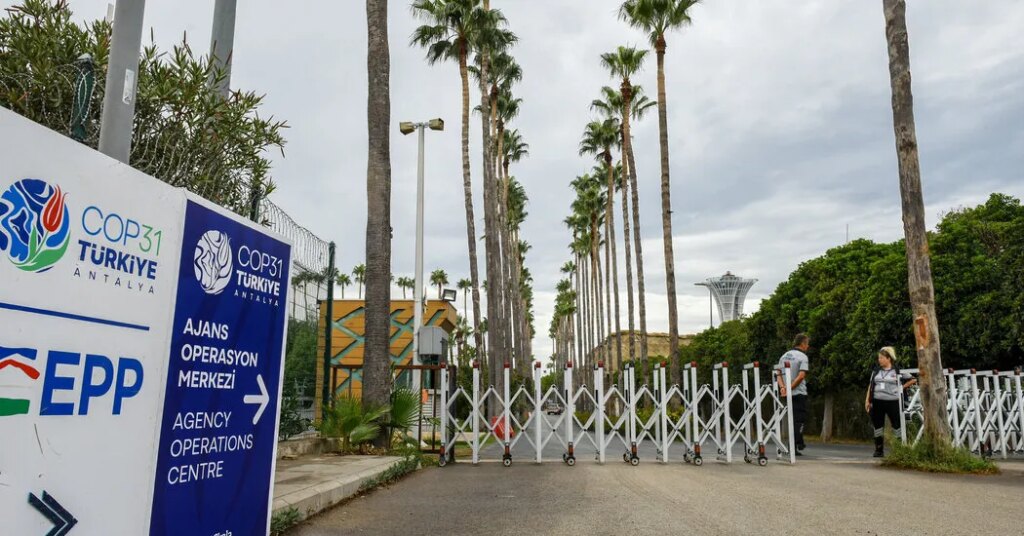
The conference takes place in Antalya, a Mediterranean resort city, at the Antalya Expo Center.
Last year’s conference was held at the edge of the Amazon rainforest, in Belém, Brazil. Next year’s conference is planned for Addis Ababa, Ethiopia.
What’s the objective?
The main goal is to make progress in limiting global temperature increase and cutting planet-warming greenhouse gas emissions. Experts and organizers say the purpose of this COP is to help flesh out existing agreements by pushing countries to live up to their past pledges and making sure they have funds and know-how.
This year’s event is sure to focus on money. Developing countries say they still don’t have the funding they need to adapt to a hotter world and recover from increasingly intense disasters. Fossil fuels will also be a contentious issue. Nations have been at loggerheads on how, and whether, to follow through on a 2023 pledge to transition away from coal, oil and gas. COP leaders are also trying to win support for a global goal on expanding the reach of electricity grids that would make more room for renewable energy like wind and solar power.
Negotiators will have to decide which of these elements can be stitched together in a final agreement.
Are COPs doing enough?
Not really.
Since the Paris Agreement, countries have indeed made some headway. Global temperatures were once projected to rise 4 degrees Celsius, or 7.2 degrees Fahrenheit, above preindustrial levels. With the spread of renewable energy and commitments by nations to cut emissions, scientists say warming is now on track for 2.8 degrees Celsius if current policies continue.
Such a temperature rise might sound modest. But that warming would bring humans outside the narrow temperature bounds in which they have flourished for millenniums. Countries say they will struggle to cope with the huge transformations, including stronger and longer heat waves, and harsher conditions for growing food.
And the world is poised to sail past its foremost climate goal of limiting temperature rise to 1.5 degrees Celsius, or 2.7 degrees Fahrenheit, above preindustrial times. In September, the United Nations said that threshold would be breached in the “next few years.”
What does the U.S. absence mean?
When President Trump pulled the United States from the 2015 Paris Agreement, it meant that the global effort to cut emissions would no longer include the country that has pumped the most carbon dioxide into the atmosphere. Other countries have criticized the move, and no other nation has followed the U.S. in exiting the accord.
From the outside, the Trump administration has worked to hamper clean energy goals, campaigning to prolong the era of fossil fuels. At home, it has stopped government support for wind and solar, while helping oil, gas and coal. Abroad, it has lobbied against a global emissions-cutting measure for the shipping industry and a treaty to limit plastics production. A recent U.N. report singled out the United States for emissions increases in 2025 that “far exceeded” those of other industrialized countries.
Who will attend?
At least 91 world leaders are expected in Antalya, but only a handful come from the industrialized countries that are most responsible for greenhouse gas pollution. Prime Minister Andy Burnham of Britain, Prime Minister Pedro Sánchez of Spain and Luiz Inácio Lula da Silva, the recently re-elected president of Brazil, have said they would attend.
President Trump will not be there, nor will any high-level representatives of his administration. But a phalanx of Congress members and state and city leaders are expected.
COPs are colorful affairs, and though negotiators often meet in closed-door sessions, the hallways fill with activists, scientists, fossil fuel lobbyists and climate experts from nongovernmental organizations.
The post What to Know About COP31 Climate Talks in Turkey appeared first on New York Times.