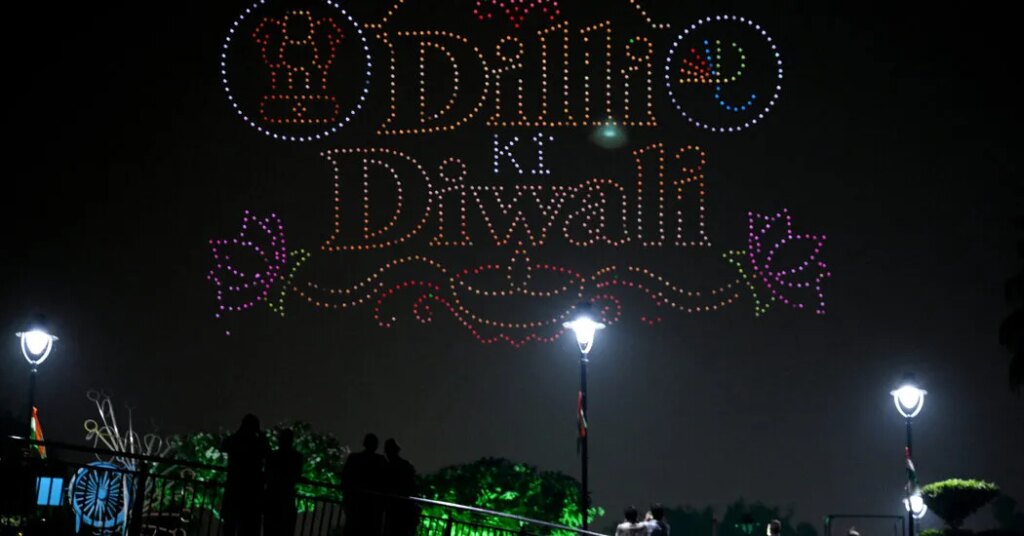
Nothing says it’s time for Diwali like the riot of colors that suddenly appears everywhere — red saris, gold kurtas, garlands of bright orange marigolds. But there’s another color that’s now compulsory in India’s capital: green.
Green, as in the environmentally friendlier fireworks that the Supreme Court of India has said are the only type that can be set off this Diwali weekend. Fireworks are otherwise banned to try to avoid contributing to the toxic haze of dust, vehicle exhaust and smoke from faraway crop fires that envelops New Delhi around this time of year.
The court ruled last week that fireworks — a staple of Diwali celebrations across the country — could be used in the capital region for three-hour windows on Saturday and Sunday, as long as they were of the “green” variety manufactured to burn faster and emit fewer harmful chemicals.
The court cited Diwali’s “religious, social, psychological and emotional connotation” that fostered “a positive atmosphere of hope, welfare and prosperity.” Since ancient times, the court observed, Hindus had lit fires on the holiday, known as the festival of lights, first with lamps and later with explosives once gunpowder was invented.
After Sunday, the actual day of Diwali, the full ban on the sale and use of all fireworks, implemented by the Delhi government in 2024, goes back into effect.
But the court’s attempt to balance public health and religious expression left some environmental activists incredulous.
“It’s a green wash that we are talking about here,” said Vimlendu Jha, an environmentalist based in New Delhi.
Mr. Jha said that such court orders in the past, including one last year, failed to work because there was no enforcement.
The Supreme Court “knows very well that the government lacks the political will to enforce the rules on the ground,” he added.
Air quality in Delhi, regularly ranked among the world’s most polluted cities, had already sharply deteriorated in recent days, owing in part to unfavorable weather conditions.
The government’s Commission for Air Quality Management declared on Thursday that a considerable uptick in dirty air over Delhi was “a matter of serious concern.” It enacted measures it said were “preventive” in nature, including halting demolition work and ordering employers to keep half of their staff home until Nov. 20.
One culprit has been wind — there’s been too little of it to clear out the bad air and it’s blowing in the worst possible direction. When it is from the northwest, it picks up smoke from fires set by farmers disposing of leftover straw as they prepare for the next season’s harvest.
Officially, the national government banned crop burning in 2015 in the states where it was contributing to poor air quality in the capital. While that led to a reduction in illegal fires by 30 percent during the first few years, lax enforcement diminished the ban’s effectiveness, according to a study published last year by the London School of Economics.
So far this season, more than 2,700 farm fires have been reported by officials in Punjab, the northwestern state where much of the burning that affects Delhi takes place.
But primarily, vehicle emissions are what cloud the capital.
As the weekend approached and residents of the Delhi region carried on with their holiday shopping, loudspeakers blared in markets warning people that any kind of firework that was not a green firework was illegal. Some shoppers said the fireworks ban was a smokescreen to begin with, obscuring the government’s inaction.
On Thursday in central Delhi, a market where “green” firecrackers were being sold wholesale was abuzz with activity. Eager customers jostled for space on narrow counters to purchase theirs in the several days permitted for their sale. Shopkeepers hardly had time to pause in between dishing out the selected ones for each of them.
The Air Quality Index — a measurement of the concentration of particles smaller than 2.5 micrometers in the air — was hovering around 400. At above 200, the air is “very unhealthy.”
Smog had enveloped the city all day and the soupy air left an acrid taste on the tongue. Almost nobody was wearing a mask.
Pollution was an excuse by the government to stop Hindus from going all out to celebrate their festival, said Babu Srivastava, 45, who has three children he said were excited to set off firecrackers this Diwali.
“All year round we see that vehicles are the top polluters in and around the city. So what difference does it make if we burst crackers for a couple of hours on our festival which comes once a year?” he said, fishing 9,000 rupees, or around $100, from his wallet to pay for a bundle of the “green” ones.
The post Polluted Delhi Tries ‘Green’ Fireworks to Clear the Air at Diwali appeared first on New York Times.