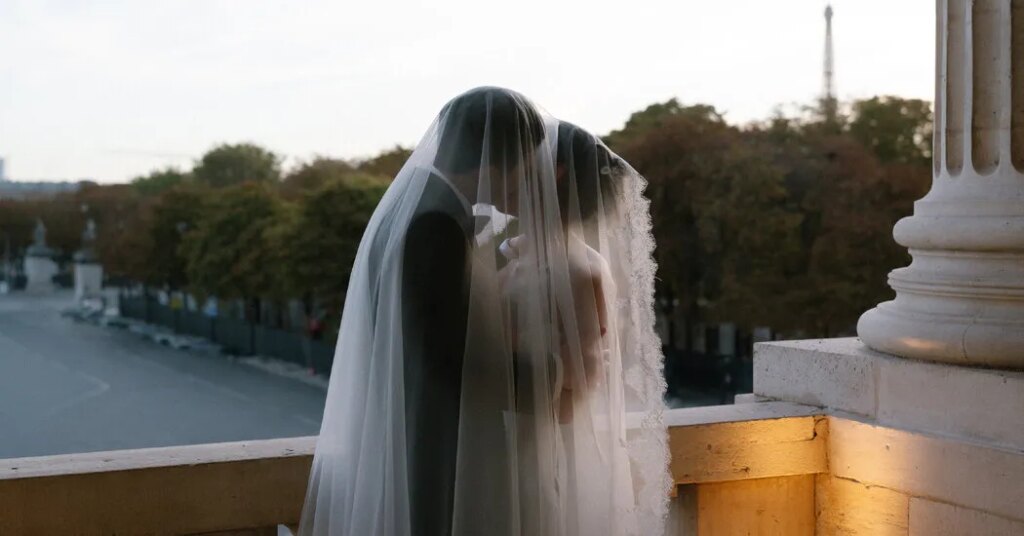
While planning her wedding, Min Sun Song remembers videos of random couples’ nuptials flooding her TikTok and Instagram accounts. “I didn’t want my special day to end up on a stranger’s feed,” said Song, 38, who wed Doyoon Kim, 41, a dentist, in September at Hôtel de Crillon in Paris.
To that end, the couple’s Montreal-based wedding photographer, Julia Garcia-Prat, signed a partial nondisclosure agreement (NDA), allowing her to post only unidentifiable photographs of the newlyweds. The couple also asked their 46 guests to refrain from taking photos.
Instead, they hired a social media content creator so guests wouldn’t feel pressured to document the festivities. The footage, however, was not intended for the public’s consumption. The goal, said Song, who works in social media advertising, was to “keep the wedding more private,” while still capturing candid moments.
Song and Kim, who live in Manhattan, have no plans to post any of the footage on their private Instagram accounts, save perhaps on the “Close Friends” feature. “We see so many influencers out in the wild taking videos of everything and everyone, and we have no control over it,” Song said. “Having that control of what we share seems like a luxury.”
Garcia-Prat isn’t surprised by the shift. This year, she estimates roughly 20 percent of her clients have requested some form of an NDA, publication restriction or additional approvals over what she can share online.
Privacy is now part of every conversation Garcia-Prat has with prospective clients, sometimes before price. “It’s becoming the new norm,” she said.
Garcia-Prat believes artificial intelligence contributes to couples’ growing privacy concerns. Recently, she spoke with a client who insisted on a full NDA for fear of feeding “his face into the A.I. machine,” she said.
Garcia-Prat said she understands her clients’ reservations. “This is their day,” she said. “It’s not a photo shoot” for the public to view. She previously charged an NDA fee, but now she waives it as long as she can share photos of décor and architecture.
Along with everyday couples, some social media influencers — and even Taylor Swift and Travis Kelce and Selena Gomez and Benny Blanco — have been resisting the expected content rollout and brand collaborations that accompany weddings. “The second that I got engaged, I got a flood of messages” from brands, said Kennedy Bingham, 30, a bridal stylist and the founder of Gown Eyed Girl, who has 1.7 million followers across social media platforms. “I understand why getting things for free is nice,” she added. “But I personally have always felt that being able to make my own choices is nicer.”
Bingham and her husband eloped in Las Vegas in 2021, partly to avoid the pressure to turn their wedding into a business opportunity. But after family members pushed for a larger celebration, they hosted about 120 guests at the Rosewood Miramar in Montecito, Calif., in August 2024. Though The Cut covered the event and Bingham shared a few posts, she opted out of brand collaborations almost entirely.
To stay off her phone, Bingham hired a content creator to chronicle the day, yet most of the footage remains untouched in a Dropbox folder. “There’s something really concerning about turning your very personal, important day into something that’s meant to give you external validation,” she said.
Drew Reggie, 37, and Lanie Bakeberg, 35, creators of @FlyMeToTheFun, took a similar stance for their September 2026 wedding before 110 guests at Trillium Links and Lake Club in Cashiers, North Carolina.
The newlyweds, who have some 812,000 combined social media followers, built their audience around aviation and had no interest in bringing sponsored content into their wedding. They have yet to share any wedding imagery on their account, but plan to share a few images down the line.
“It’s a life day,” Bakeberg said, not a day for promotion. “I don’t really want there to be a 30-second reel about it,” she added, noting that even with a public career, “you have to keep something sacred.”
Ashley Powell, the founder of Frost & Co., an influence strategy company in the milestone economy based in Santa Monica, Calif., sees this as part of a sea change. “I believe we are watching the influencer bride evolve into the private bride,” she said. “Privacy is the last luxury we all have left,” Powell added, noting that this shift is especially pronounced at high-budget weddings, whence trends often trickle down.
The most influential bride may no longer be the one who shares the most, but the one who retains authorship over her narrative, she asserted. Accordingly, Powell predicts the advent of a new wedding vendor: “a story architect,” who choreographs what gets released, when and on which platforms. Powell perceives this role as “the caretaker” of a wedding’s narrative, all the more necessary when “the day gets documented beautifully and remembered thinly,” as is the case in modern times.
For wedding vendors, the restrictive posting policies and NDAs have become a “big struggle” per Nicole Dohrman, owner of Dreams in Detail, an event planning firm in Los Angeles and New York City.
Dohrman points to the weddings of celebrities like Taylor Swift and Travis Kelce and Selena Gomez and Benny Blanco as inspiring everyday couples to follow suit by limiting what they share online or forgo posting altogether. “It creates more exclusivity,” she said. For other couples, the decision to share is driven by a reluctance to flaunt wealth or a desire to maintain professional confidentiality.
Dohrman estimates roughly half of her couples ask for some level of privacy or control around social media, from asking guests to wait to post any photos of the newlyweds until the couple shares first to distributing stickers to cover camera lenses to prevent photography and video recording altogether.
Christina Allen Cathcart, 40, took the former approach at her October 2026 wedding, to “protect the aesthetic” of an event that took more than a year to plan.
“You don’t want it to be overpowered by someone just posting some random, blurry” iPhone photo, said Cathcart, a nurse practitioner working in health care policy in Baltimore. Her wedding was held at the Grand Bohemian Hotel in Charlotte, N.C., with approximately 112 guests in attendance.
Motherhood made Cathcart more intentional around what she shared on social media, particularly when it came to protecting her young children. “I don’t want a lot of that stuff just all over the internet,” said Cathcart, whose six-month-old and two-year-old were in her wedding.
Nicole Newsum-Heriveaux was similarly thoughtful around social media for her October 2025 wedding. Newsum-Heriveaux, 45, who owns a public relations firm in Brooklyn, displayed no-photo signage at her ceremony at the V.I.P. Country Club in New Rochelle, N.Y. Along with reminder messages from the couple’s wedding planner and a note on their wedding website, the best man also reminded their 171 guests to put their phones away in both English and Haitian Creole for the groom’s Haitian relatives.
In the year since the wedding, Newsum-Heriveaux has only posted a handful of photos to her private Instagram account, mainly for milestone occasions like Mother’s Day and Valentine’s Day.
For Newsum-Heriveaux, the point is to share selectively, rather than turn her wedding into a play-by-play. “I’m not a content creator,” she said.
It appears even some content creators are on board with that ethos. Dohrman recently planned an influencer bride’s wedding for 250 guests, including other influencers and celebrities. “She had five dress changes,” Dohrman said.
“There’s not a single photo online.”
The post Is This the End of the Wedding Overshare? appeared first on New York Times.