DURANT, Miss. — The ripples of the blue tsunami started in the Delta. Down a tiny road covered in brown leaves from the large oak trees was a house with wood-paneled walls covered with quotes from Maya Angelou and photos of Harriet Tubman. There, Kameisha Smith, 31, sat at a folding table and pressed her long lavender nails on her laptop keyboard, staring at a spreadsheet of people who might solidify a historic change to this country’s political trajectory.
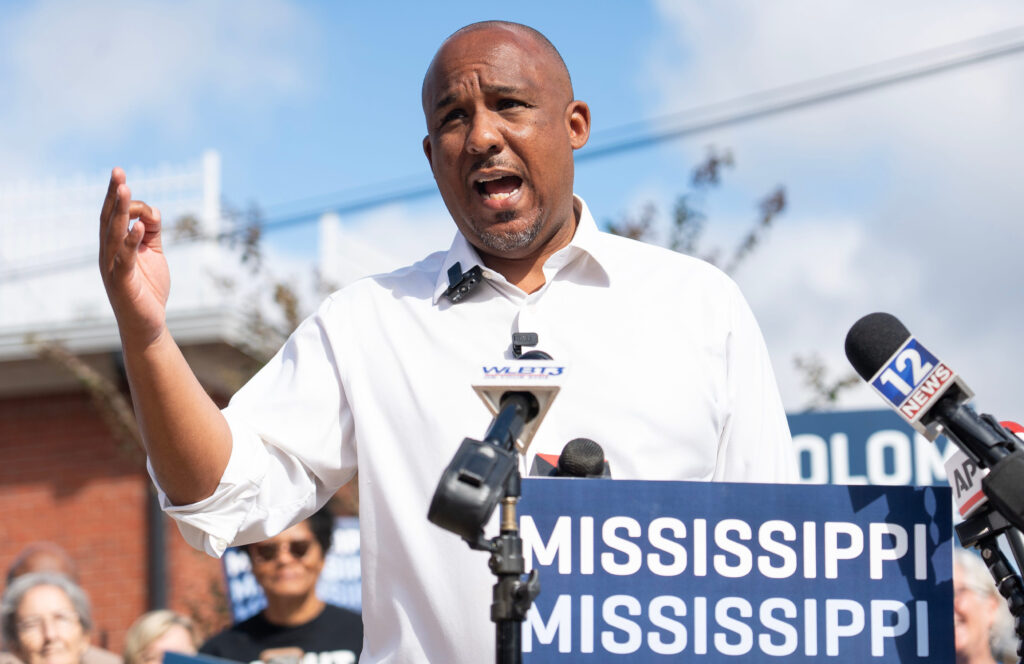
It was 36 hours after a jaw-dropping midterm election, and pundits across the country wondered how this deeply conservative state, with its history of disenfranchisement and disenchantment, ended up with an African American prosecutor named Scott Colom within striking distance of winning election to the U.S. Senate.
“This race has everybody on pins and needles, pins and needles,” Smith said. “This has been the most engagement from young people around here in this election, and everyone wants to know, what’s taking so long? And I’ve got to make sure all their votes count.”
Yes, Colom had zeitgeist-catching commercials and captured the resentment toward Republican Sen. Cindy Hyde-Smith, who had shrugged off worries about the high cost of beef. But there was a more desperate, more granular engine powering record-high turnout and engagement among the state’s Black youth.
Across the Mississippi Delta — poor, Black, rural — there were houses like the one where Smith was busy at work, where organizers spent months figuring out how to get a community of nonvoters excited about reengaging in democracy.
When Colom was trying to figure out the final message for his Senate campaign, he and his team chose to end with a commercial about Medgar Evers, the African American veteran whom white supremacists killed as he was conducting voter registration campaigns.
“We can’t just ask people to vote for me,” Colom said in an interview with The Washington Post on Thursday morning. “We just got to talk about sacrifice. We got to talk about the importance of voting.”
It was also about stressing the idea of what he called “Mississippi Values” — including Evers’s audacious and righteous response to abusive power. Those values were revealed in the work of Fannie Lou Hamer and the Mississippi Freedom Party, and others who worked during the Civil Rights Era to break some of the most racist policies in the South. Still, Colom knew it would take a herculean effort in a place that hadn’t elected a Black politician to statewide office since the fall of Reconstruction.
Smith just focused on reaching would-be voters where she grew up in Holmes County. It is one of the smaller counties in the state — about 15,000 people, 80 percent Black, with 34 percent living below the poverty line. But it was a place where Colom could run up the score to offset Whiter, more conservative districts.
Smith had enlisted canvassers, offering them an hourly wage that dwarfed what they could make at the local Sonic or the DG Market. They drove into housing projects and down country roads, looking to persuade young people to register and older people who had stopped casting ballots to start believing again that their vote matters.
This year, an expected 58 percent of eligible voters there cast ballots, the biggest increase since 2024 of any county in the state, according to a Post analysis of election results and census data. Holmes County had a 16-point increase in its voter turnout compared with 2018, the last midterm election with a similarly competitive Senate race. But there was still work to do. The Senate race between Colom and incumbent Hyde-Smith was too close to call, and Smith wanted to make sure that no ballot was thrown out unfairly.
So, with one hand, she scanned down her list of voters that her group had registered and began calling and texting those voters with the other, double-checking if there was any trouble at the polling booths.
The phone blinked and buzzed with responses from first-time voters, which Smith found affirming. But they told her about many problems, too — some said they had to cast “affidavit ballots” because of some sort of mishap at the polling place.
A ballot could provisionally be set aside for a host of reasons. Maybe the voter showed up without an ID, or they might have voted in the wrong precinct or moved without changing their address. An election committee had to review those affidavit ballots by hand, and, in some cases, voters had five business days to address the mistake.
The campaigns estimated there were originally as many as 20,000 instances of voters who cast such ballots. They could make a difference in a race in which about 2,500 votes separate the two candidates.
Smith wanted to get as many ballots counted as possible.
“People are tired of it all,” she said. “They know that people are trying to change the rules on us. And because they voted, I want to make sure they all counted.”
So she and her team of canvassers vowed to crisscross the county to find them before it was too late.
Her phone buzzed again.
After the Supreme Court gutted the Voting Rights Act in April, all manner of organizations — from Black Voters Matter to the NAACP to regional nonprofits — were sowing money into the South to energize majority-Black districts with low voter turnout. Holmes County was high on their list.
Smith started organizing in her hometown when she was just in second grade, launching a petition lobbying the school board for new playground equipment. She was hooked, later forgoing finishing college to do community organizing and youth training around Holmes County.
National organizations sought the help of Smith and others to strategize on reviving activism after the Voting Rights Act decision this spring. But in meetings, Smith said, she grew tired of hearing older community leaders complaining about young people not caring enough about the future. No one asked them why. So, she put together a survey asking people under 35 about their voting habits. She distributed it online and at churches.
About 75 responded. Most said they were concerned about the high cost of insurance and neighborhood violence. Some said they were hesitant to vote because it was unclear what any elected official could do for them. Some avoided voting because they did not want to have to serve on a jury.
In response, Smith typed up four-by-six index cards explaining the difference between a senator and a House representative. She secured money to pay people $20 an hour to register voters.
Smith wanted her canvassers young. She signed up 15, 11 of them under 40, and taught them the importance of being nonpartisan when registering people to vote.
She encouraged them to start their voter registration journeys with their own families. One canvasser, Shan’terrius Sly, a 19-year-old honors student at Jackson State, persuaded two dozen family members to sign up. “I’ve always wanted to be an activist,” Sly said. “It’s really time for a new generation to step up and do things. Some of the older generations weren’t invested. Gen Z is aware. We see what’s going on. We aren’t going to let it slide.”
They knocked on doors in the housing projects and drove down long dirt roads to make sure people were registered. They found voters at community events where young people met to ride tractors and dirt bikes. If there was a house party, there was a canvasser.
“They were bringing 12 to 13 ballots a day,” Smith said. “The county is small, so that’s a lot.”
Smith tallied that the group registered 283 new voters in a county with a voting population of around 12,000. And then, she made and printed guides featuring candidates and their positions, and handed them out to the men hanging out on the street and set up stations at Halloween events called “Trunk or Treat,” where neighbors decorate their cars and put candy in their trunks.
On Election Day, the canvassers gathered at the old house, known as the Nollie Jenkins Family Center, before checking on precincts. If they did not see any voters at the precinct, they drove into the community, rolled down their car windows and asked people if they needed a ride to the polls.
Smith herself drove 15 people, the last of them around 6:50 p.m., which is when she, too, stood in line to cast her ballot before the 7 p.m. deadline. When she handed over her ID, the poll worker looked at her and shook her head.
It turned out that Smith had been purged from the voting rolls because she didn’t update her address.
“I had been so busy trying to register other people that I didn’t check my own,” Smith said. Her ballot was one of 2,443 purged in the county. Her vote would not count.
After 7:30, the canvassers returned to the house and watched the returns. At the beginning, Hyde-Smith had a small, healthy lead. But Holmes County’s votes had not been submitted.
Close to midnight, the Holmes County votes came in. And Colom was ahead by 28 votes.
“We pushed him ahead,” Smith said. “I could not believe it. We showed that our votes matter.”
The next day, Colom traveled to a historically Black college outside Jackson with free pizza to thank the college students who supported him. At night, he ate wings in the basement of the chapel with volunteers. Hyde-Smith told the media she was certain she would emerge victorious, and the governor expressed certainty that she would win.
Attorneys flew in from across the country to help ensure that there would be no foul play when handling the ballots. And Smith’s phone kept buzzing, filled with messages from people from Holmes County who wanted to make sure their votes were not lost in the fray.
Colom has a history of being a trailblazer. At age 28, he became the youngest and first Black judge appointed in the history of Lowndes County and later the first Black city prosecutor for the city of Columbus. He successfully ran for district attorney for Circuit Court District 16 in 2015, running on a reformist agenda that emphasized diversion programs for nonviolent offenders, and unseated a nearly 30-year incumbent. As district attorney, he managed a small staff and personally prosecuted more than two dozen jury trials — obtaining guilty verdicts in nearly all of them.
But Rep. Bennie Thompson, the long-standing congressman from Jackson, told him in the early stages of his Senate campaign that it was most important to be known “as a listener. You’ve got to be out there so people feel like they know you.”
So he barnstormed the state, holding events in all 82 counties — and noting that Hyde-Smith had not hosted a town hall in six years.
“I know so much is at stake,” Colom told The Post after the election. “So because of my ancestors’ sacrifices, I knew that I had no excuse. If I was tired, I said, ‘Listen, I got to keep going.’ If I felt like somebody was like, ‘What would give you a day off?’ I’m like, ‘No, give me a town hall.’ I wanted to make sure I just left it all on the field. So at the end of it, regardless of the outcome, I could feel confident that I honor my ancestors. I honored their sacrifices by sacrificing in ways that’s not even comparable to their sacrifices.”
Colom went to a Trump rally in Corinth in a sweatshirt and tech pants, asking people what they thought about tariffs and gas prices. Video of his casual interactions with the group went viral. His campaign became known for its tart commercials, including a parody of “Sinners” written by his twin brother that portrays a fictional Hyde-Smith as a restless spirit asking for one more chance to keep her promises. Another mocked Hyde-Smith’s suggestion that residents just eat other proteins if beef prices were too high.
But while the national media marveled at their wit, people across the state marveled at something else: They actually knew the people talking in the videos.
“I recognized a man in the video because he used to buy lunch from me at the gas station,” said Alexis York, 29, a federal worker in Jackson, who said she was motivated to vote for the first time in this election. “And that made me feel like he really understood where we were coming from. He wasn’t using actors. So my spirit just told me that he should be the one to win.”
On Thursday morning, Colom walked into a popular greasy spoon called Brent’s Drugs to eat breakfast with volunteers. Three women — two Black, one White — sat at a table marveling at what his election would mean for the state.
“In the shadow of everything, especially with the Nolan Wells case, every time Mississippi comes up, it’s been a negative,” Nickie Gray, 57, said to the other volunteers. “My relatives who live outside, they’re afraid to come here. So with Scott in office, maybe we could let them know that this place has positive things.”
“They think it’s super racist here, and there’s an element of that,” Lee Parrott, 68, replied. “But [with this campaign], I think White people have shown they’re more willing to listen. They’re just frustrated with people thinking that Mississippi is so, so racist.”
Jackie Washington, 73, looked at Colom eating breakfast with his wife at the counter and told the women that she remembered when Black people couldn’t eat at that counter. Now, the Black person dining there was looking like he would represent the entire state, if things kept going the way they were going.
“This place can still change things,” Washington said. “Don’t count us out.”
Later that afternoon, Smith left her home base and headed to the clerk’s office in nearby Lexington to make sure votes were counted. As she pulled into the parking lot, she saw a tall Black man with tiny locks carrying a sheet of paper walking to the car.
“Did you vote?” she asked.
“This was my first time,” said Corey Ellington, 24, a high school football coach. “I was excited about it, but they said something was wrong with my address.”
“Did you get purged?” she asked.
“I don’t know,” Ellington said.
“All right, honey, I’ll find out for you,” she said before walking through the metal detectors and into the clerk’s office. It was a quiet place, with light caramel-colored walls and thick red reading books, and the air freshener made the place smell like a floral soap.
“I have questions about ballots,” she said as she walked to the back, where a county staffer was looking over the voter information. Smith gave him the name of a resident who said she had registered to vote on Sept. 6 but was told at the polls that her registration form was dated Oct. 6, one day after the deadline.
The clerk looked up the voter’s name and birthday, and confirmed the form was received Oct. 6. Smith asked him to pull the physical registration form, just to be sure, and the clerk pulled a stack of papers from the top of a cabinet and searched for the voter.
Smith looked behind him and watched him work. No dice. It turned out that the voter had an organization mail the form in for her, and the organization handed the forms in late. That vote was lost.
“This is why I always come to you and hand them in,” Smith said. “I don’t like when people mess with the mail.”
“Is there any other one I can help you with?” the clerk asked.
Smith rubbed her fingers on her temples and then pulled out notes on her phone with a list of names of voters who had complained about the ballots.
“Yes,” she exhaled.
In the courtroom next door, four election officials stood at a table in front of the bench with a box filled with affidavit ballots. Sly, the 19-year-old canvasser, and four other residents sat on the benches behind, watching the group to ensure that they did not toss out ballots unfairly.
The protocol: Election Commissioner Elnora Patton would read out the name, the address and the phone number — if all were provided — and then describe the issue with the ballot. As the committee read the names, Sly knew the potential voters so well that she could correct Patton when she mispronounced their names. And then, the list of voters with questionable ballots got even more familiar.
So many were family members she had helped to register. One was her cousin, whose 18th birthday was on Oct. 8. He was only 17 when he registered, but Sly thought he would be fine to vote because he would have been of age come Election Day.
“This ballot is rejected,” Patton said. He needed to be 18 by the registration deadline, not Election Day. Sly looked down, frustrated by her misunderstanding of the rules.
The next ballot they called was for Patricia Sly, her great-aunt. The election official eyed the ballot and said it would be rejected if Patricia Sly did not come to the booth with her ID.
“Excuse me,” Sly said. “I brought her to the office earlier today, and she showed her ID, and they said her ballot would count.”
“I don’t see it on the computer,” said another commissioner, looking at the voting rolls.
“Well, I know I brought her,” Sly said. “Please check again.”
The official left the courtroom and returned in a couple of minutes.
“Someone left a copy of the ID on my desk,” she said. The ballot was accepted.
Then came Lawanda Sly, another aunt. She also forgot to bring her ID to the polling place.
“I can get her over here!” Sly said.
But night had fallen, and the commission was closing up for the day. Sly vowed that she would bring her over the next day to make sure that the ballot counts were accurate.
On Friday morning, Sly climbed into her Audi and started blasting Kendrick Lamar as she made her way to pick up her Aunt Lawanda.
“When you’re doing activism, Kendrick just has a song for everything you’re feeling,” she said as the lyrics pounded: “We gon’ be alright.” Sly drove past the clerk’s office and the Dollar General and the large field of grass filled with cars with broken doors and trunks, then scaled up a rocky, pothole-filled street that led to her aunt’s house.
“You ready?” Sly asked.
Lawanda Sly walked out in a T-shirt and blue jeans, jumped into the car and started munching on Doritos from a bag in the back. At 41, she worked as a personal care assistant and did not regularly carry her ID, which is why it had slipped her mind when she went to the polls.
“So did Colom win?” Lawanda asked.
“He’s still in the lead,” her niece replied. At this point, Colom’s lead had extended to 2,000 votes.
“I know that White woman’s mad,” Lawanda told her. “I’m excited for him.”
“It’s Mississippi, so you never know,” Sly replied. She understood the state’s history, its eagerness to purge votes.
Sly walked with her aunt into the courtroom, where the election officials were examining even more affidavit ballots.
“I found her!” Sly said, and the election official smiled. Lawanda giggled and beamed as she handed in her ID to the group, who verified it to be real.
“We are going to accept this ballot,” Patton said.
Lawanda and her niece smiled as they made their way back to the car.
Sly dropped her off and looked at her phone again. More messages. She drove to a stranger’s house with a dog barking and rang the doorbell before leaving a message that he should come to the clerk’s office to check on his ballot.
She called another stranger who promised he would show up with his license at the clerk’s office when he was off work. There was one woman who needed to bring her ID to the polls but left no address, so Sly and Smith were messaging and calling friends in Cruger — population 268 — to figure out if someone knew where she lived and could tell her to come check her ballot. She drove to pick up another woman who had lost her license and had not been sure her vote would count if she showed her voter ID — until she spoke with Sly.
“My vote’s going to count,” Lakeyda Jackson, 29, told her. “But I’m nervous. We got out and did it. The point has been made; our community went out and voted, and he’s ahead. Why haven’t they declared him the winner yet? It’s unfair to you and all the work you put in.”
“It’s like it’s unbelievable when Black people do something,” Sly said. “But we are going to make them believe it.”
They pulled up to the clerk’s office and stepped out of the car. She looked at her phone, and Smith had sent the names of even more people who had difficulties with ballots. So many voices had the potential to be lost.
“We’re doing it,” Sly said. And she walked in with Jackson to ensure that at least one more person’s voice was heard.
Patrick Marley, Katie Mettler and Lydia Sidhom contributed to this report.
The post In the Mississippi Delta, a fight to make every vote count appeared first on Washington Post.