The Israeli opposition leader Gadi Eisenkot has been tasked with forming a government that could unseat Prime Minister Benjamin Netanyahu. Now, he has to figure out how to do it.
On Sunday, Isaac Herzog, the Israeli president, gave Mr. Eisenkot a formal mandate to establish a ruling coalition after last month’s inconclusive election. Mr. Herzog met last week with representatives of each of Israel’s political parties, most of whom recommended Mr. Eisenkot for the job.
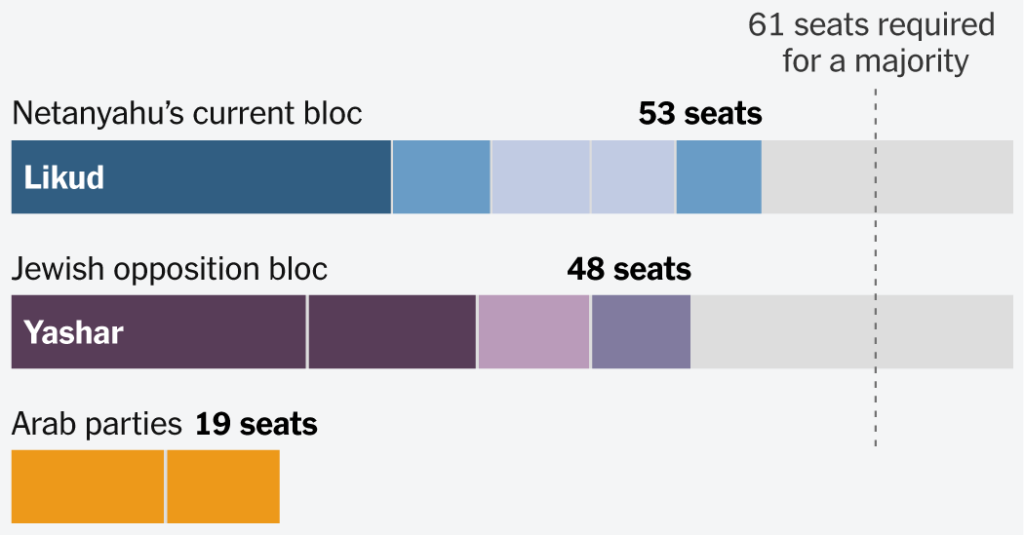
The opposition leader has up to six weeks to complete the difficult challenge of setting up a coalition. Neither his allies nor Mr. Netanyahu’s government attained a 61-seat majority in the 120-member Parliament, known as the Knesset, leaving them without a clear path forward.
Mr. Eisenkot argued in an acceptance speech on Sunday that Israel’s volatile political situation “demands compromises from all of us” — even if that would mean breaking prior campaign promises.
“We must form a national emergency government. This will require creative and unconventional political steps,” he said.
If Mr. Eisenkot is unable to form a government after up to six weeks, then it’s likely to be Mr. Netanyahu’s turn to attempt to find an agreement. If no one manages to form a government, then Israel will head to a second round of elections and, in the meantime, Mr. Netanyahu will remain in power. Mr. Eisenkot and his allies have vowed to unseat Mr. Netanyahu, Israel’s longest-serving leader, whose rule has divided the country.
A majority of 67 lawmakers recommended Mr. Eisenkot for prime minister during the discussions with Mr. Herzog last week, bolstered by the backing of the two Arab parties, Raam and the Joint List. But forming a government with those parties’ support will be complicated — some of Mr. Eisenkot’s allies could refuse to join a coalition that depends on their support.
Mr. Netanyahu’s coalition received 53 seats in Parliament, but he himself received just 46 recommendations to form a government. The seven lawmakers from the ultra-Orthodox United Torah Judaism party declined to back either him or Mr. Eisenkot.
Israel’s parliamentary system typically requires parties to find enough common ground to assemble a majority, at least 61 seats.
That has produced some unlikely alliances and, increasingly in recent years, some unstable, short-lived governments. From 2019 to 2022, five elections were held in Israel.
In the coming days, Mr. Eisenkot will conduct intense negotiations that could end in the establishment of a government or in deadlock, making another election impossible to rule out.
Here are some possible outcomes on how the parties may align.
Scenario One
A Jewish-Arab alliance
For Mr. Netanyahu’s opponents, securing a majority could depend on support from Arab parties. But that would be challenging politically for Mr. Eisenkot.
If he were to work with both Arab parties — the Joint List, an alliance of three Arab-led factions, and Raam, a pragmatic Islamist party — he would have a significant majority in Parliament.
But many Jewish Israelis, including some of Mr. Eisenkot’s allies, have said they would reject a government that relies on the Arab parties. And Mr. Eisenkot has also stipulated some principles for joining his coalition that the two Arab-led parties have not met — neither, for example, has called Hamas a terrorist group. The Joint List also includes leftists and Palestinian nationalists who reject Israel’s founding ideal of a “Jewish democracy,” which Mr. Eisenkot said his coalition partners must endorse.
Mr. Eisenkot also could form a minority government by leaving Arab lawmakers out of the coalition but securing an agreement from them to support it. The Joint List has said it would not join a governing coalition, but it has offered to help the Jewish-led opposition parties to oust Mr. Netanyahu from office by supporting an Eisenkot-led government.
It is unclear how sustainable such an arrangement would be. The Arab parties are strongly opposed to Israel’s occupation of the West Bank and to the war in Gaza. And many right-wing Jewish Israelis are skeptical of giving those parties leverage over sensitive matters of state security.
Scenario Two
A unity government
A unity government led by Mr. Netanyahu and Mr. Eisenkot offers another path to a clear majority. Some analysts argue that the two men’s parties have more in common with one another than they do either with the left or with the ultra-Orthodox religious parties.
But such an alliance remains a long shot and could prove too unpalatable for the leaders.
Mr. Eisenkot’s campaign focused on the urgent need to unseat Mr. Netanyahu, whom he has said is unfit to serve as prime minister. Similarly, Mr. Netanyahu may not be keen to share power with, or delegate significant authority to, his fiercest rival.
On Friday, Mr. Eisenkot said his immediate goal was to eject Mr. Netanyahu from office. Mr. Netanyahu responded a day later by calling for unity — but with himself in charge.
Mr. Eisenkot has similarly said he would welcome members of Mr. Netanyahu’s Likud party to join a government under his own leadership, provided they accepted his core conditions.
Scenario Three
An ultra-Orthodox-backed government
Mr. Eisenkot could seek the support of the two ultra-Orthodox parties, which are longtime allies of Mr. Netanyahu but have grievances against him. That might prove difficult, given that the opposition has long criticized military draft exemptions for ultra-Orthodox men.
United Torah Judaism’s decision not to recommend Mr. Netanyahu could be a sign that it wants to work with Mr. Eisenkot to form a government and reach a compromise on legislation to conscript ultra-Orthodox citizens into the military.
Mr. Liberman has long refused to sit in a government with ultra-Orthodox lawmakers. On Friday, however, he suggested he could be open to working with them, saying it was “permitted and desired” to be flexible on the issue of conscription.
“This is painful for me, and I know it’s painful for many others,” he said on social media. “But in light of the challenges we’re dealing with today, the national interest of the state of Israel and the people of Israel must stand above all other considerations.”
Samuel Granados and Josh Holder contributed reporting.
The post How Israel’s Opposition Could Unseat Netanyahu (or Not) appeared first on New York Times.