Cornelia Powers is a writer based in D.C.
There is a pivotal moment in “The Legend of Bagger Vance” — Steven Pressfield’s novel (later made into a movie) about a despairing war hero turned golf champion, Rannulph Junuh — when Junuh’s mentor, Bagger Vance, first speaks of the “Authentic Swing.” Based loosely on the character of “Bhagavan” from the Bhagavad Vita, Vance likens the golfer’s search for the Authentic Swing to a person’s search for the authentic self. The two experiences often intertwine, he says, making golf not only “a metaphor for the soul’s search for its true ground and identity” but also an instrument through which to “recall that soul and become it.”
“What hooks us about the game of golf,” says Vance, “is that it gives us glimpses” — glimpses of our truest selves, of a better world, “like a mystic being granted a vision of the face of God.”
In recent years, many golf fans have found themselves wondering whether the game has lost some of its soul. The sport has had to contend with geopolitical “sportswashing,” cheating accusations and an increase in alcohol-fueled heckling and violence. The last of these was on full display at the Ryder Cup a year ago, where a boozed-up American crowd led vulgar chants aimed at members of the European team. At one point, someone hit the wife of Northern Irish player Rory McIlroy with a beer.
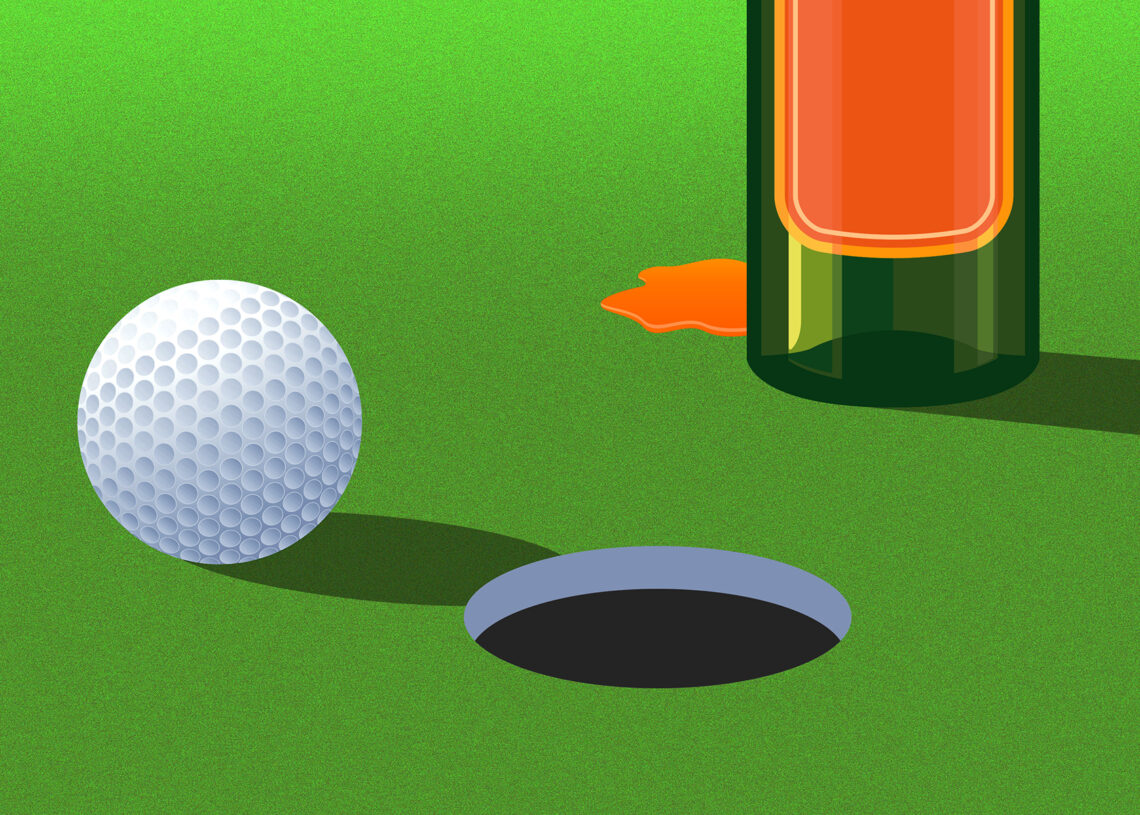
Unlike in Great Britain, where the game began, in the United States alcohol plays a central role in golf. A 2021 study published through the National Institutes of Health found that “few sports have integrated alcohol as seamlessly into their experience.” As Corey Davis, the founder of Soba Golf — a grassroots community built for golfers who are sober or are trying to get sober — told me, “Golf is really the only sport where it’s socially acceptable not just to have a drink while playing, but often to get pretty drunk.”
As a sober person, I know how hard it can be to talk about sobriety without sounding like a proselytizing killjoy; people should feel free to enjoy golf however they want without pressure or judgment — full stop. Yet as a golfer, I find something heartwarming in the existence of a sober golf counterculture. In recent years, several players on the PGA Tour have opened up about their sobriety, as have prominent figures such asMalbon Golf founder Stephen Malbon, Random Golf Club founder Erik Anders Lang and golf author Tom Coyne.
Founded last year, Soba Golf has grown quickly at a time when Americans have never been golfing more or drinking less. Like millions of other Americans, Davis took up golf during the covid pandemic, when he already had a decade of sobriety under his belt. He bought clubs on eBay and became a regular at his local municipal course. “I just became obsessed,” he told me. When he started digging into the connection between golf and sobriety, he uncovered incredible communities, such as Philadelphia’s Wilson-Smith Golf League, made up of people who had been anonymously living the experience of sober golf for years.
In founding Soba, Davis says he’s tapping into something that has always been there. Golf may have become associated with drinking, but it also offers a chance to slow down, be in nature and reflect. During Soba’s weekly meetings, members talk about how golf and sobriety each demand humility, patience and resilience, creating a positive feedback loop. In a recent meeting, one member summed it up: “Just like when I walk off the golf course, I want to close my eyes at night and say, ‘You know what? I did the best that I could today. I took every shot, and this is my score.’”
Like a real-life Bagger Vance, Davis believes golf is a spiritual practice — something he suspects many sober golfers would agree with. In my own early days of recovery, I spent a lot of time on a golf course, which became a sort of church. Away from all the noise, with only my body and my clubs, I could feel the clock rewind and my armor melt away, unearthing what felt like my truest and most childlike self.
Embracing golf as a spiritual experience, communities such as the Wilson-Smith Golf League and Soba Golf help people rediscover their love of the game without any booze-related entanglements or expectations. Soba’s meetings are attended by people who have been sober for 35 years, people who have been sober for two weeks and people who are struggling to quit. Together, they talk about grief, job loss, dating, new parenthood and more. What unites everyone is a love of golf and a sense of the good it can do if you let it.
Golf legend and five-time British Open champion J.H. Taylor once called golf “a metaphor for all those vicissitudes of human experience which test and form the soul.” The most proximate synonym of “to golf,” indeed, is not “to play” but “to listen,” “to exist.” Much like recovery, golf can take you to the deepest, darkest parts of your being, at times leaving you pretty battered and bruised. Yet what can come out on the other side is what Bagger Vance called a recalling of a “greater wisdom” — a remembrance of a sacred truth that helps us become a better version of ourselves, one day, and one swing, at a time.
The post Golf has a drinking problem. There’s a new way around it. appeared first on Washington Post.