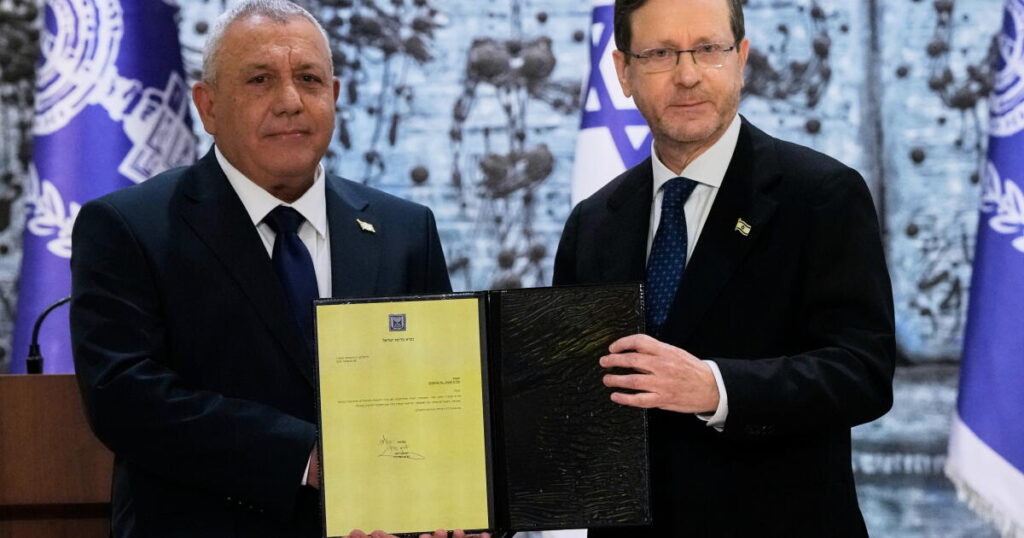
JERUSALEM — Israeli President Isaac Herzog on Sunday evening officially gave opposition leader Gadi Eisenkot the first chance to form the next government.
After the formal announcement, Eisenkot, who ran as Prime Minister Benjamin Netanyahu’s main rival, now has to launch complicated negotiations with potential coalition partners. He has up to six weeks to form a government.
At the ceremony in Jerusalem, Eisenkot said he wanted a leadership that people can trust, that will act in the interests of the public and that represents all parts of society.
The Oct. 27 election gave neither Netanyahu’s bloc nor Eisenkot’s a clear majority in parliament. Among the kingmakers — and most politically fraught potential allies — are the Arab-led parties. They made historic gains in the election and have been a target of Netanyahu and his allies.
Eisenkot said Sunday that the conditions for parties joining his governing coalition are support for Israel as a Jewish and democratic state, for its declaration of independence, for military or national service, and recognizing the Hamas militant group as a terrorist organization.
While the announcement doesn’t guarantee that Eisenkot will be the next prime minister, Herzog’s decision is another blow to Netanyahu, who lost his parliamentary majority in the election.
Here’s a closer look at what lies ahead:
No clear winner
In Israel, people vote for parties, which form alliances. A coalition needs to have a majority of at least 61 seats in the 120-member parliament, known as the Knesset, to form a government.
Neither Netanyahu nor Eisenkot secured a majority in the election. Netanyahu’s coalition plunged from a peak of 68 seats to just 53. The opposition bloc, led by Eisenkot, won 48 seats, and Arab-led parties secured the other 19.
Eisenkot’s challenges
Eisenkot has three options: a power-sharing agreement with Netanyahu, support from Arab-led parties — something several members of his bloc do not support — or an agreement with the ultra-Orthodox parties, which demand military exemptions for their community.
Eisenkot, a former army chief, and his partners made equal military service a central part of their campaign. Specifically, they are seeking an end to the long-standing draft exemptions enjoyed by the ultra-Orthodox.
After Herzog announced Saturday that he would tap Eisenkot, the candidate vowed to form a government as quickly as possible.
But doing so will almost certainly require compromises or broken promises.
Netanyahu’s position
Netanyahu has repeatedly claimed the election was “stolen” by Arab parties, which rallied their supporters to vote in large numbers. But he has offered little evidence to support the claims.
Netanyahu is expected to continue his pressure tactics against Eisenkot, saying any alliance with the Arab parties would be an act of betrayal.
Israel’s Shin Bet security agency has launched an investigation into possible foreign interference in the vote, but the country’s Central Elections Committee — and Herzog — say the vote was valid and even if wrongdoing is found, it did not have a significant impact on the result.
Netanyahu called for a “national unity” government with Eisenkot on Saturday night. But it remains unclear whether the two rivals could agree on a power-sharing agreement, and such coalitions are fragile and often collapse.
Arab-led parties
Eisenkot has the option of forming a coalition with the support of the two Arab-led parties, which won an unprecedented 19 seats in the highest Arab election turnout. Only one Arab party, Ra’am, has ever joined a governing coalition, in 2021. Ra’am has said it will support Eisenkot, but the party does not have enough seats on its own to push Eisenkot into the majority.
Breaking with decades of precedent, the second Arab-led party, the Joint List, said it will support Eisenkot from outside the coalition to end Netanyahu’s grip on power.
That cooperation is fraught for both sides. For the Joint List, it would mean backing a government unlikely to end Israel’s wars or curb settlement expansion in the occupied West Bank. For Eisenkot and other opposition parties, it would mean aligning with parties that not only criticize Israel’s policies but reject its identity as a Jewish state.
One of Eisenkot’s partners, the more conservative Yisrael Beytenu party, already has said it will not join a coalition with Arab-led parties.
Ultra-Orthodox parties
Eisenkot also says that any party that joins him must support mandatory military service or civil service. It remains unclear whether the ultra-Orthodox religious parties are prepared to compromise.
These religious parties, which were part of Netanyahu’s outgoing coalition, want to preserve their military exemptions, which they say are needed to preserve their devout lifestyle. But the exemptions have grown especially controversial among the broader public during the last three years of war.
Anticipating its position as a swing vote, the ultra-Orthodox party United Torah Judaism has left the door open to cooperating with Eisenkot.
Next steps
Eisenkot has 28 days to form a coalition, with a possible two-week extension from the president. If he is unable to form a government, Netanyahu could then be given a chance put together a coalition. If Netanyahu is also unable to do so, the country will return to elections early next spring.
Israel’s new members of Knesset will be sworn in Tuesday evening. Netanyahu and his Cabinet will remain in office in a caretaker capacity, with limited powers, until a coalition is formed.
Lidman and Dell’Orto write for the Associated Press. Lidman reported from Tel Aviv.
The post Eisenkot is officially tasked with forming next Israeli government. A look at what’s next appeared first on Los Angeles Times.